
When Taspar became khan of the Göktürks, he appointed two princes of his house as lesser khans under him.[1] His nephew Ishbara, whom the Chinese histories call Shetu, received the title Erfu Khan and the command of the east.[1] A son of Taspar’s younger brother Rudan Khan received the title Buli Khan and lived in the west.[1] The Zizhi tongjian enters the appointment under 572, the year of Mukan’s death.[2]
Background
Mukan reigned twenty years. On his death he passed over his son Apa, whom the Chinese call Daluobian, and set up his younger brother. This brother became Taspar Khan.[1] The Zhou Shu says that the state had grown rich and strong since Mukan’s time. It had set its mind on overriding China.[3] Taspar commanded several hundred thousand bowmen. The Zhou and the Qi competed for marriages with him and emptied their treasuries to serve him.[1]
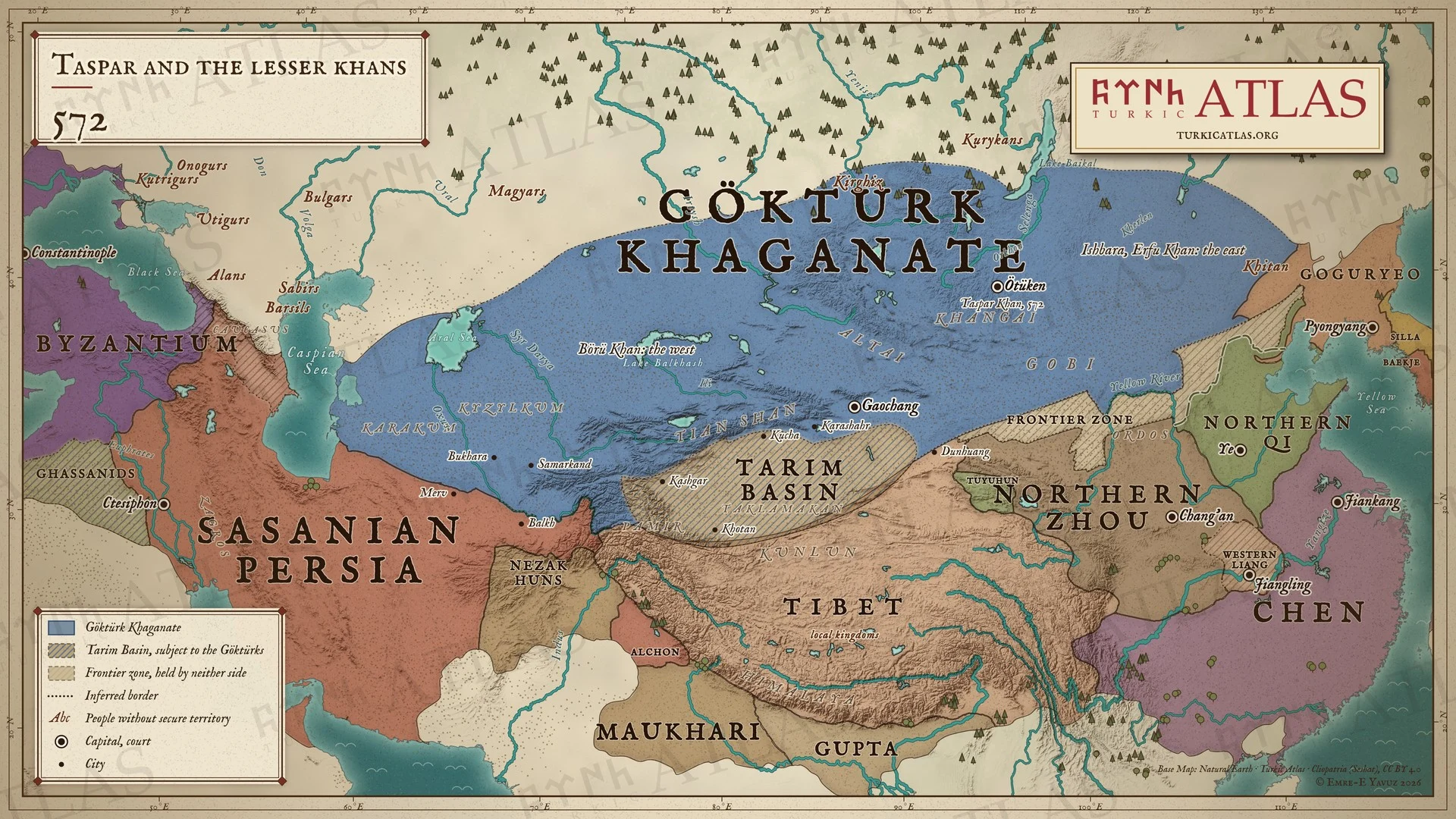
The two lesser khans
The Tongdian explains both titles in a note: Erfu and Buli were lesser khans.[4] It adds that Ishbara was the son of Issik Khan. On his deathbed Issik had passed over Ishbara in favour of Mukan.[4] Some scholars render the eastern title as Niver. It renders the western one as the Turkic böri, “wolf”.[5]
The identity of the western khan is less certain. The Sui Shu, the Tongdian and the Zizhi tongjian make him a son of Rudan Khan.[6] The Bei Shi lacks the word for “son” and makes Rudan Khan himself the Buli Khan.[7] A modern translation of the Sui Shu notes the difference.[8] The Tongdian writes the father’s name Danou instead of Rudan.[4] The Sui Shu gives the Buli Khan no personal name. He does not appear again in its account.[1]
Some scholars place the appointment in the first year of Taspar’s reign.[9] They see the appointment as a change in the hierarchy, forced by the size of the empire. The khan now had deputies who could act in his name, and power passed down the ranks of the Ashina.[9]
Consequences
Taspar reigned ten years.[1] When he died, the lesser khan of the east decided the succession. Ishbara threatened the assembly with war if Apa were chosen. Later he took the throne himself. The Zizhi tongjian enters his accession under 581.[10] The succession crisis grew out of the appointment of 572.
References
- ^ a b c d e f g Sui Shu (Book of Sui), juan 84
- ^ Zizhi tongjian (Comprehensive Mirror in Aid of Governance), juan 171
- ^ Zhou Shu (Book of Zhou), juan 50
- ^ a b c Tongdian, juan 197
- ^ Golden 1992, p. 148
- ^ Sui Shu (Book of Sui), juan 84; Tongdian, juan 197; Zizhi tongjian (Comprehensive Mirror in Aid of Governance), juan 171
- ^ Bei Shi (History of the Northern Dynasties), juan 99
- ^ Mau-tsai 1958, Turkish edition, p. 65
- ^ a b Yavuz 2025, p. 305
- ^ Sui Shu (Book of Sui), juan 84; Zizhi tongjian (Comprehensive Mirror in Aid of Governance), juan 175
Sources
- Sui Shu (Book of Sui), juan 84
- Bei Shi (History of the Northern Dynasties), juan 99 (after Wei Shu, Zhou Shu and Sui Shu)
- Tongdian, juan 197 (after Sui Shu and Zhou Shu)
- Zhou Shu (Book of Zhou), juan 50
- Zizhi tongjian (Comprehensive Mirror in Aid of Governance), juan 171, 175 (after Wei Shu, Zhou Shu, Sui Shu and Bei Shi)
Literature
- Peter B. Golden, An Introduction to the History of the Turkic Peoples (1992)
- Emre-E. Yavuz, The Gokturk Empire: 2nd Edition (2025)
- Liu Mau-tsai, Çin Kaynaklarına Göre Doğu Türkleri (1958, Turkish edition)
What links here4
- Persons
- Börü Khan · Rudan Khan
- Institutions and Titles
- Great Khan · The Western and Southern Khans
Cite this article
Yavuz, Emre-E. “Taspar's Appointment of the Lesser Khans (572).” Turkic Atlas, revised 8 November 2026. https://turkicatlas.org/events/taspars-lesser-khans-572/
Last revised: 8 November 2026

