
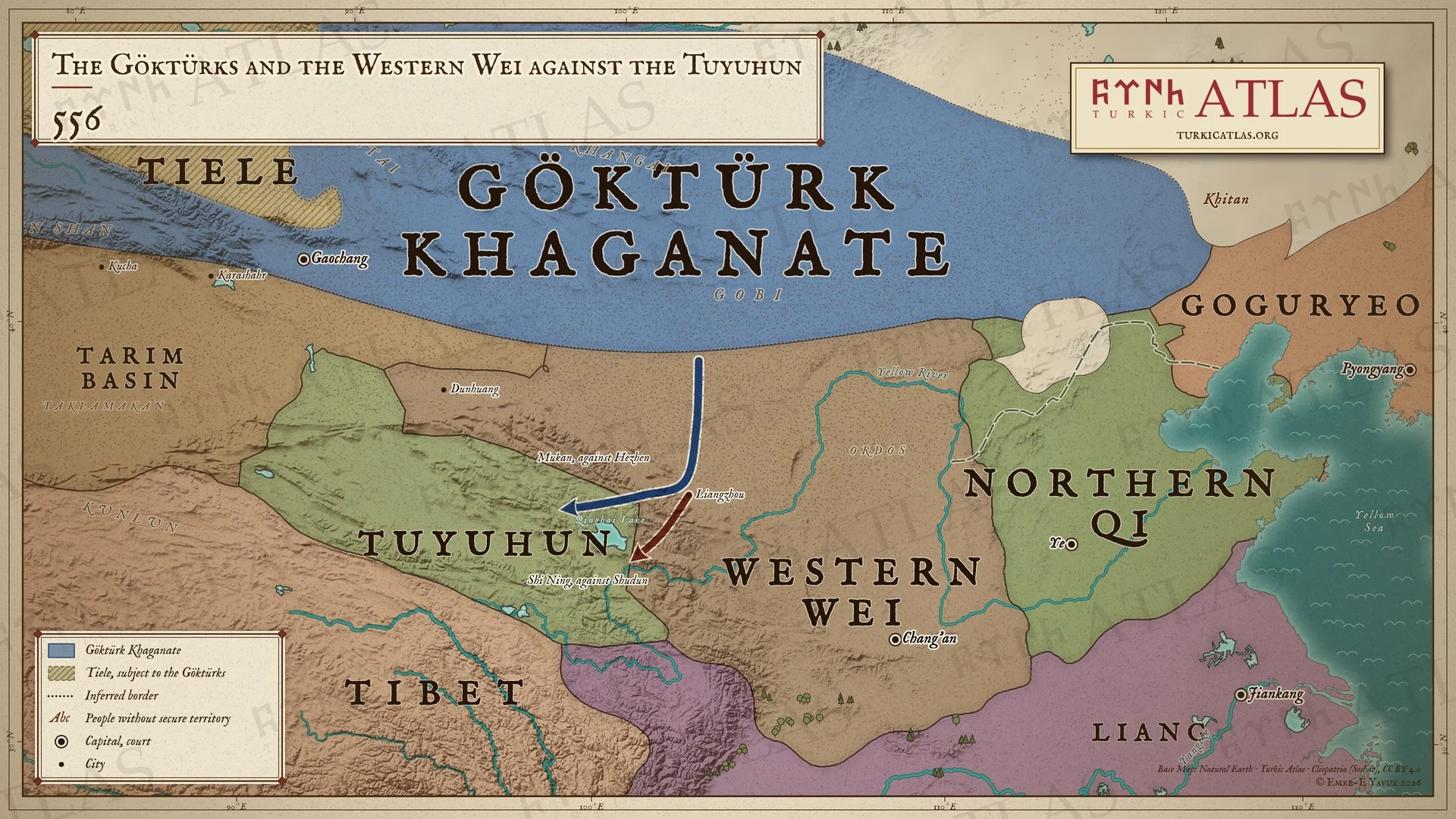
In 556 Mukan Khan marched against the Tuyuhun, the people of the Qinghai lake, through the territory of the Western Wei.[1] A Wei general, the governor of Liangzhou Shi Ning, went with him.[2] Together they took the two Tuyuhun towns of Shudun and Hezhen. Mukan captured the wife and children of the Tuyuhun ruler.[3]
The Tuyuhun
The Zhou Shu traces the Tuyuhun to an elder half-brother of Murong Hui, a chief of the Xianbei of Liaodong.[4] Their ruler in the 550s, Kualü, was the first of his house to call himself khan.[4] He had a walled seat fifteen li west of the Qinghai lake but did not live in it.[4] Instead he stayed in a felt tent and moved in search of grass and water.[4]
Kualü sent horses, sheep and cattle to the Wei, but his raids on the frontier did not stop.[4] In 553 Yuwen Tai led a great army to Guzang. Kualü took fright and sent tribute.[4] In the same year he sent envoys to the Qi as well.[4] Shi Ning caught one of these embassies on its way home at Chiquan, west of his seat at Liangzhou.[4]
The march
Mukan asked leave to pass through Liangzhou to fall on the Tuyuhun. Yuwen Tai ordered Shi Ning to follow him with his horsemen.[2] When the army reached Fanhe, the Tuyuhun had learned of it. They fled into the southern mountains.[2] Mukan meant to divide his forces and pursue them. Then he meant to gather again at the Qinghai lake.[2]
Shi Ning advised otherwise. Shudun and Hezhen, he said, were the nests of the Tuyuhun. If their roots were pulled up, the rest would scatter of themselves.[2] Mukan agreed and divided the army in two. He took the northern road to Hezhen. Shi Ning made for Shudun.[2]
Shudun and Hezhen
On the way the king of Suozhou, a Tuyuhun prince, met Shi Ning in battle and was killed.[2] Shudun was the old Tuyuhun capital and held much treasure.[2] The Tuyuhun ruler had already fled to Hezhen. He had left his Zhengnan king with several thousand men to hold the town.[2] Shi Ning attacked and fell back.[2] The defenders opened the gate to pursue him. His men turned and got in before it could be shut.[2] He took the Zhengnan king alive and gave all the captives and treasure to the Göktürks.[2]
A third prince, the Heluoba king, had built a palisade more than fifty li round in broken country to bar the road.[2] Shi Ning broke it.[2] His men took or killed the defenders by the ten thousand. They captured tens of thousands of animals.[2] Mukan meanwhile took Hezhen. He captured the wife and children of the Tuyuhun ruler, with a great quantity of valuables.[2] The Tuyuhun chapter of the Zhou Shu adds livestock to the spoils.[4]
At the Qinghai lake
The two armies met again at the Qinghai lake.[2] Mukan took Shi Ning’s hand and praised his courage and resolve.[2] He gave him the good horse he rode and had him mount it before his tent. Then he walked beside him on foot to see him off.[2] The biography says that every plan of Shi Ning’s had succeeded. The Göktürks therefore stood in awe of him and called him “a divinely wise man of China”.[2] At parting Mukan gave him a hundred slaves, five hundred horses and ten thousand sheep.[2]
Shi Ning went back to his province and was soon summoned to court. Yuwen Tai had died. In his grief, Shi Ning asked leave to go to the tomb and report the victory there.[2] Yuwen Tai died in the tenth month of 556.[5]
The date
The Zhou Shu dates the campaign in two ways. Its Tuyuhun chapter puts it in the second year of the Wei emperor Gong, 555.[4] Its Göktürk chapter says only “in the third year” and places the campaign after the killing of the Rouran at the Qingmen gate.[4] The collation notes of the Zhou Shu take both for the third year of Emperor Gong, 556. The Bei Shi’s Tuyuhun chapter agrees with this dating.[4] The Zizhi tongjian enters the campaign under the ninth month of 556.[6] Shi Ning’s return to a court in mourning fits that year.
The date is thus given as 555, after the Tuyuhun chapter. A second dating gives 556. A third dating takes the Göktürk chapter’s “third year” to be the third year of the emperor Fei. It gives 554.[7]
Result
The campaign is the one war the Göktürks and the Western Wei fought side by side in their alliance. The Göktürks carried off the captives and the treasure of the Tuyuhun towns. The Wei general came home with the khan’s gifts.
References
- ^ Zhou Shu (Book of Zhou), juan 28; Zizhi tongjian (Comprehensive Mirror in Aid of Governance), juan 166
- ^ a b c d e f g h i j k l m n o p q r s t u v Zhou Shu (Book of Zhou), juan 28
- ^ Zhou Shu (Book of Zhou), juan 28; Zhou Shu (Book of Zhou), juan 50
- ^ a b c d e f g h i j k l Zhou Shu (Book of Zhou), juan 50
- ^ Zhou Shu (Book of Zhou), juan 2
- ^ Zizhi tongjian (Comprehensive Mirror in Aid of Governance), juan 166
- ^ Julien 1864, p. 336
Sources
- Zhou Shu (Book of Zhou), juan 2, 28, 50
- Zizhi tongjian (Comprehensive Mirror in Aid of Governance), juan 166 (after Wei Shu, Zhou Shu, Sui Shu and Bei Shi)
Literature
- Stanislas Julien, Documents historiques sur les Tou-kioue (Turcs) (1864)
What links here1
- Battles & Events
- The Göktürk–Wei alliance
Cite this article
Yavuz, Emre-E. “Göktürk–Wei Campaign against Tuyuhun (556).” Turkic Atlas, revised 8 November 2026. https://turkicatlas.org/events/tuyuhun-campaign-556/
Last revised: 8 November 2026

