
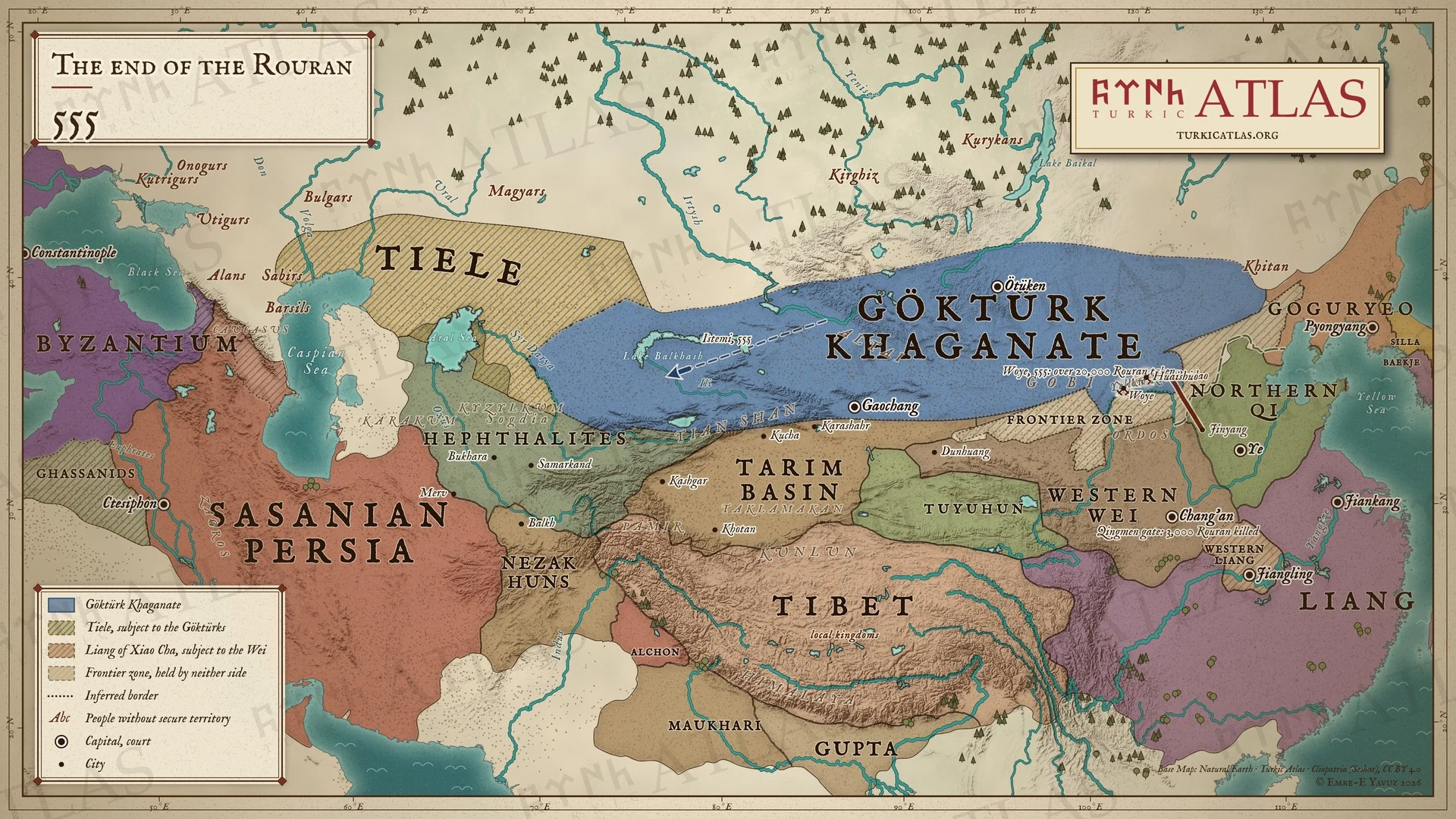
In 555 the Western Wei gave up the Rouran ruler Dengshuzi and some three thousand of his people to the envoys of Mukan Khan, and the Göktürks killed them outside the Qingmen gate.[1] Qingmen was a gate of Chang’an, where the Western Wei court sat. With them ended the following that had raised Dengshuzi as its ruler in 552.
The flight
Dengshuzi was an uncle of Anagui.[2] After Bumin’s victory of 552, Anagui killed himself, and the Rouran who remained set Dengshuzi up as their ruler.[2] Issik Khan defeated him at Mount Mulai, north of the Woye garrison. After Issik’s death Mukan led an army against him and destroyed him.[2] Dengshuzi fled with what was left of his people to the Wei.[2]
The Rouran chapter of the Bei Shi gives the year. The Göktürks had broken the Rouran again and again. In the second year of the Wei emperor Gong, 555, the Rouran led more than a thousand households into Guanzhong.[3] Guanzhong was the basin of the Wei river around Chang’an, the heartland of the Western Wei.
The demand
Mukan’s people had grown strong, and he sent envoys to ask that Dengshuzi and the others be put to death.[2] The Bei Shi gives the reason. The Göktürks trusted in their strength and in their friendship with the Western Wei. They feared that the survivors would find a great state to lean on.[3] Envoy followed envoy on the road, asking that all of them be killed.[4]
Yuwen Tai held power at the Wei court. He put the request to his council and granted it.[3] The Zhou Shu calls him by his temple name Taizu and says only that he consented.[5]
The killing
The Wei seized Dengshuzi and three thousand of his people and handed them to the Göktürk envoys. The Göktürks killed them outside the Qingmen gate.[2] The Göktürk chapter of the Bei Shi repeats the sentence.[6] The Rouran chapter counts more than three thousand and says that they were bound before they were handed over. It adds that they were beheaded.[3] It also says that those not yet grown men were spared and given to the households of princes and dukes.[3]
The Rouran chapter does not name the man at their head. It speaks of “the ruler of the Rouran”, and the name Dengshuzi comes from the Zhou Shu.[3] The Zizhi tongjian names him and counts more than three thousand. It enters the killing among the events of 555.[7]
The historians’ judgement
The Zhou Shu is the history of the dynasty that Yuwen Tai’s house founded. Its historians did not pass over the killing. At the close of his annals they praise Yuwen Tai at length and then name two deeds against him.[8] One was a captured city whose whole population was enslaved. The other was the Rouran: they had come to submit, and their whole stock was put to death.[8] The historians wrote that both deeds arose from expediency and ran against virtue and moral teaching. They add that perhaps these deeds were the reason why the Zhou did not last long.[8]
References
- ^ Zhou Shu (Book of Zhou), juan 50; Bei Shi (History of the Northern Dynasties), juan 98
- ^ a b c d e f Zhou Shu (Book of Zhou), juan 50
- ^ a b c d e f Bei Shi (History of the Northern Dynasties), juan 98
- ^ Bei Shi (History of the Northern Dynasties), juan 98; Zizhi tongjian (Comprehensive Mirror in Aid of Governance), juan 166
- ^ Zhou Shu (Book of Zhou), juan 50; Zhou Shu (Book of Zhou), juan 2
- ^ Bei Shi (History of the Northern Dynasties), juan 99
- ^ Zizhi tongjian (Comprehensive Mirror in Aid of Governance), juan 166
- ^ a b c Zhou Shu (Book of Zhou), juan 2
Sources
- Zhou Shu (Book of Zhou), juan 2, 50
- Bei Shi (History of the Northern Dynasties), juan 98, 99 (after Wei Shu, Zhou Shu and Sui Shu)
- Zizhi tongjian (Comprehensive Mirror in Aid of Governance), juan 166 (after Wei Shu, Zhou Shu, Sui Shu and Bei Shi)
What links here5
- Conflicts
- The Göktürk–Rouran Wars
Cite this article
Yavuz, Emre-E. “The Qingmen Executions (555).” Turkic Atlas, revised 28 October 2026. https://turkicatlas.org/events/qingmen-executions-555/
Last revised: 28 October 2026

