
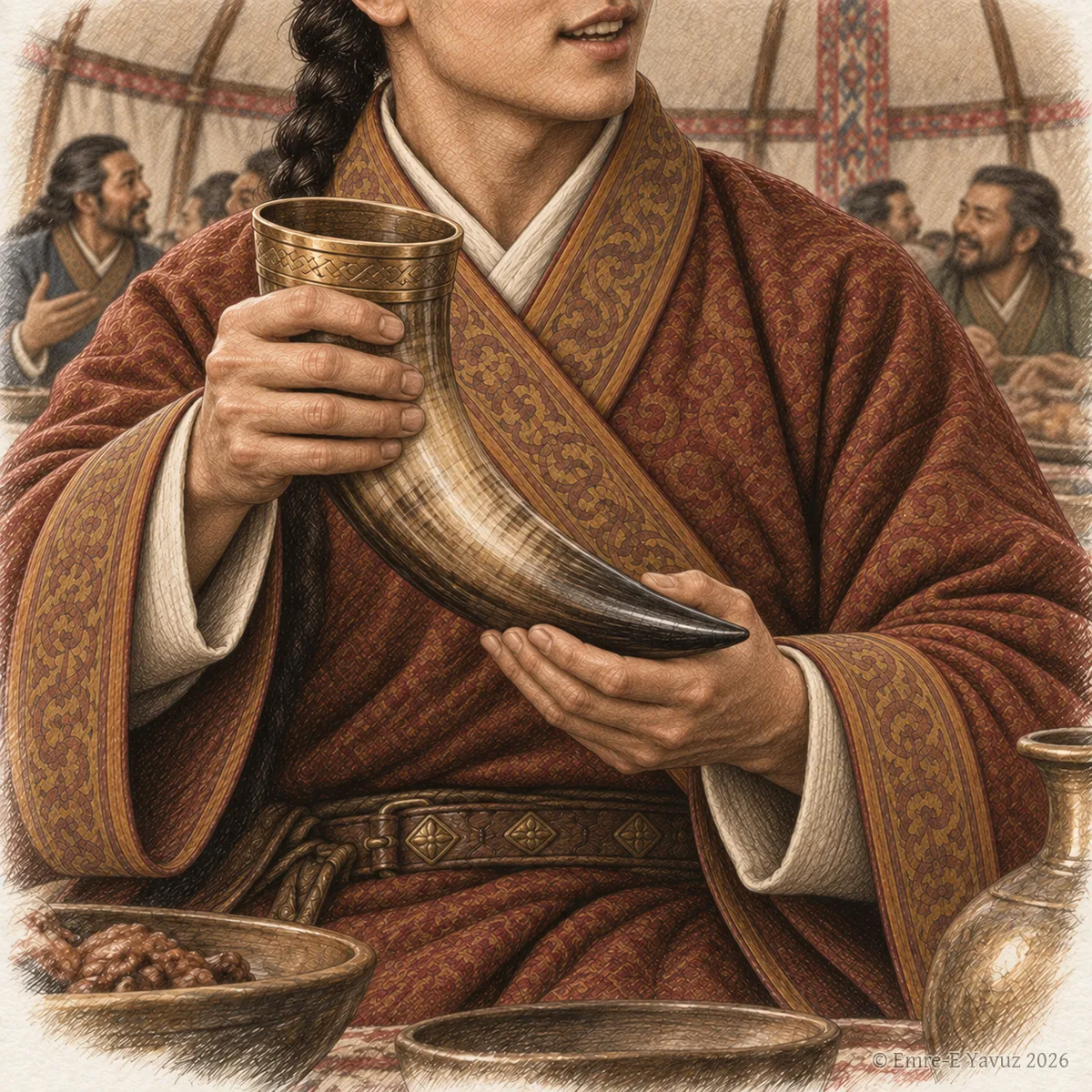
Daluobian, 大羅便, was a Göktürk title for a heavy man. The Tongdian says that the fat and stout were called daluobian.[1] Daluobian, it explains, was a wine vessel.[1] It resembled a horn, 角, but was thicker and shorter. The bearer’s build resembled the vessel, and this gave the title.[1] One translation takes 角 here not for a horn but for a three-legged wine cup.[2]
The Tongdian adds that this office was especially noble and that only the sons and younger brothers held it.[1] The same words, sons and younger brothers, name the princes of the ruling house, the tegins, at the head of the passage.[1] One translation reads them here, too, as the sons and brothers of the khan.[2]
As a name
The Chinese histories give the same sounds as the personal name of a prince. When Mukan Khan died, the Sui Shu says, his son Daluobian, written 大邏便, was passed over for the throne.[3] After his cousin Ishbara had become khan, Daluobian told him that both of them were sons of khans. He asked why he alone had no rank.[3] Ishbara made him Apa Khan.[3] He is Töremen Apa, and the Tongdian itself writes his name 大邏便 in its chapter on the west.[4]
The Tongdian reserves the office to sons and younger brothers, and Daluobian was a khan’s son by his own words. No source says whether his name was the title.[5]
References
- ^ a b c d e Tongdian, juan 197
- ^ a b Mau-tsai 1958, Turkish edition, p. 21
- ^ a b c Sui Shu (Book of Sui), juan 84
- ^ Tongdian, juan 199
- ^ Sui Shu (Book of Sui), juan 84; Tongdian, juan 197
Sources
- Tongdian, juan 197, 199 (after Sui Shu and Zhou Shu)
- Sui Shu (Book of Sui), juan 84
Literature
- Liu Mau-tsai, Çin Kaynaklarına Göre Doğu Türkleri (1958, Turkish edition)
What links here2
- Institutions and Titles
- The Twenty-Eight Ranks
- Languages
- Chinese transcriptions of Turkic
Cite this article
Yavuz, Emre-E. “Daluobian.” Turkic Atlas, revised 28 October 2026. https://turkicatlas.org/institutions/daluobian/
Last revised: 28 October 2026

