
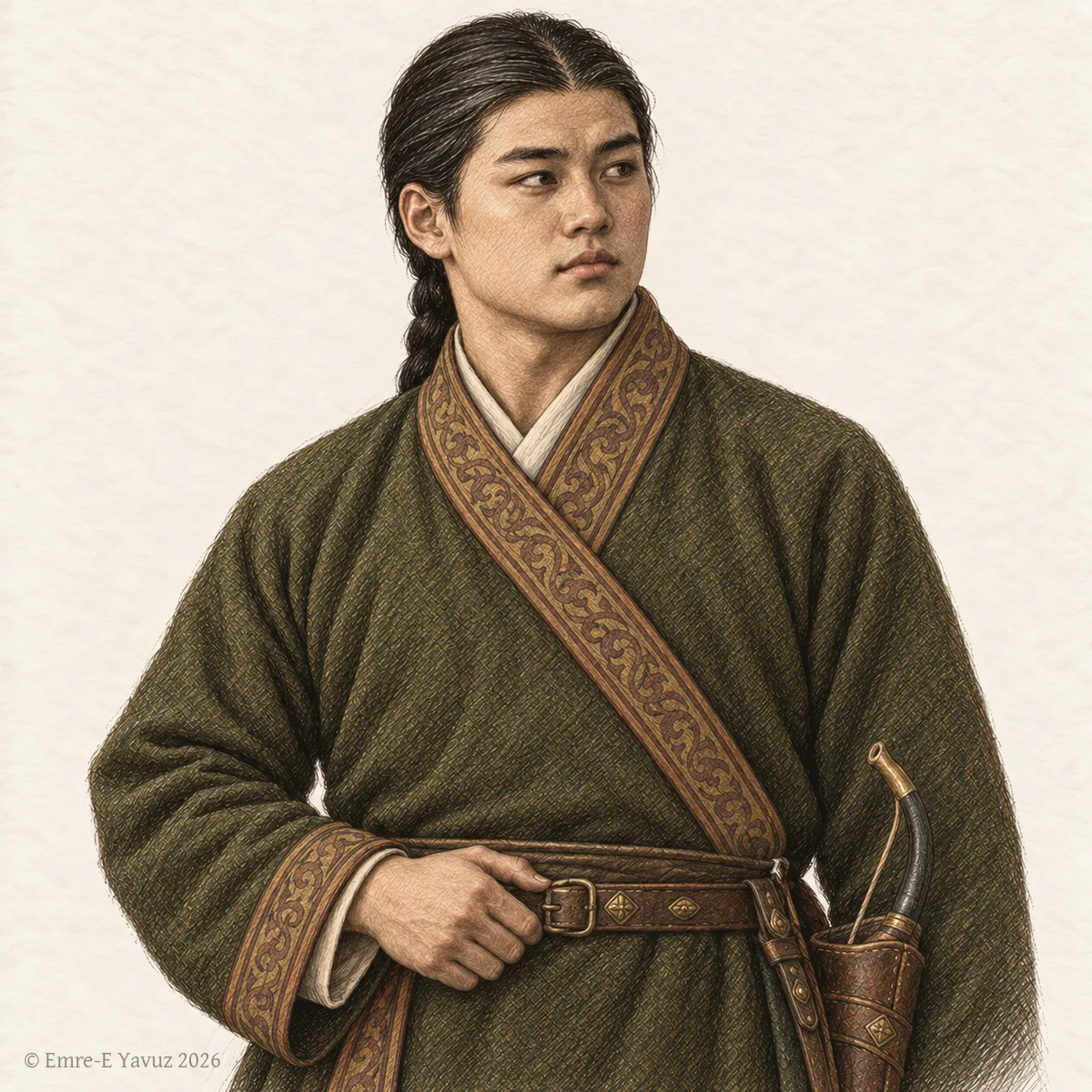
Tegin was the title of the sons and younger brothers of the Göktürk khan. They were princes of the house of Ashina.[1] The Tongdian says it in one clause: the khan’s sons and younger brothers are called tegin.[2] The Jiu Tang Shu and the Xin Tang Shu say the same.[3] The best-known holder of the title is Kül Tegin, the younger brother of Bilge Khan. He carried the title in his name.[4]
The rank in the Chinese lists
The Zhou Shu names the great offices in order: first the yabgu, then the shad, then the tegin, then the silifa and the tutunfa.[5] Below them came the lesser offices, twenty-eight grades in all. Every one of them was hereditary.[5] The Sui Shu gives the same order.[6] For the western Göktürks, the Jiu Tang Shu adds that the tegins were always taken from the khan’s sons, his younger brothers and his clan.[7]
The Chinese histories also show tegins at work. In 599 Tulan Khan sent an envoy, Yintou Tegin, to argue his case against Rangan before the Sui emperor.[6] Among the western Göktürks, Niri Khan was the son of Yangsu Tegin. Niri’s younger brother Poshi Tegin went to the Sui court with Niri’s widow.[6] When Tong Yabgu was murdered, his son Dieli Tegin fled to Kangju.[8]
The biography of the pilgrim Xuanzang shows how a tegin could rise.[9] At Kunduz, Tong Yabgu’s eldest son, Tardu Shad, was poisoned by his young new wife.[10] The shad’s son by an earlier wife was a tegin. He seized his father’s rank of shad and married his stepmother.[9]
Two spellings
The Sui Shu and the Tongdian write the title 特勤, teqin.[11] The Jiu Tang Shu and the Xin Tang Shu write 特勒, tele, with a different second character.[3] The received text of the Zhou Shu also has 特勒.[5] Its modern edition changes the word to 特勤 and notes that every 特勒 is a scribal error for 特勤.[5] The monument of Kül Tegin decided the reading.[12] Its Chinese text writes the prince’s name with 特勤. The name 闕特勒 in the Tang histories is therefore to be read the same way.[12] Older works that followed the Tang spelling print the title as tele.[13]
In the inscriptions
The Turkic faces of the monument were raised in the Second Khaganate. They spell the title 𐱅𐰃𐰏𐰤, tigin, and write it together with the name.[14][15] In line 30 of the east face, Bilge Khan speaks of “my younger brother Kül Tegin”. The name stands there as one word.[14] The writer of the inscription signed it with the same title.[16] He calls himself Yollug Tegin, the nephew of Kül Tegin, and says that he spent twenty days on the writing.[16][17] Some scholars regard this signature as a sign of the weight that writing had as the Göktürks.[18]
The inscriptions give the title a plural of its own, tegit. They give tarkat for the tarkan and seŋüt for the seŋün in the same way. The ending -t is the plural of titles. It may have come into the language together with these titles, possibly from a Mongolic language.[19] In the Uyghur texts that follow, the ordinary plural -lär is added to the old one. The result is tegitlär, princes.[20]
Painted texts on the Tayhar rock at Hoyto Tamir carry the title in short names, among them Tigin Bars and Kara Tegin. The readings are uncertain.[21]
On the donor paintings of Bezeklik, the word stands on the name tablet of a lady. The tablet is read ögrüne tigin täŋrim körki, “the likeness of Her Highness the princess Joy”. Beside it is a painted portrait of a woman in a long gold robe.[22] The reader took tigin there for a title borne by a woman. The date of the painting is uncertain.[22]
The tegin was thus a rank of birth.[2] A son or brother of the khan was a tegin before he held any command. A shad, in the Tongdian’s words, was the man who led the troops of a separate division.[2]
References
- ^ Tongdian, juan 197; Xin Tangshu (New Book of Tang), juan 215
- ^ a b c Tongdian, juan 197
- ^ a b Jiu Tangshu (Old Book of Tang), juan 194; Xin Tangshu (New Book of Tang), juan 215
- ^ Kül Tegin inscription
- ^ a b c d Zhou Shu (Book of Zhou), juan 50
- ^ a b c Sui Shu (Book of Sui), juan 84
- ^ Jiu Tangshu (Old Book of Tang), juan 194
- ^ Xin Tangshu (New Book of Tang), juan 215
- ^ a b Life of Xuanzang, juan 2; Beal 1911, p. 47–48
- ^ Life of Xuanzang, juan 2; Beal 1911, p. 47
- ^ Sui Shu (Book of Sui), juan 84; Tongdian, juan 197
- ^ a b Mau-tsai 1958, Turkish edition, p. 20
- ^ Thomsen 1896, p. 73
- ^ a b Kül Tegin inscription; Radloff 1894–1895, parts 1–3, p. 18
- ^ Tekin 1968, p. 380–381
- ^ a b Kül Tegin inscription; Radloff 1894–1895, parts 1–3, p. 39
- ^ Tekin 1968, p. 272
- ^ Edward 1993, p. 37
- ^ Erdal 2004, p. 128,158
- ^ Erdal 2004, p. 158
- ^ Sertkaya 2000, p. 326, 343
- ^ a b von Le Coq 1913, pl. 30
Sources
- Zhou Shu (Book of Zhou), juan 50
- Sui Shu (Book of Sui), juan 84
- Tongdian, juan 197 (after Sui Shu and Zhou Shu)
- Jiu Tangshu (Old Book of Tang), juan 194
- Xin Tangshu (New Book of Tang), juan 215 (after Jiu Tangshu)
- Life of Xuanzang, juan 2
- Kül Tegin inscription
Literature
- Liu Mau-tsai, Çin Kaynaklarına Göre Doğu Türkleri (1958, Turkish edition)
- Vilhelm Thomsen, Inscriptions de l'Orkhon déchiffrées (1896)
- Wilhelm Radloff, Die alttürkischen Inschriften der Mongolei (1894–1895, parts 1–3)
- Samuel Beal (trans.), The Life of Hiuen-Tsiang by the Shaman Hwui Li (1911)
- Marcel Erdal, A Grammar of Old Turkic (2004)
- Talât Tekin, A Grammar of Orkhon Turkic (1968)
- Albert von Le Coq, Chotscho. Facsimile-Wiedergaben der wichtigeren Funde der ersten Königlich Preussischen Expedition nach Turfan in Ost-Turkistan (1913)
- Tryjarski, Edward, Anonymity, Adaptation and Diffusion of the Asian and European Runic Scripts (1993)
- Osman Fikri Sertkaya; Sartkocaulı Harcavbay, Hoyto Tamir (Moğolistan)’dan yeni yazıtlar (ön neşir) (2000)
What links here29
- Persons
- Jujian Tegin · Kang Shaoli · Kuhanzhen · Poshi Tegin · Rudan Tegin · Si Yabgu Khan · Tardu Shad · Yangsu Tegin · Yinnai Tegin · Yintou Tegin
- Battles & Events
- Göktürk Aid to Li Yuan (617) · Proclamation of Bumin Khan (552)
- Peoples
- Nezak Shahs
- Institutions and Titles
- Daluobian · Envoys and Embassies · Külüg Chur · Levirate · Saŋun · Sifa · Tarkhan · The Twenty-Eight Ranks
- Languages
- Chinese transcriptions of Turkic
Cite this article
Yavuz, Emre-E. “Tegin.” Turkic Atlas, revised 8 November 2026. https://turkicatlas.org/institutions/tegin/
Last revised: 8 November 2026

