
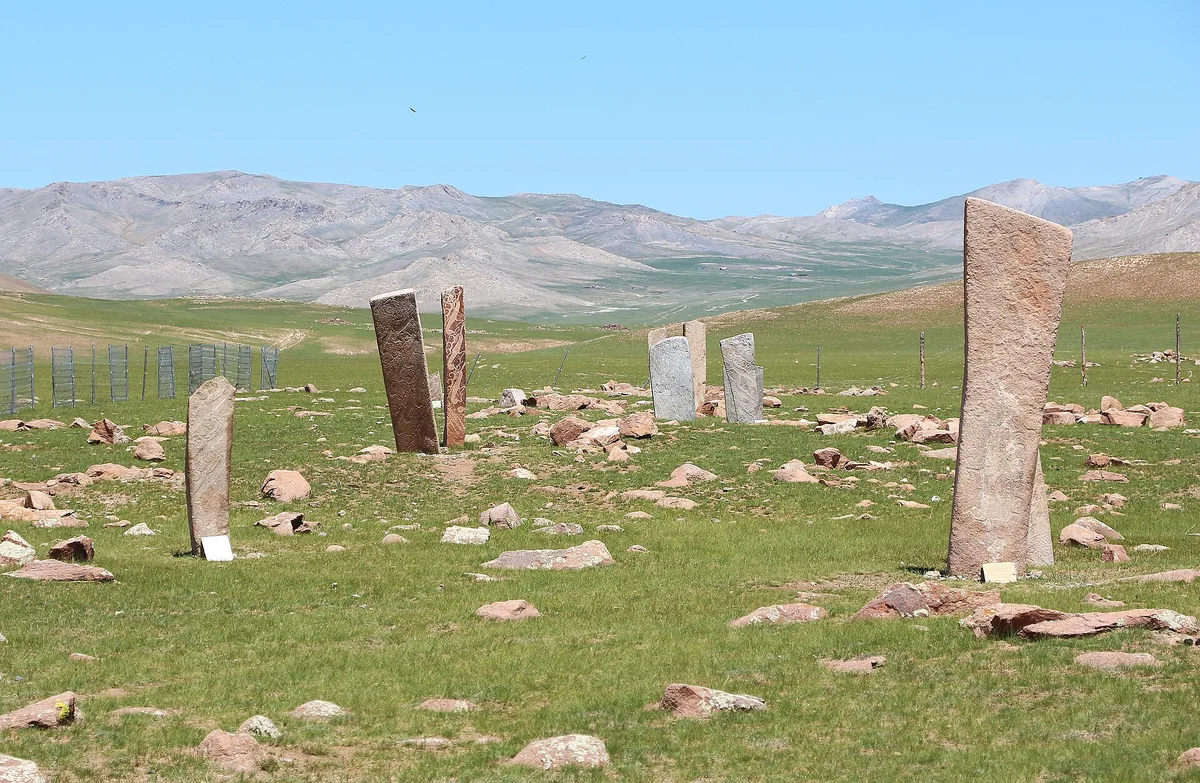
Deer stones are standing slabs of the Mongolian and South Siberian steppe. They were raised in the late Bronze Age and the early Iron Age. They are carved with files of stylised deer with backswept antlers, and usually a belt, weapons and earrings are marked on the stone. They stand near burials and in rows.
They are the oldest monumental sculpture of the eastern steppe and the distant ancestor of a form that recurs much later: a shaped stone set up for the dead. The balbal and the Göktürk memorial enclosures are also shaped stones of this kind.
At Döge-Baarı in Tuva, next to a Kirghiz mound of the ninth or tenth century, stood a stele with a row of balbal stones to its east. Excavation showed the stele to be an overturned deer stone, buried head down in the Kirghiz age.[1] The finder is unsure whether the line on its south face is runiform. The signs that can be made out do not look Turkic.[1]
References
Literature
- Kormuşin, İgor V., Kuzey Tuva Öğök-Turan Vadisindeki Göktürk Anıtlarının Bazı Özellikleri (2000)
What links here2
- Religions
- Burial and the balbal · Stone Figures
Cite this article
Yavuz, Emre-E. “Deer stones.” Turkic Atlas, revised 7 November 2026. https://turkicatlas.org/institutions/deer-stones/
Last revised: 7 November 2026


