
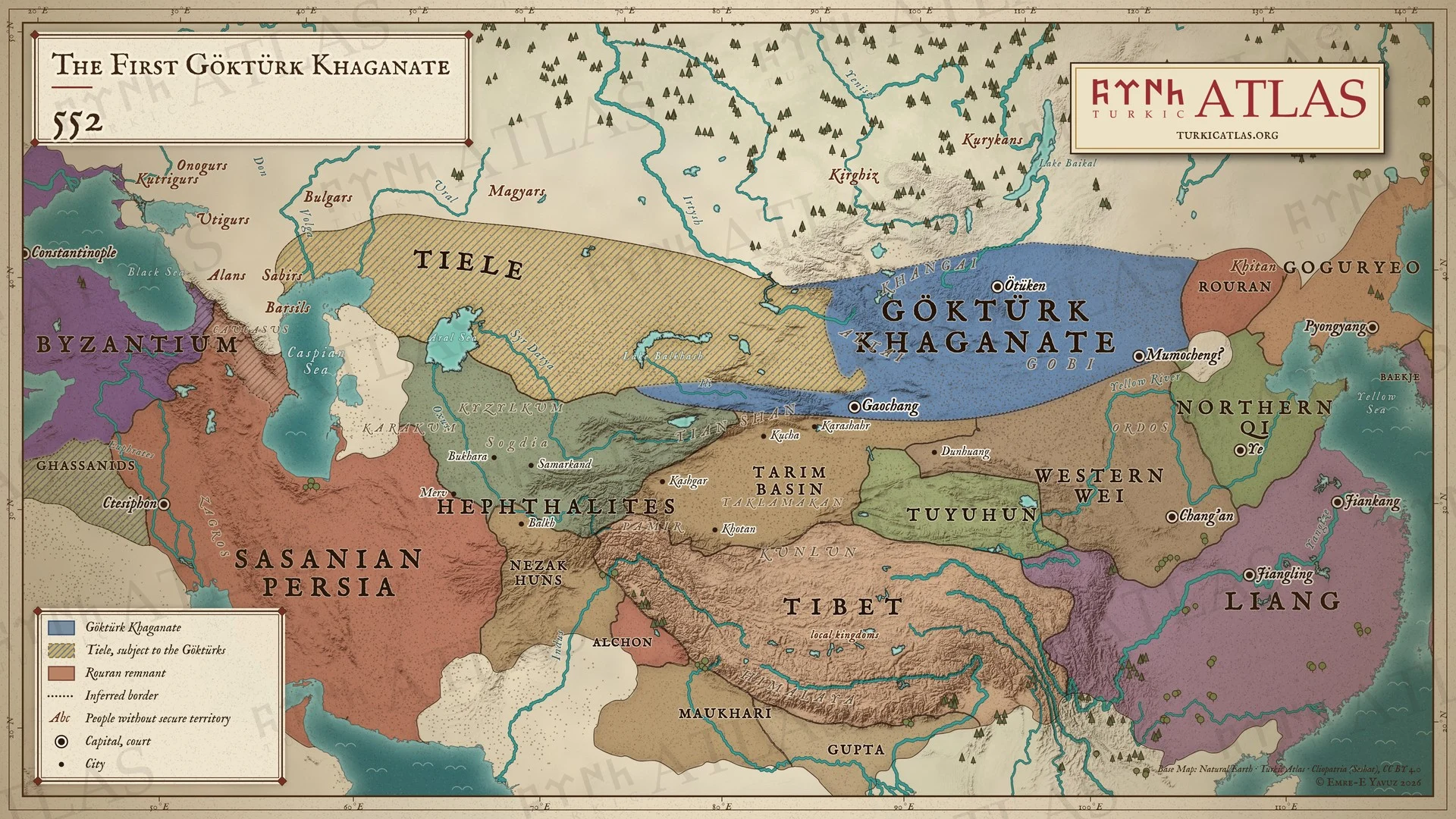
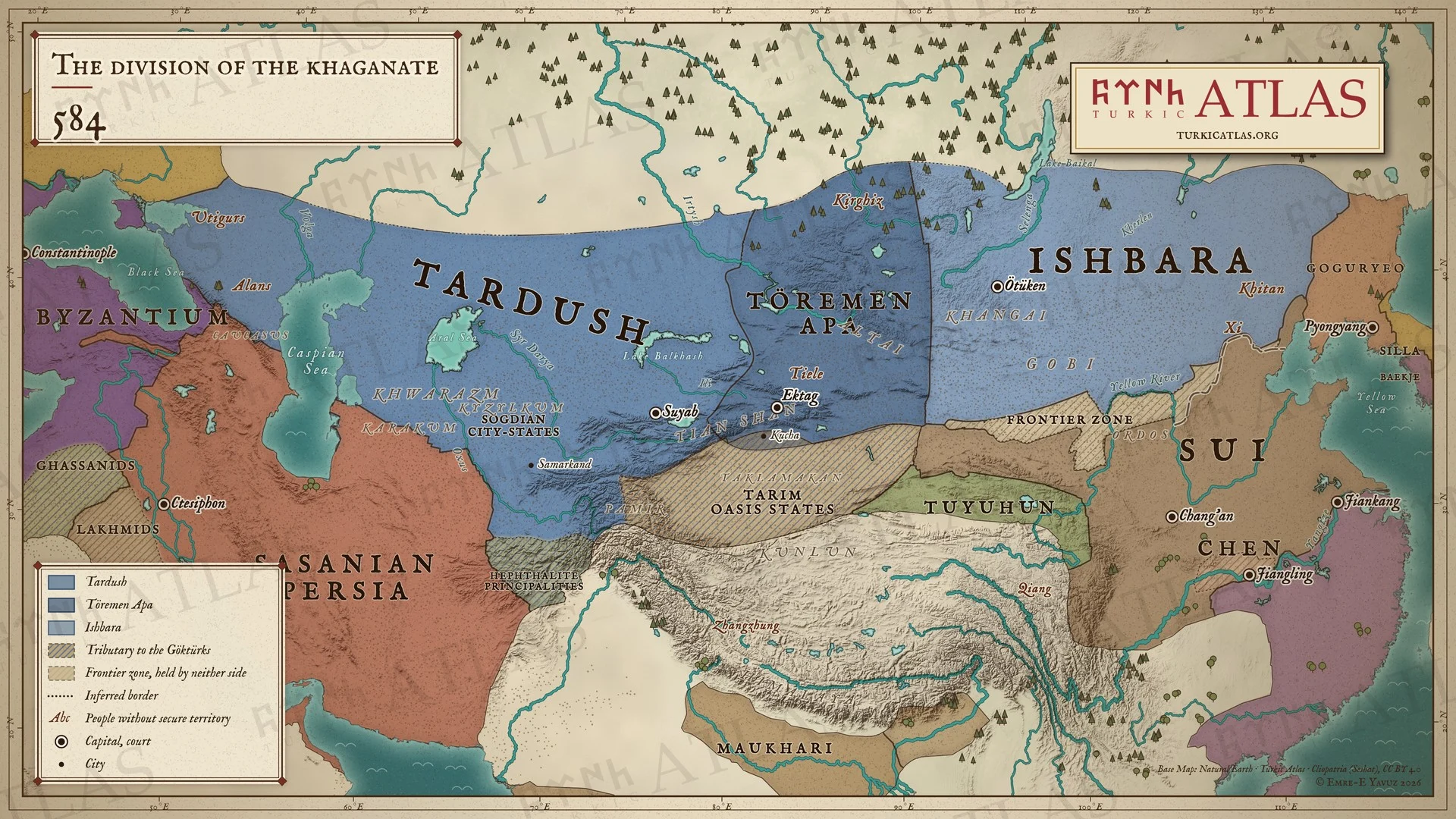
Bumin's younger brother took the western command at the founding and held it for a quarter of a century. In that time the Göktürks destroyed the Hephthalites together with Persia, took the trade of Sogdiana, quarrelled with the Sasanian king over silk, allied with Byzantium and brought the peoples of the Pontic steppe under their rule. When Istemi died in 576 his sons stood on the Black Sea. Twelve years later his successors fought the first great war against Persia.
1/8
Istemi
552–576
The yabgu himself: his names, his rank, his campaigns and his death.
Istemi was Bumin's younger brother, and he outlived him by a quarter of a century. In the spring of 553, with Bumin dead and Bumin's son Issik on the throne, he led an army west out of the Altai. One count gives him a hundred thousand men, a second thirty to fifty thousand, and by the summer he had reached the Seven Rivers. Menander, the Byzantine historian, calls him Silziboulos, a form read as his title, Sir Yabgu, and one reading ranks him a yabgu, a deputy of the khan. He held the west for twenty-three years and died in 576; the Roman envoy Valentinos found his son in mourning. The Kül Tegin inscription names the two founders side by side, Bumin Khan and Istemi Khan, and gives them one title between them.
 Ashina
2/8
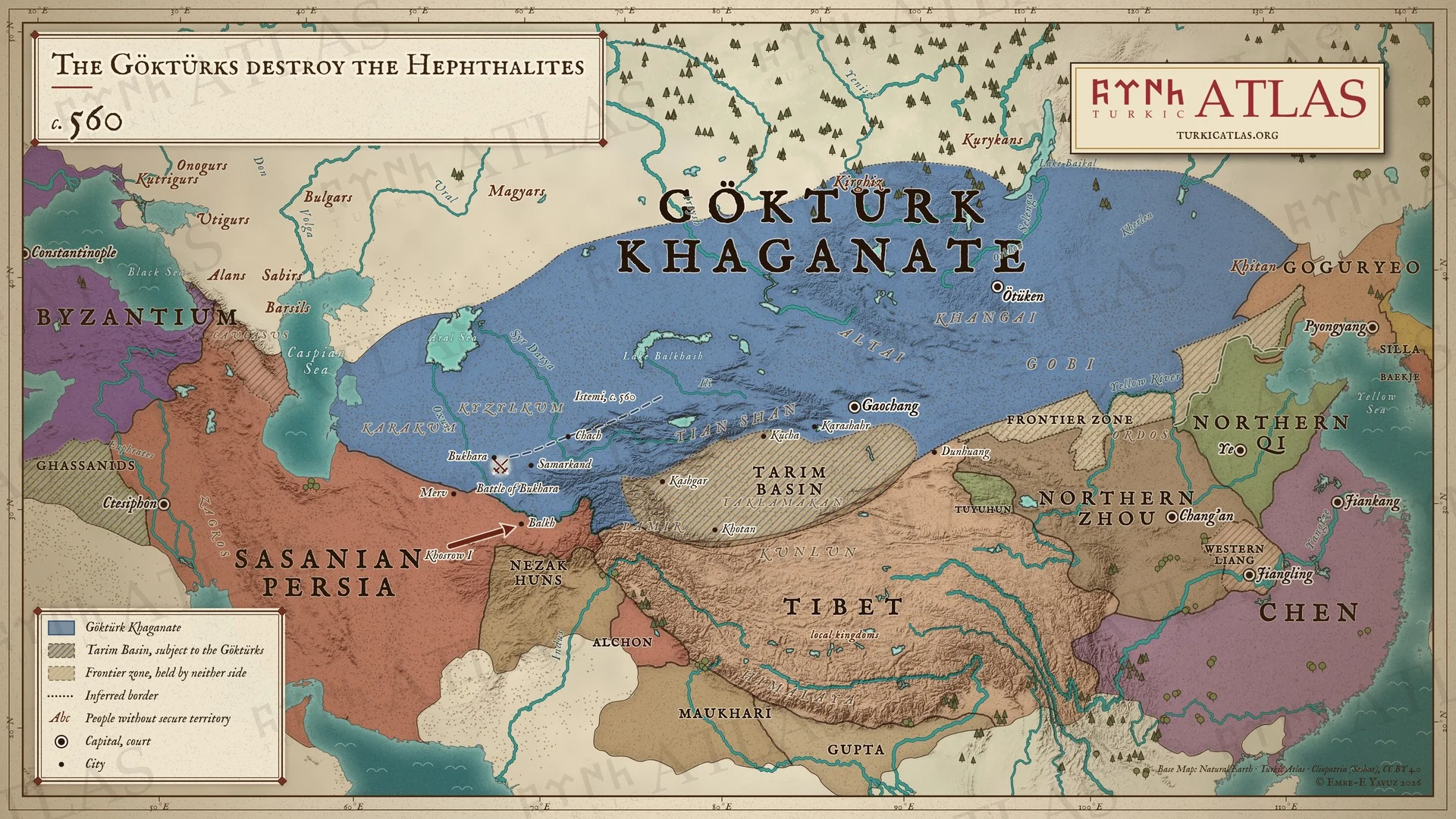
The Göktürk–Hephthalite war, 555–563
555–563
The war fought with Persia against the Hephthalites, and the partition along the Oxus.
The Hephthalites had held both sides of the Oxus for a century, and twice they had decided who sat on the Sasanian throne. Within a few years of founding their own state, the Göktürks attacked them. Istemi came from the north and Khosrow I of Persia from the south, and Khosrow sealed the compact by taking a daughter of Istemi to wife. On one modern reconstruction the Hephthalite king Gatfar gathered his troops near Bukhara and fought in the hills at Nesef, and after eight days the Göktürks won. One reckoning puts the destruction in 557, a second about 560, a third between 563 and 567. The victors divided the realm along the Oxus, the country north of it to the Göktürks and the country south of it to Persia. Within a decade the two victors were enemies.
 First Göktürk Khaganate
 Sasanian Persia
 Hephthalites
3/8
Göktürk Expansion along the Silk Road
553–629
Sogdiana, Bukhara and the road west: the campaigns, the merchants and every war with Persia.
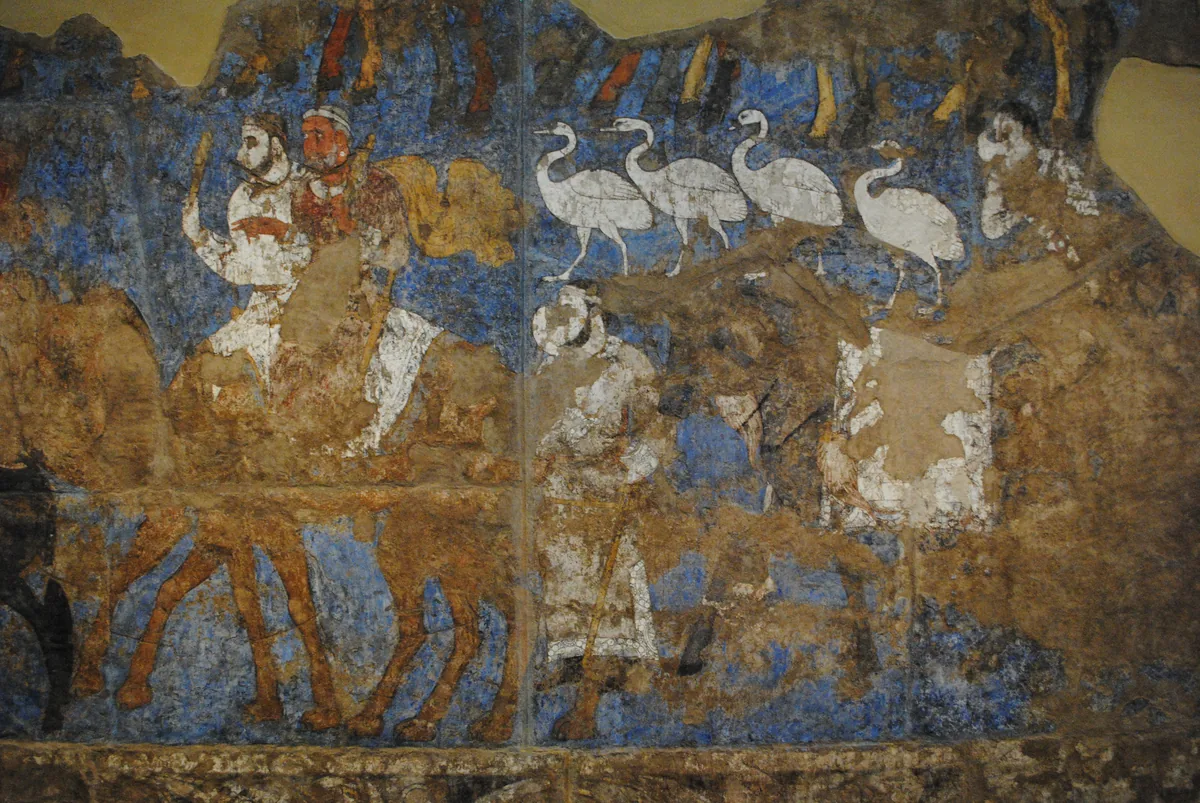
Sogdiana had no single king. Each city had its own, and after the fall of the Hephthalites all of them, Bukhara and Samarkand among them, passed under Göktürk protection. From the beginning the Sogdians administered the commercial interests of the khaganate. The silk came from China: the Zhou court gave the Göktürks a hundred thousand pieces a year, and the Qi emptied their treasury to do the same. The Sogdians proposed to carry the surplus west, and the first road to the western market ran through Persia. Between the partition on the Oxus and the siege of Tiflis in 628, the Göktürks and Persia met under arms many times, among them in Istemi's campaign of 569 and the war of 588. The friendship between Göktürks and Sogdians that began under Istemi lasted into the age of the Uyghurs.
 Byzantium
- Sasanian Persia
- Hephthalites
4/8
The Göktürk–Sasanian Trade Conflict
560–570
The silk the Persian king burned, the envoys who died, and how an ally became an enemy.
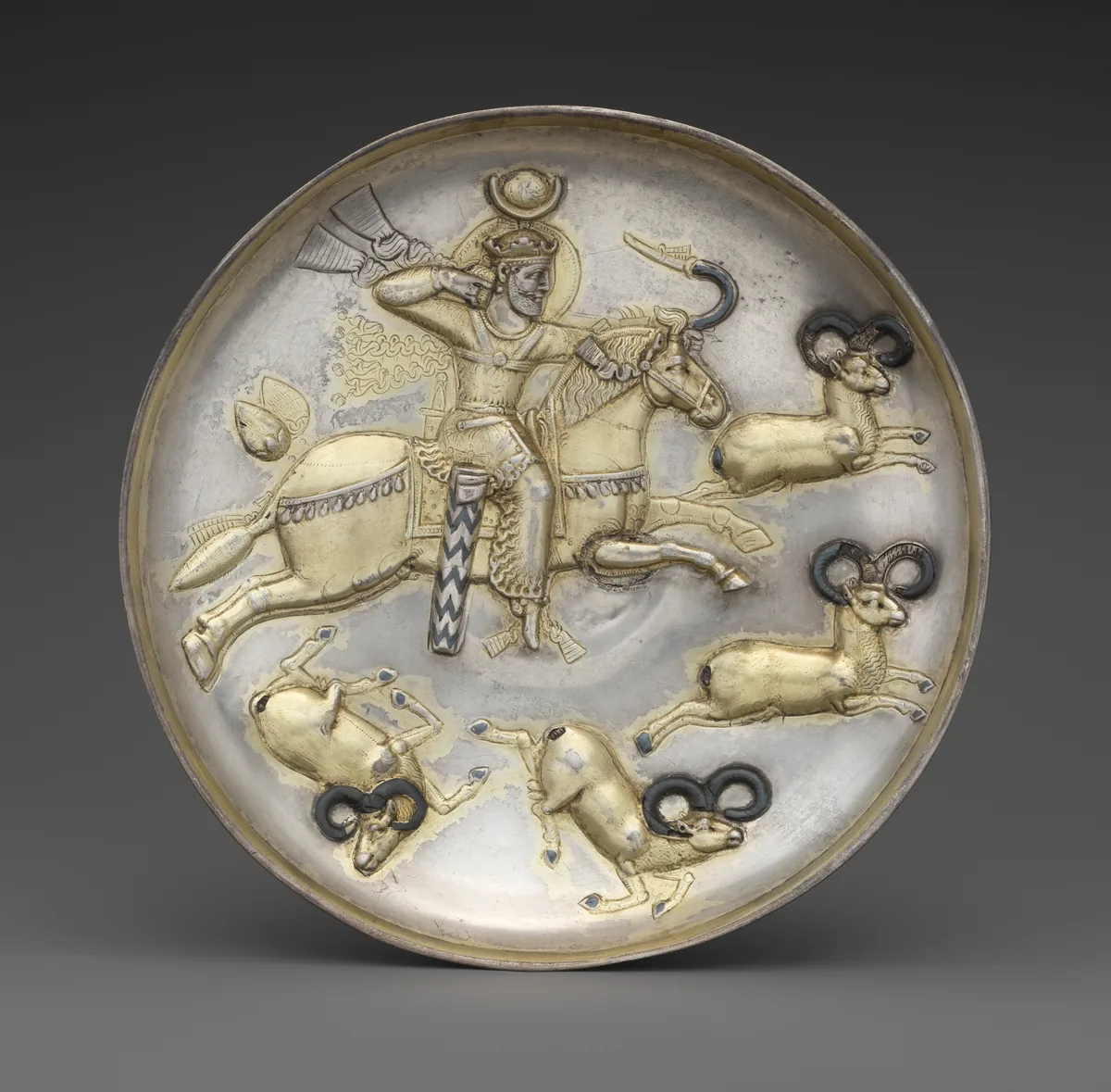
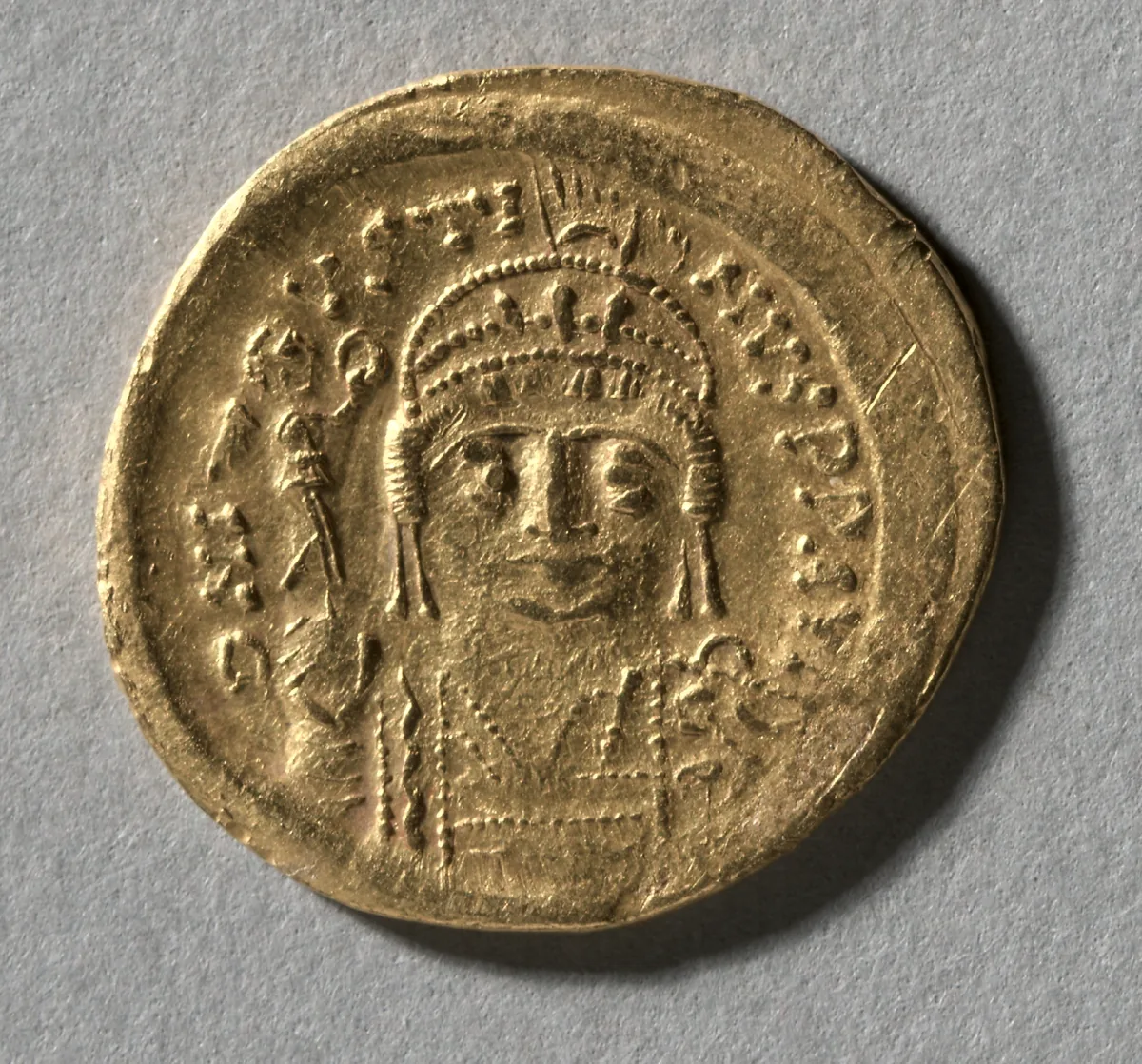
After the Hephthalite war the Sogdians, now subjects of the Göktürks, wanted to sell raw silk in Persia, and Istemi sent them to Khosrow I under Maniakh. Khosrow put them off from day to day, until the Hephthalite Katulph, who had gone over to the Persians, gave his advice: buy the silk at its price and burn it before the envoys' eyes. The silk was burned. Istemi sent a second embassy, of Göktürks this time, and most of its members died of poison mixed into their food. The Persians put it about that the envoys had died of the stifling heat. Istemi understood that his envoys had been murdered, and Menander dates the enmity of the Persians and the Göktürks from that moment. Maniakh then advised him to court the Romans, who used more silk than any other people.
5/8
The Göktürk–Byzantine alliance
568–628
Maniakh in Constantinople, Zemarchos at the Golden Mountain, and the alliance against Persia.
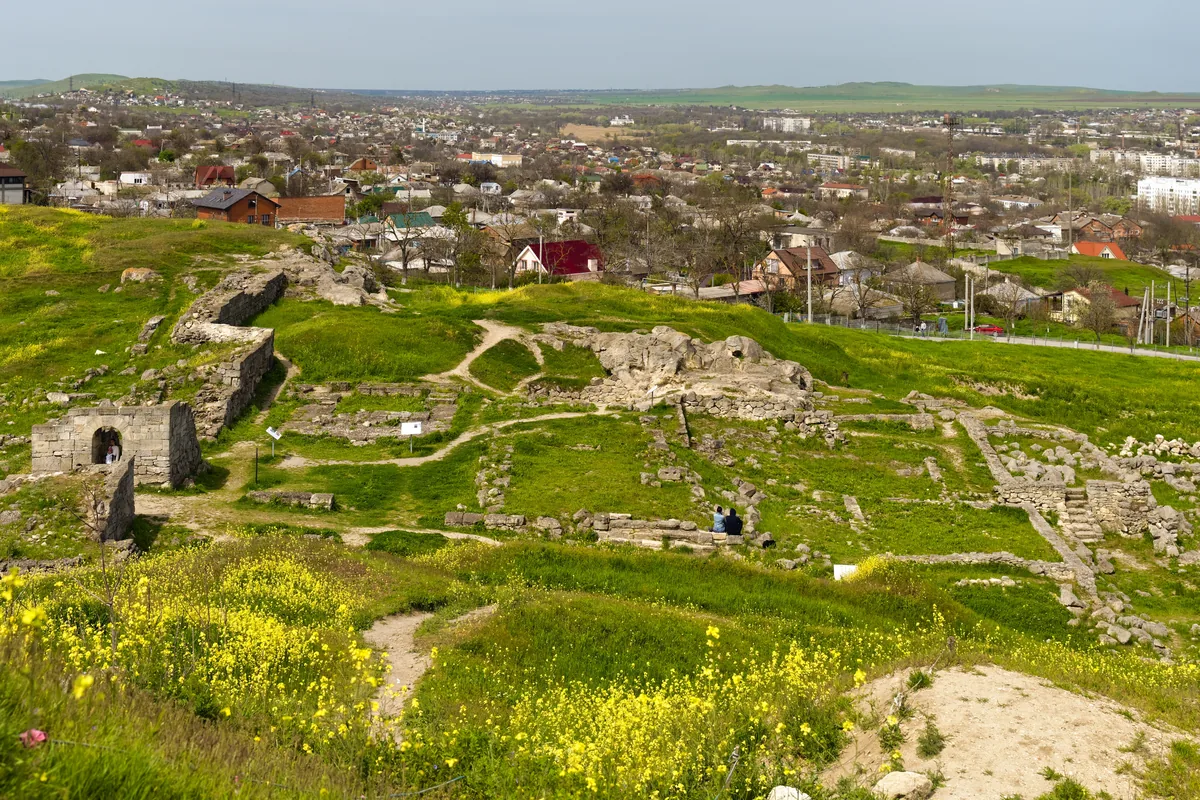
In 568, at the beginning of the fourth year of Justin II, Maniakh reached Constantinople with silk and a letter in Scythian writing. His embassy asked for peace and a military alliance, and its members swore with raised hands, calling curses on themselves and on Istemi if they lied. In August 569 Justin sent Zemarchos east, and Istemi declared that the friend of the Romans would be his friend and their enemy his enemy. About 570 the Göktürks invaded Media and urged Justin to attack Persia from the other side. In 576 they took the Roman city of Bosporos; Menander has open war follow, and one reading has the alliance stand. Half a century later Heraclius made it again. Both times it was made against Persia, the one power that bordered on both partners.
6/8
Göktürk Expansion into Europe
557–598
The Avars, the Pontic steppe, the Caucasus and the Crimea: everything the Göktürks did in Europe.
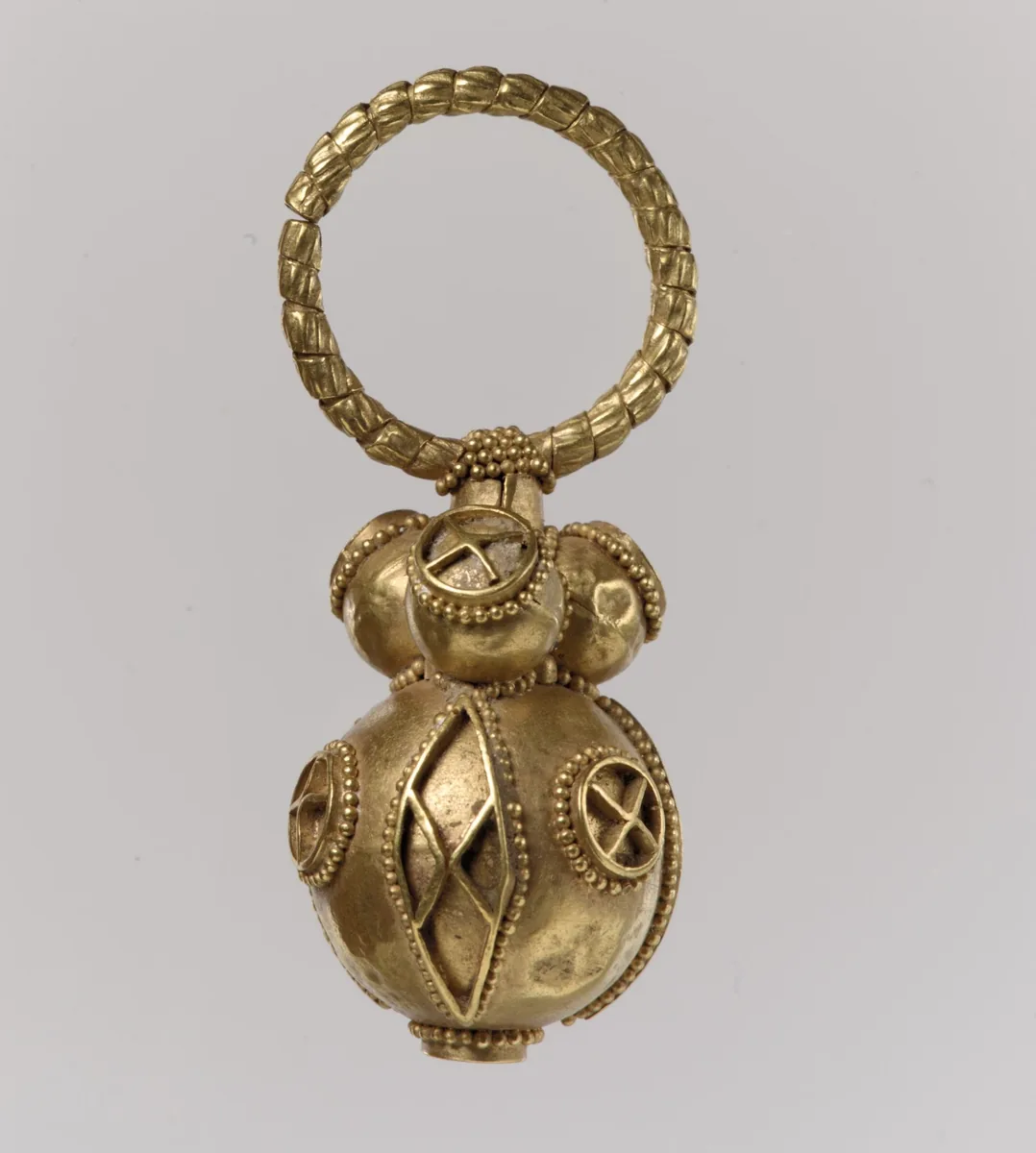
The Göktürk advance into Europe began as the pursuit of the Avars, who reached the Pontic steppe about 557. The Avars were neither birds nor fish, Istemi said, to escape the Göktürk swords through the air or under the sea, and once his war with the Hephthalites was over he would fall on them. By 568 the Göktürks held the nomads of the western steppe; beyond the Volga the Ugur chief kept Istemi's power. In 576 Istemi's son Turxanthos received the Roman envoy Valentinos in mourning and called the Avars his runaway slaves. He sent Bochan with a very large army against Bosporos in the Crimea, where Anagai of the Utigurs already lay, and the city fell. One reading has the Göktürks hold the Crimea until 598. The Khazars later took over the steppe between the Volga and the Crimea.
 Avars
- Byzantium
7/8
Turkic Tribes in Europe
463–650
The Utigurs, the Kutrigurs, the Onogurs and their neighbours, the peoples the Göktürks found in the west.
The peoples the Göktürks found in the west had come in waves. About 463 the Saragurs, the Ogurs and the Onogurs arrived, driven from their seats by the Sabirs, and they spoke Oguric, a form of Turkic that survives today in Chuvash. In the sixth century the Utigurs held the steppe east of the Sea of Azov and the Kutrigurs the steppe west of it, and Justinian set them against each other until the two peoples decimated one another. The Avars came through in the 550s, in flight from the Göktürks. The Alans were no Turkic people but Iranian nomads, and the road of the Göktürk embassies to Rome ran through their country. From the 560s most of these peoples stood under Göktürk hegemony. When that power broke in the seventh century, the Bulgars and the Khazars took its place.
8/8
Göktürk–Persian war, 588–589
588–589
Balkh, Herat and Bahram Chobin: the first great war between the Göktürks and Persia.
Nineteen years after Istemi's campaign against Persia, in 588, a Göktürk army crossed the Oxus and took Balkh, Herat, Talakan and Badghis. Tabari calls its king Šāba, "the over-king of the Turks", and gives him three hundred thousand men; a more realistic figure lies between twenty and thirty thousand. Hormizd IV, the son of Khosrow I, sent Bahram Chobin against him with twelve thousand chosen men, and Bahram killed Šāba with an arrow. One reading makes Šāba Bagha, the brother of Ishbara; a second makes him a son of Tardush; a third, a prince of the small states on the Oxus. In 589 Bahram retook Herat and reached the country around Bukhara. The victory made him strong enough to turn against his own king, and within two years Hormizd had lost his throne.
- Sasanian Persia
© Emre-E Yavuz 2026© Emre-E Yavuz 2026© Emre-E Yavuz 2026
