
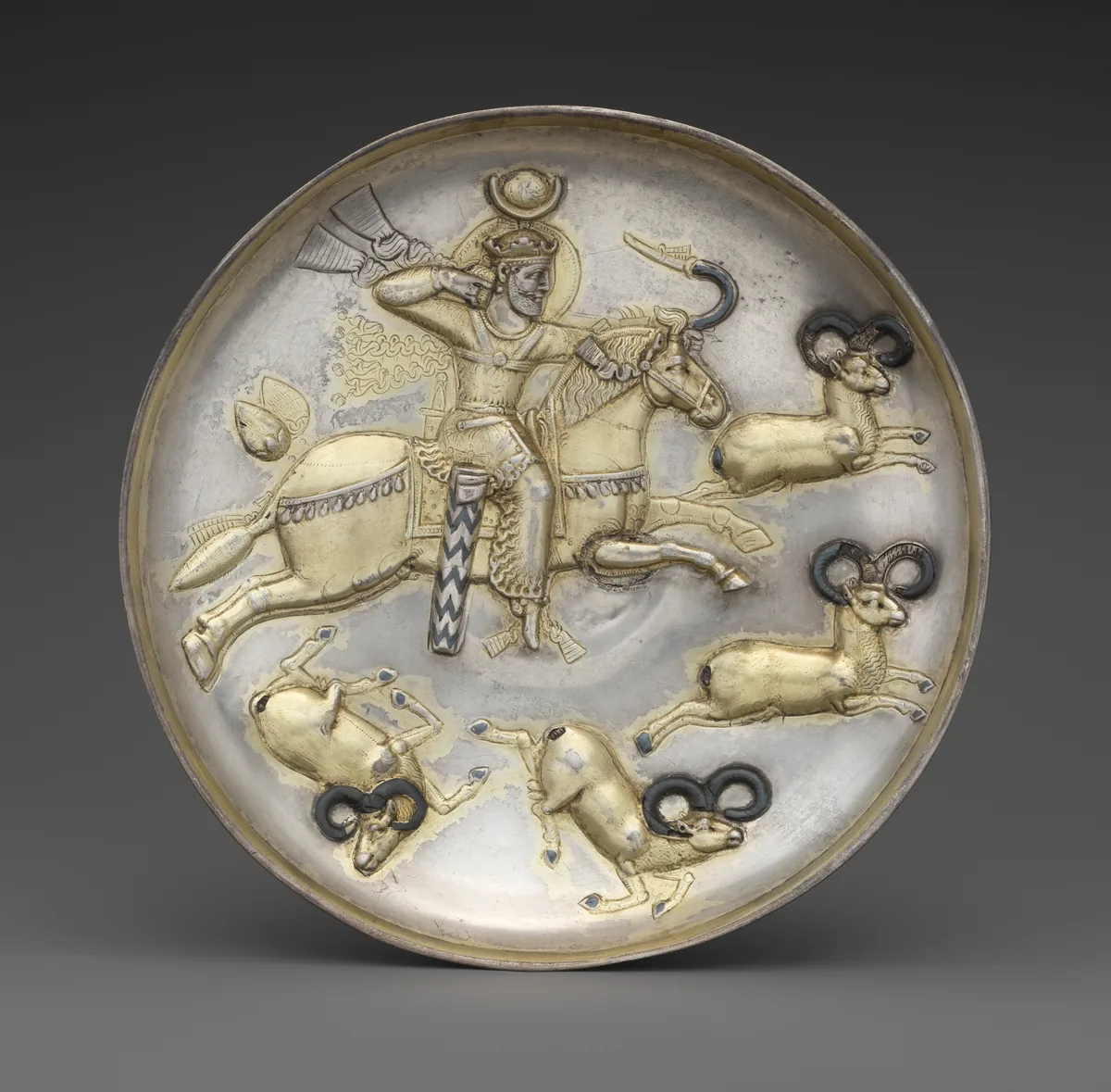
- 400
- 500
- 600
- 700
- 800
- 900
- Rouran 400–554
- First Göktürk 552–630
- Tang rule 630–682
- Second Göktürk 682–744
- Uyghur 744–840
- Kirghiz 840–924
- Huns 370–469
- Western Göktürk 552–659
- Türgesh 699–766
- Karluk 766–800
- Khazar 650–969
The Göktürk–Sasanian trade conflict was the quarrel between the western Göktürks under Istemi and Sasanian Persia under Khosrow I over the sale of silk across Persia in the 560s. Khosrow refused the silk of the Göktürks and their envoys. The refusal ended the partnership of the Hephthalite war.[1] The Göktürks answered by sending their silk and their envoys around Persia to Constantinople. They also sought an alliance with the Romans against Persia.[2]
The frontier on the Oxus
The quarrel began with a victory the two powers had won together, the Göktürk–Hephthalite war.[3] Istemi from the north and Khosrow from the south destroyed the realm of the Hephthalites. The victors divided its lands.[3] The Göktürks took the territories north of the Amu Darya, the Oxus of the Greek writers.[4] Menander states the result for the cities of Sogdiana. The Sogdians had been subjects of the Hephthalites and were now subjects of the Göktürks.[5]
For the first time, the Göktürk khaganate bordered on the Sasanian empire.[6] One account holds that a small district south-east of Bukhara fell to neither side and later became a cause of friction.[6] According to the same account, Istemi and Khosrow met at Gurgan on the Caspian in 560. They fixed the frontier along the Oxus from the Aral Sea and concluded a pact of non-aggression.[7] Istemi gave Khosrow one of his daughters in marriage to seal it.[8] Tabari names Hormizd, Khosrow’s successor, as the son of the khagan’s daughter.[9]
The Persian tradition claims more than the line on the river.[10] Tabari has Khosrow push beyond Balkh and quarter his troops in Ferghana.[11] Some scholars reject this, since Menander shows the Sogdians as Göktürk subjects after the fall of the Hephthalites.[12] Transoxiana was therefore never Sasanian. The Oxus frontier was probably first reached under Khosrow I.[13] A different proposal places the demarcation on the Oxus and the pass of the Iron Gate on the limit between the two empires.[14] The two conquerors now stood so close, it is argued, that a quarrel between them was unavoidable.[12]
Even so, the pact did not reconcile Persia to the new situation.[15]
Silk, the Sogdians and the Chinese payments
The Sogdians had stood beside the Göktürk khans from the beginning.[16] They administered the commercial interests of the khaganate. They pushed it towards Constantinople, the final market of the silk the Göktürks drew out of China.[4] Their cities kept a large measure of autonomy under the khaganate.[17]
The silk came from the Chinese courts. The Zhou Shu records that from the time of Mukan the Zhou court, bound to the khaganate by marriage, gave it a hundred thousand pieces of silk and brocade a year.[18] The Qi, fearing Göktürk raids, emptied their treasury to do the same.[18] The silk the Sogdians wanted to sell in Persia has been identified with exactly this payment.[19] The Sogdians, it is argued, proposed to the Göktürk princes that they double the profit of the Chinese payments by carrying the unused surplus to the west.[20]
The Sogdians therefore needed a buyer. The nearest was Persia. Beyond Persia lay the market of the Roman empire.
Sasanian control of trade
Persia had a merchant class of its own. In the sixth century, the Sasanian state was at its height. Its merchants were the chief rivals of the Sogdians.[21] The Sasanian policy has been described as a control of frontier trade.[22] Treaties with Rome fixed the places of exchange. Permits to trade kept foreign merchants to large frontier towns.[23] Direct contact between the Sogdians and the Syrian or Greek merchants would have ended the Persian role as intermediary. The shah had every reason to deny it.[24] In the east the Sogdians were probably confined to Merv, or at least to the old royal road towards Holwan.[24]
Menander gives Khosrow’s reason in the same terms.[25] The king disliked the Sogdian request because it would give the Göktürks free access to Persian territory.[25]
Silk production in Byzantium
The western end of the market was changing at the same time. In one version, two Sogdians smuggled silkworms from Khotan through the young khaganate to Constantinople, on the commission of the emperor Justinian.[26] Byzantium could then make its own silk from 555. The Chinese and Persian monopoly was broken.[27] Others hold that Byzantium had only just begun its own production. It was therefore less eager for Göktürk silk.[28]
The Greek writers tell the smuggling in two versions.[29] Procopius has monks bring the eggs from a country he calls Serinda.[29] Theophanes of Byzantium has a Persian bring them in a hollow staff.[29] Theophanes adds that Justin II later showed the rearing of silkworms to Göktürk envoys. The envoys were astonished, since the Göktürks then held the markets and ports of the Seres.[29]
The first embassy to Khosrow
The embassies to Ctesiphon began with a Sogdian request.[5] The Sogdians asked their king to send an embassy to the Persians, so that they might sell raw silk to the Medes.[5] In one account, the heads of the Sogdian merchant guilds came to Istemi in 568, with the leave of their city kings. They asked permission to go to the Persian court at Ctesiphon.[30] They wanted Khosrow’s permission to trade across Persian territory.[15] Istemi agreed only reluctantly. He sent a delegation of influential Sogdian merchants.[27] In Menander, the king, whom he calls Dizaboulos, agreed and sent Sogdian envoys. Maniakh led them.[25]
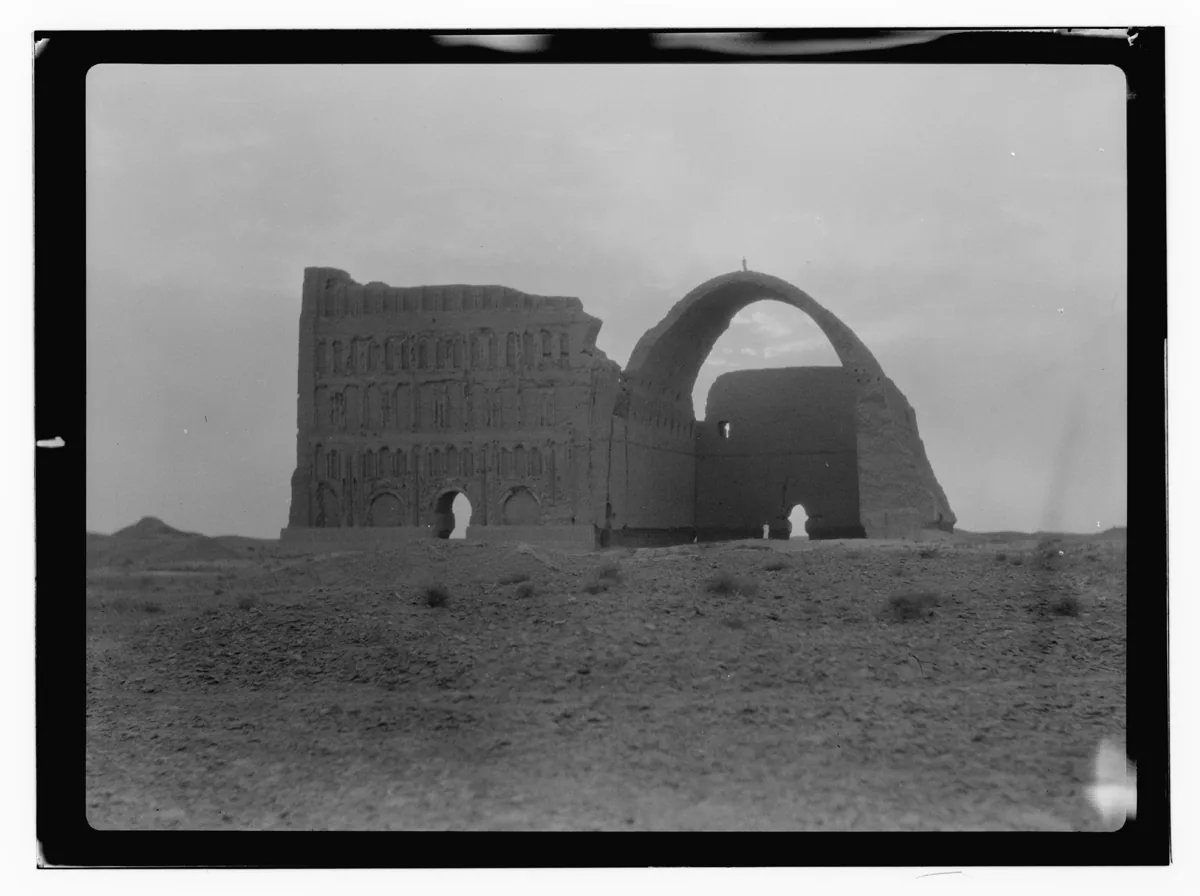
At the Persian court the envoys asked that the silk trade be allowed to proceed without hindrance.[25] Khosrow put them off from day to day. When they pressed him, he called a council.[25] There the Hephthalite Katulph gave his advice.[25] He had betrayed his own people to the Göktürks after his king violated his wife. He had since gone over to the Persians.[25] He told the king to buy the silk at its price and burn it before the envoys’ eyes. The king would then not seem to wrong them. It would be plain that he wanted no silk from the Göktürks.[25]
The silk was burned. One account has Khosrow’s subjects set fire to the goods in the open street, in full public view.[31] Khosrow meant to show that he acted from Persian interest and would allow no silk trade with the Göktürks.[31] Menander has the silk burned before the envoys. The Sogdians went home displeased.[25]
The second embassy
Istemi at once sent a second embassy, this time of Göktürks. He wished to make the Persians friends of his state.[25] Khosrow took counsel with the Persian officials and with Katulph.[25] They judged friendship with the Göktürks wholly against Persian interest, because, in their words, the Scythian race was untrustworthy.[1]
Another account says that Khosrow had part of the delegation poisoned at a dinner, so that the Göktürks would stop sending embassies to Persia.[32] The Persians blamed the unaccustomed drought and heat. Only a few Göktürks were spared.[33] In Menander, most of the envoys died of poison mixed into their food. Three or four escaped.[34] A rumour went round among the Persians that the envoys had died of the stifling heat, since their own country lies often under snow.[34]
Istemi was not deceived. Menander calls him shrewd and clever. He says that Istemi believed, as was indeed the case, that his envoys had been murdered.[34] Menander dates the enmity of the Persians and the Göktürks from this moment.[34] The outcome was a closed frontier on both counts. The Sogdian merchants had no licence to trade. The Göktürks had no passage through Persian territory.[33]
Khosrow’s fortifications and Sinjibu’s demands
Tabari tells the Persian side of the quarrel.[35] In the usual identification, his khagan Sinjibu is Istemi.[36] Khosrow raised towns, castles and walls in the region of Sul, with stone quarried in Gurgan.[37] He fortified the gate of Sul and the roads and passes by which the khagan would have to come.[38] Sul has been placed in Gurgan, south-east of the Caspian.[39]
Then Sinjibu came to the gate.[10] He had won over the Abkhaz, the Bangar and the Balangar. They told him that the kings of Persia had always bought them off with payments.[40] The khagan set out with a hundred and ten thousand warriors. At Sul he demanded money for himself and the old payments for the three peoples.[10] Khosrow refused. The gate of Sul was fortified. Five thousand soldiers held the Armenian frontier.[38] When Sinjibu learned how strong the defences were, he went home with his purpose unfulfilled.[38]
Tabari gives the episode no year. The Persian account may confuse the walls of Gurgan with the Caucasus. If so, Sinjibu’s real object was the part of Khorasan the Gurgan walls protected.[36]
The turn to Constantinople
Maniakh, whom Menander calls the head of the Sogdians, seized the moment.[34] He advised Istemi that it was better for the Göktürks to court the Romans and carry the silk to them, since the Romans used more of it than any other people.[34] He offered to travel with the Göktürk envoys himself, so that Romans and Göktürks would become friends.[34] Istemi agreed. He sent Maniakh with greetings, a gift of silk of great value and a letter to the emperor.[34]
In one account, Istemi accepted the plan on one consideration: the enemy of his enemy could become his friend.[41] The embassy reached Constantinople at the beginning of the fourth year of Justin II. The envoys asked for peace and a military alliance.[42] The quarrel with Persia, a chapter in the wider Göktürk expansion along the Silk Road, thus produced the Göktürk–Byzantine alliance.[2]
The Persian envoy at Talas
Justin sent Zemarchos back with Maniakh. The return embassy found Istemi preparing for war.[43] Istemi took Zemarchos and twenty of his people with him on his march against the Persians.[44] At a place called Talas a Persian envoy met him.[45]
Istemi invited both envoys to a feast and seated the Romans on the more honoured couch.[46] He complained at length of the wrongs he had suffered from the Persians. This, he said, was why he was going to war.[46] The Persian envoy broke the custom of silence at meals and answered the charges so hotly that those present marvelled at his anger.[46] After that they parted. Istemi made ready his expedition against the Persians.[46]
In one account, the breach of manners confirmed Istemi in his decision to attack.[47] It also regards the expedition as a smaller campaign aimed at plunder.[47] It dates Istemi’s campaign against Persia to 569.[48] Another view puts a bold stroke against Persia in 569 or 570, while Zemarchos was with the khagan.[36] Menander does not narrate the campaign. In another fragment, he says that the Göktürks invaded Media and ravaged the land. They sent an embassy to Justin to draw him into the war.[49] Of the many causes of the war between Rome and Persia, Menander names the Göktürks as the one that most roused Justin.[50]
Silk through the Caucasus
The Sogdian silk now went to Constantinople by the northern road.[51] Maniakh travelled over mountains near the clouds, over plains, lakes and rivers. He crossed the Caucasus to reach the city.[51] The embassy may have gone north of the Caspian because the southern road was barred at Gurgan.[52]
Persia tried to close the northern road as well. On Zemarchos’ return, the Ugurs warned him that four thousand Persians lay in ambush at the river Kophen.[53] In Alania, the ruler Sarodios warned him that the Persians waited near Suania.[54] Zemarchos sent ten porters laden with silk down the Mindimian road as a decoy. He went himself by the road of Dareine to the Black Sea.[54] Five more Roman embassies went to the Göktürk court before 576. In one account, every one was attacked on the road by Persian mercenaries.[55]
The silk still arrived. Gregory of Tours records that the Persarmenians came to the emperor in 571 with a great store of unwoven silk. This may be the fruit of the traffic across the Caucasus.[56]
The later course
The Persian answer reached beyond the steppe.[57] Theophanes of Byzantium places the Persian conquest of southern Arabia after the Roman embassies to Central Asia, as a riposte to them.[57] The Armenian revolt of 571 followed. War between Rome and Persia broke out in 572.[57]
The frontier on the Oxus remained the line of conflict. Tabari makes Hormizd IV the son of the Göktürk princess. In that king’s eleventh year, he has Šāba, “the over-king of the Turks”, march with three hundred thousand men as far as Badhghis and Herat.[58] Bahram Chobin killed him with an arrow.[59] In one account, both sides wanted the war of 588–589. The Persians claimed Transoxiana on historical grounds.[60] The first great Göktürk–Persian war was the long consequence of the quarrel over the silk.
Explanations of the conflict
Scholars explain the quarrel in several ways. One explanation sees a commercial war, a blockade between the Sasanians and the Sogdians.[61] It links the refusal with the Persian seizure of Yemen, as if Persia had closed every road to Byzantium at once.[62] A second rejects this, because the conquest of Yemen came after the events in Central Asia.[57] It understands the bonfire as frontier policy joined to high politics. The silk was the product and the symbol of the tribute China paid the new enemy.[24] Persia, it argues, chose to check the Göktürks by every means, beginning with a lofty refusal to use that silk. It avoided the cause for war that confiscation would have given.[63]
A third explanation sees two commercial policies at variance, since both powers sought to control the western end of the silk route.[4] A fourth places the cause in Khosrow’s refusal of Göktürk trading privileges. The refusal broke his friendship with Istemi and brought the Göktürks and Byzantium together.[64] A fifth extends the trade motive to the war of 589. It regards the war as an attempt to break the Sasanian hold on the trade between east and west.[65] A sixth holds that this claim still needs substantiation.[65]
The explanations differ on the duration as well. According to one, the political motive faded quickly. The setback concerned only the very short term.[66] In Menander, the refusal at the Persian court opened an enmity that brought the Göktürks and the Romans together against Persia.[2] The silk burned before the Sogdian envoys set the direction of Göktürk policy in the west for a generation.
References
- ^ a b Menander Protector; Dindorf 1871, p. 46–47
- ^ a b c Menander Protector; Dindorf 1871, p. 47–49
- ^ a b Golden 1992, p. 127–128
- ^ a b c Golden 1992, p. 128
- ^ a b c Menander Protector; Dindorf 1871, p. 45
- ^ a b Yavuz 2025, p. 274
- ^ Yavuz 2025, p. 278–279
- ^ Yavuz 2025, p. 278
- ^ Tabari; Nöldeke 1879, p. 252
- ^ a b c Tabari; Nöldeke 1879, p. 159
- ^ Tabari; Nöldeke 1879, p. 167
- ^ a b Nöldeke 1879, p. 159
- ^ Nöldeke 1879, p. 17
- ^ Chavannes 1903, p. 228–229
- ^ a b Yavuz 2025, p. 280
- ^ Golden 1992, p. 122
- ^ Golden 1992, p. 144–145
- ^ a b Zhou Shu (Book of Zhou), juan 50
- ^ de la Vaissière 2005a, p. 209–210
- ^ de la Vaissière 2005a, p. 210
- ^ de la Vaissière 2005a, p. 227
- ^ de la Vaissière 2005a, p. 230
- ^ de la Vaissière 2005a, p. 230–231
- ^ a b c de la Vaissière 2005a, p. 231
- ^ a b c d e f g h i j k Menander Protector; Dindorf 1871, p. 46
- ^ Yavuz 2025, p. 285
- ^ a b Yavuz 2025, p. 281
- ^ Golden 1992, p. 129
- ^ a b c d Chavannes 1903, p. 233
- ^ Yavuz 2025, p. 280–281
- ^ a b Yavuz 2025, p. 282
- ^ Yavuz 2025, p. 282–283
- ^ a b Yavuz 2025, p. 283
- ^ a b c d e f g h Menander Protector; Dindorf 1871, p. 47
- ^ Tabari; Nöldeke 1879, p. 158–160
- ^ a b c Nöldeke 1879, p. 158
- ^ Tabari; Nöldeke 1879, p. 158
- ^ a b c Tabari; Nöldeke 1879, p. 160
- ^ Nöldeke 1879, p. 123
- ^ Tabari; Nöldeke 1879, p. 158–159
- ^ Yavuz 2025, p. 284–285
- ^ Menander Protector; Dindorf 1871, p. 45–49
- ^ Menander Protector; Dindorf 1871, p. 49–52
- ^ Menander Protector; Dindorf 1871, p. 52
- ^ Menander Protector; Dindorf 1871, p. 52–53
- ^ a b c d Menander Protector; Dindorf 1871, p. 53
- ^ a b Yavuz 2025, p. 292
- ^ Yavuz 2025, p. 388
- ^ Menander Protector; Dindorf 1871, p. 68–69
- ^ Menander Protector; Dindorf 1871, p. 68
- ^ a b Menander Protector; Dindorf 1871, p. 48
- ^ Chavannes 1903, p. 235
- ^ Menander Protector; Dindorf 1871, p. 55
- ^ a b Menander Protector; Dindorf 1871, p. 56
- ^ Yavuz 2025, p. 293
- ^ de la Vaissière 2005a, p. 235–236
- ^ a b c d de la Vaissière 2005a, p. 229
- ^ Tabari; Nöldeke 1879, p. 269
- ^ Tabari; Nöldeke 1879, p. 271
- ^ Yavuz 2025, p. 326
- ^ de la Vaissière 2005a, p. 228
- ^ de la Vaissière 2005a, p. 228–229
- ^ de la Vaissière 2005a, p. 231–232
- ^ Yavuz 2025, p. 448
- ^ a b Golden 1992, p. 133
- ^ de la Vaissière 2005a, p. 232
Sources
Literature
- Emre-E. Yavuz, The Gokturk Empire: 2nd Edition (2025)
- Étienne de la Vaissière, Sogdian Traders: A History (2005)
- Peter B. Golden, An Introduction to the History of the Turkic Peoples (1992)
- Theodor Nöldeke, Geschichte der Perser und Araber zur Zeit der Sasaniden. Aus der arabischen Chronik des Tabari übersetzt und mit ausführlichen Erläuterungen und Ergänzungen versehn (1879)
- Édouard Chavannes, Documents sur les Tou-Kiue (Turcs) occidentaux (1903)
- Ludwig Dindorf (ed.), Historici Graeci minores, Bd. II: Menander Protector et Agathias (1871)
What links here11
- States
- Sasanian Persia
- Conflicts
- Göktürk Expansion into Europe · Göktürk–Persian war, 588–589 · The Göktürk–Hephthalite war, 555–563
- Battles & Events
- Maniakh's embassy to Constantinople, 568
- Institutions and Titles
- Raw Materials and Trade among the Turkic Peoples · Silk in the Steppe · The Economy of the Steppe Empires
Cite this article
Yavuz, Emre-E. “The Göktürk–Sasanian Trade Conflict.” Turkic Atlas, revised 8 November 2026. https://turkicatlas.org/conflicts/gokturk-sasanian-trade-conflict/
Last revised: 8 November 2026

