
- 400
- 500
- 600
- 700
- 800
- 900
- Rouran 400–554
- First Göktürk 552–630
- Tang rule 630–682
- Second Göktürk 682–744
- Uyghur 744–840
- Kirghiz 840–924
- Huns 370–469
- Western Göktürk 552–659
- Türgesh 699–766
- Karluk 766–800
- Khazar 650–969
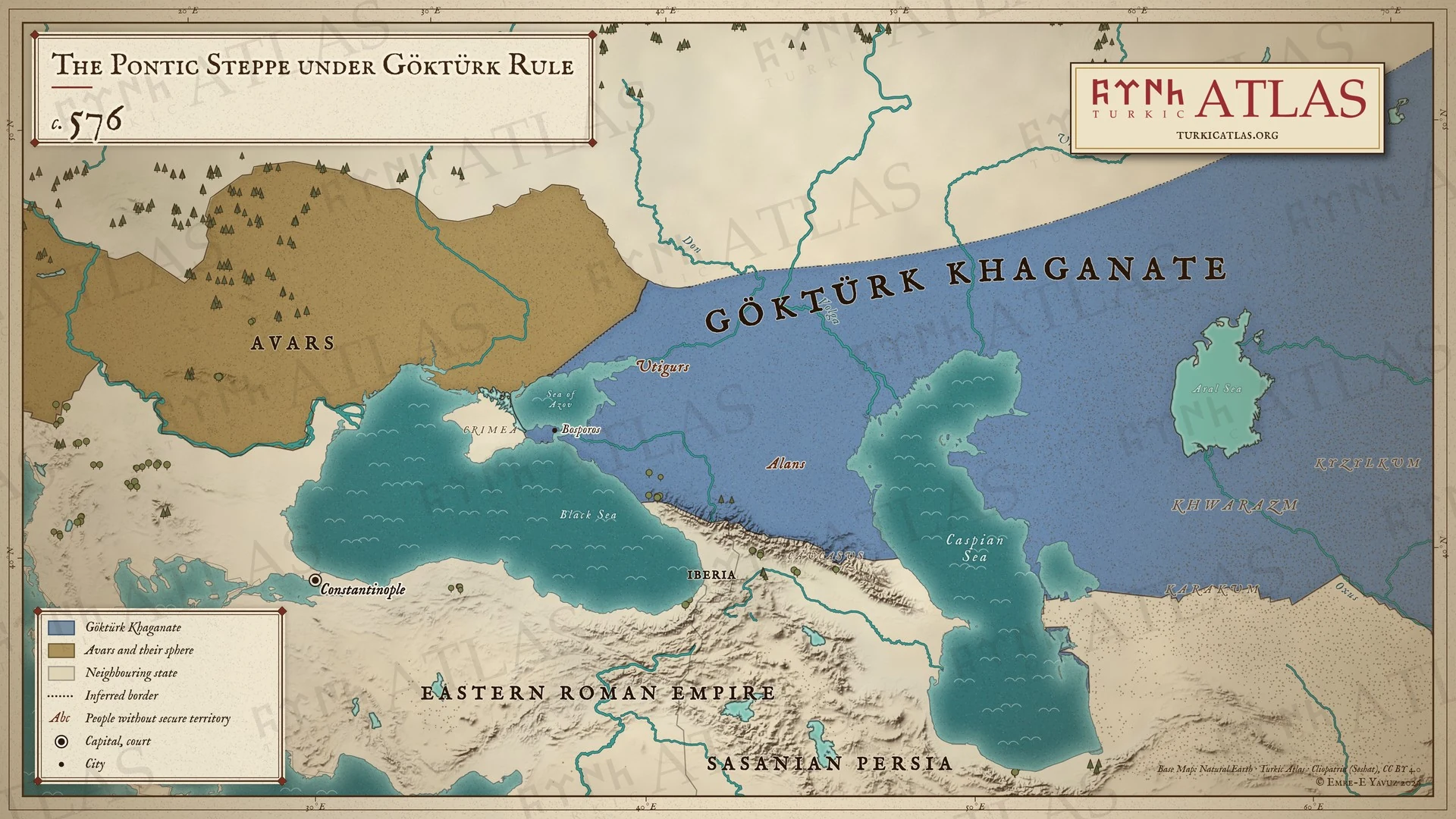
The Turkic tribes in Europe were the peoples of Turkic speech or Turkic leadership who held the steppe between the Volga, the Caucasus and the lower Danube from the fifth to the seventh century.[1] They came in waves.[1] The Oguric peoples arrived about 463. In the sixth century the Hunnic unions of the Utigurs and the Kutrigurs held the country by the Sea of Azov.[2] The Sabirs held the north Caucasus. The Avars came through in the 550s, in flight from the Göktürks.[3] From the 560s most of these peoples stood under the hegemony of the Göktürks.[4] In 576 a Göktürk army with its Utigur subjects took the Roman city of Bosporos in the Crimea.[5] When Göktürk power in the west broke in the seventh century, the Bulgars and the Khazars took its place.[6]
The migration of about 463
About 463 the Saragurs, the Ogurs and the Onogurs sent envoys to the eastern Romans.[7] Priscus says that these peoples had been driven from their seats in a fight with the Sabirs, whom the Abares had expelled in turn.[8] The Abares had themselves been forced out by peoples from the shore of the Ocean. These peoples fled from sea mists and from a multitude of griffins.[8] The griffins are a detail taken from Herodotus.[7] The chain of displacement ran from Inner Asia to the Pontic steppe. The wars of the War-Huns and the expansion of the Rouran about 450 set it off.[9]
The new arrivals spoke a form of Turkic that differed markedly from the Turkic of the runic inscriptions.[10] These Oguric languages survive today only in Chuvash and in the fragments of Volga and Danubian Bulgar.[10] Some scholars tie the Oguric tribes to the Dingling, whom the Chinese sources later call the Tiele. They have the Sabirs push them from the Kazakh steppe.[10] A Syriac list of peoples of the mid-sixth century counts Onogur, Ogur, Sabir, Bulgar, Kutrigur, Avar and Saragur each under its own name.[11]
Ogurs
The Ogurs are the people whose name the others share. Onogur, Saragur, Utigur and Kutrigur have all been explained as compounds of Ogur.[12] The name corresponds to Oguz under the regular correspondence of r and z. The two peoples are not thereby one.[13] After 463 the Ogurs are named again only in the accounts of the Avar and Göktürk conquests.[14]
When the Roman envoy Zemarchos came back from Istemi about 570, he crossed the Emba, the Ural and the Volga and came to the Ugurs.[15] Their chief, Menander says, “maintained there the power of Dizaboulos”, that is, of Istemi. He gave the Romans water skins for the desert crossing.[5] Some scholars regard these Ugurs as Ogurs west of the Volga. Their ruler was the khagan’s deputy there.[16] An old emendation reads Utigurs in the passage instead.[17]
Onogurs
The Onogurs settled north of the Caucasus and by the Sea of Azov, where the geographer of Ravenna still knew a patria Onogoria.[18] Jordanes knew them as the Hunuguri, the people from whom the trade in marten skins came.[19] Some scholars make Onogur a federation of ten tribes, which took in the Bulgars, the Utigurs and the Kutrigurs.[20] A second holds that there is no direct evidence for when or how the Onogurs joined the Bulgars. Later Byzantine writers join their names as Onogundur-Bulgars.[21] A third takes the Onogurs for an Ugric people with a Turkic name.[22]
The Onogurs fell with the Ogurs first under the Avars and then under the Göktürks.[23] Some scholars find them among the peoples that Turxanthos claimed as slaves in 576.[16] The text printed by Dindorf has the Utigurs at that point.[24]
Saragurs
The Saragurs, the “White Ogurs”, came west with the Ogurs and the Onogurs.[11] About 467 they fell on the Akatziri and other peoples of the old Hunnic union.[11] Priscus then has the Saragurs, joined with the Akatziri and other peoples, lead an army against Persia.[25] They found the Caspian gates held by a Persian garrison. They turned aside into Iberia, ravaged it and raided the towns of Armenia.[25] The Saragurs were probably absorbed by stronger unions, perhaps by the Sabirs.[11]
Utigurs
The Utigurs held the steppe east of the Sea of Azov.[26] Their leader Sandilkhos told Justinian that the Kutrigurs spoke the same language, lived in the same tents and wore the same dress as his own people, and were their kinsmen.[5] Justinian set the Utigurs against the Kutrigurs all the same. The two peoples decimated one another.[14]
After a spell under the Avars the Utigurs came under Göktürk rule.[14] In 576 their ruler Anagai lay before Bosporos with a Göktürk force. Turxanthos sent the commander Bochan with a second, very large army to take the city.[5] Anagai had set a woman named Akkagas over the Scythians of that country.[5] The siege of Bosporos brought the Göktürk realm to the Crimea, its western limit.[27]
Kutrigurs
The Kutrigurs held the steppe west of the Sea of Azov and raided the Roman Balkans, in 551 under Chinialon and in 558 under Zabergan.[28] They passed under the Avars. In 568 the Avar khagan Baian sent ten thousand “Kutrigur Huns” across the Save into Dalmatia.[5] When the Avars fled west before the Göktürks, they took Kutrigur elements with them to Pannonia.[14] In 598 a Göktürk khagan wrote that the Tarniakh and the Kotzageroi had fled from the Göktürks to the Avar khagan’s people in Europe.[29] Some scholars identify the Kotzageroi with Kutrigurs.[30]
Sabirs
The Sabirs were the people who had driven the Oguric tribes west about 463.[8] By 515 they held the north Caucasus. Sabir mercenaries served both Rome and Persia.[31] Their origin and language are argued. The proposals range from Common Turkic and Oguric to Ugric.[32] In 558 the Avars destroyed the Sabirs, as Menander records. Yet Sabirs still fought for Rome and for Persia in the 570s south of the Caucasus.[5] After the Göktürk conquest of the region the Sabir union was probably reorganised with the Khazars at its head.[33]
Bulgars
The Bulgars appear first in 480, as allies of the emperor Zeno.[32] Their name is interpreted as “the disturbers”, from a Turkic verb meaning to stir or confuse.[32] Their origins are unclear.[34] The peoples brought under Göktürk organisation included elements of the Bulgars. How far and how long Göktürk rule over them reached is unclear.[4]
In the far west, the Onogur and Bulgar elements probably joined the great Tiele revolt against Göktürk rule at the beginning of the seventh century.[35] The breakdown of Göktürk power there was one of the conditions for the Bulgar state of Kubrat on the Kuban.[36] About 635 Kubrat threw off the overlordship of the Avars and allied with Heraclius.[37]
Avars
The Avars came into the Pontic steppe about 557 as refugees from the Göktürks.[38] Some twenty thousand of the nobility of the Rouran state fled west after it fell. From them most likely came the khagans and the ruling nobility of the Avars.[39][40] In 568 the Göktürk envoys at Constantinople reckoned the Avars who had fled from their rule at about twenty thousand.[5] Istemi himself had said that the Avars were neither birds nor fish, to escape the Göktürk swords through the air or under the sea. He said that he would fall on them once his war with the Hephthalites was over.[5]
In the Pontic steppe the Avars defeated or subdued the Sabirs, the Utigurs, the Kutrigurs and the Antes. In 567 and 568 they drove the Gepids out of Pannonia.[38] Theophylact reports that the Barsilt, the Onogurs and the Sabirs took the newcomers for the true Avars. According to him, the European Avars had wrongly assumed the name.[41] A mixed origin of the European Avars is one of the other proposals.[41] In 576 Turxanthos called the Avars the Göktürks’ runaway slaves and threatened to trample them under his horses’ hooves.[5]
Alans
The Alans were no Turkic people.[42] They were Iranian nomads. From the first century they had dominated the Iranian nomads of the western steppe. The Ossetians are probably their descendants.[42] The land road of the Göktürk embassies to Rome ran through their country. The Avar embassy of 558 reached the Romans through the Alan ruler Sarosios. Maniakh’s embassy of 568 crossed the lands of the Alans.[43] On Zemarchos’ return the Alan ruler Sarodios admitted the Göktürk envoys only after they had laid down their arms.[5] In 576 Turxanthos named the Alans first among the peoples who had resisted the Göktürks and now served them as slaves.[5]
The Göktürk order in the west
By the 560s the Göktürks had established their hegemony over the nomads of the western steppe.[4] Beyond the Volga the chief of the Ugurs held the country for Istemi about 570. The Alans and the Oromuschoi near them still kept some independence.[16] By 576 the Utigurs and the Alans were subject, and the Göktürk realm was divided into eight portions. Turxanthos, who ruled one of them, claimed that all the earth obeyed him from the rising of the sun to its setting.[5] He also knew, he said, where the Dnieper, the Danube and the Hebros flowed, and where the Avars had crossed into Roman land.[5]
The alliance with Rome turned on these peoples. Turxanthos’ chief grievance in 576 was that the emperor had made a treaty with the Avars.[5] The siege of Bosporos followed. Menander ends his account of the embassy of Valentinos in open war.[5] Some scholars have the Göktürks go on to besiege Cherson and hold the Crimea until 598.[44] In 598 a Göktürk khagan wrote to the emperor Maurice that he had subdued all the Ogor. He wrote that the Tarniakh and the Kotzageroi had fled from him to the Avars.[45]
Some scholars count this as the first time that all the Turkic peoples, from the Kirghiz in the east to the Ogurs and the Bulgars in the west, stood under one banner.[46]
The Khazar sequel
The Khazar khaganate grew out of the Göktürk order north of the Caucasus.[47] Some scholars have it arise under Göktürk overlordship after the fall of the Sabirs.[47] A second has the dominant Sabir union reorganised after the Göktürk conquest, with the Khazars at its head. It cites al-Masʿudi’s remark that the Khazars are called Sabir in Turkic.[33] The Romans called the Khazars, when they first met them, “the Turks from the east”.[48] Still others hold that Tong Yabgu and Börü Shad laid the foundation of the later Khazar realm with their conquests in the Caucasus in 627.[49]
The Oguric peoples who came west in 463 lived on in the Bulgars after the Göktürk order had gone. The successor of that order north of the Caucasus was the Khazar khaganate.
References
- ^ a b Golden 1992, p. 92-111
- ^ Golden 1992, p. 92-100
- ^ Golden 1992, p. 105-111
- ^ a b c Golden 1992, p. 128
- ^ a b c d e f g h i j k l m n o p Menander Protector
- ^ Golden 1992, p. 134-135,236
- ^ a b Golden 1992, p. 92
- ^ a b c Priscus; Müller 1851, fr. 30, p. 104
- ^ Golden 1992, p. 93
- ^ a b c Golden 1992, p. 95
- ^ a b c d Golden 1992, p. 97
- ^ Golden 1992, p. 97,99
- ^ Golden 1992, p. 96
- ^ a b c d Golden 1992, p. 100
- ^ Golden 1992, p. 129-130
- ^ a b c Golden 1992, p. 130
- ^ Menander Protector; Dindorf 1871, p. 55
- ^ Marquart 1903, p. 42-44
- ^ Jordanes; Mierow 1915, § 37, p. 60
- ^ Yavuz 2025, p. 105,137
- ^ Golden 1992, p. 102-103
- ^ Marquart 1903, p. 44-45
- ^ Golden 1992, p. 101
- ^ Menander Protector; Dindorf 1871, p. 87
- ^ a b Priscus; Müller 1851, fr. 37, p. 107
- ^ Golden 1992, p. 99
- ^ Yavuz 2025, p. 321
- ^ Golden 1992, p. 99-100
- ^ Theophylact Simocatta; Chavannes 1903, p. 248
- ^ Marquart 1903, p. 504
- ^ Golden 1992, p. 105-106
- ^ a b c Golden 1992, p. 104
- ^ a b Golden 1992, p. 236
- ^ Golden 1992, p. 103
- ^ Golden 1992, p. 134-135
- ^ Golden 1992, p. 135
- ^ Golden 1992, p. 245
- ^ a b Golden 1992, p. 111
- ^ Golden 2013, p. 62–63
- ^ al. 2022, e6
- ^ a b Golden 1992, p. 109
- ^ a b Golden 1992, p. 50,53
- ^ Golden 1992, p. 111,128
- ^ Yavuz 2025, p. 321,388
- ^ Theophylact Simocatta; Chavannes 1903, p. 247-248
- ^ Yavuz 2025, p. 389
- ^ a b Marquart 1903, p. 46
- ^ Marquart 1903, p. 47
- ^ Yavuz 2025, p. 363
Sources
- Menander Protector
- Theophylact Simocatta
- Jordanes (after Priscus and Ammianus Marcellinus)
- Priscus
Literature
- Peter B. Golden, An Introduction to the History of the Turkic Peoples (1992)
- Peter B. Golden, Some Notes on the Avars and Rouran (2013)
- Guido Alberto Gnecchi-Ruscone et al., Ancient Genomes Reveal Origin and Rapid Trans-Eurasian Migration of 7th Century Avar Elites (2022)
- Josef Marquart, Osteuropäische und ostasiatische Streifzüge (1903)
- Emre-E. Yavuz, The Gokturk Empire: 2nd Edition (2025)
- Édouard Chavannes, Documents sur les Tou-Kiue (Turcs) occidentaux (1903)
- Karl Müller (ed.), Fragmenta Historicorum Graecorum, Bd. IV (darin: Menandri Protectoris fragmenta, griechisch mit lateinischer Übersetzung) (1851)
- Ludwig Dindorf (ed.), Historici Graeci minores, Bd. II: Menander Protector et Agathias (1871)
- Charles Christopher Mierow, The Gothic History of Jordanes in English Version, with an Introduction and a Commentary (1915)
- anonymous, Chronicle of Pseudo-Zachariah Rhetor (ca. 568/569)
What links here2
Cite this article
Yavuz, Emre-E. “Turkic Tribes in Europe.” Turkic Atlas, revised 8 November 2026. https://turkicatlas.org/ethnicities/turkic-tribes-in-europe/
Last revised: 8 November 2026

