
Tonyukuk was the counsellor of Ilterish Khan, Kapgan Khan and Bilge Khan in turn.[1] He also commanded the armies of the Second Göktürk Khaganate. He led them over the Sayan against the Kirghiz and over the Altai and the Irtysh against the Türgesh.[1] He was the author of the inscription at Bain Tsokto.[2] In it he says, in the first person, that without Ilterish and without himself there would have been neither a realm nor a people.[3] He is the one man of the Göktürk centuries who speaks for himself and not for a dynasty.[4] The Tang court, which had its own reasons to measure him, called him in 725 “deep and full of stratagems, growing wiser with age, a man of the stamp of Li Jing and Xu Ji”.[4]
Sources
He is known from two sides that barely touch. His own inscription covers the years from 682 to the death of Kapgan in 716 and stops there. It tells of the rising, the march to Ötüken and the campaigns. It ends with a reckoning in which the reigning Bilge Khan is named, but nothing of his reign is told.[1] The Tang history’s chapter on the Göktürks names him for the first time in 716, as an old officer of Kapgan’s court whom the new khan recalled. It follows him to 725.[4] The stone gives the young man and the general, while the Chinese texts give the old man and the statesman. Neither source mentions what the other tells. The two Orkhon monuments cover the same forty years from the khan’s side. The Kül Tegin monument does not name him.[5] The Bilge Khan monument names him once. He stands in a list of the dignitaries of the court, in lines spoken by the khan’s son Tengri.[6]
Early life
“I myself was born into the realm of China. The Türk people were then subject to China.”[7] That is how the inscription opens. It is the one thing Tonyukuk says about his origins. It places his birth in the fifty years between 630 and 682, when the eastern Göktürks lived under Tang administration along the frontier. The Tang history’s statement that he was over seventy in 716 places it before 646. A boy born on the Chinese side of the frontier in the 640s, to a people the Chinese governed through their own chiefs, could have been raised in Chinese. He could also have known the Chinese court. Friedrich Hirth argued that this is what happened, and that Tonyukuk is the Ashide Yuanzhen of the Tang history. His argument rests on exactly that possibility.
The inscription says that he was born into the realm of China, which is a statement about the place of his birth.[1] One modern author draws from it that Tonyukuk was Chinese by descent.[8] The inscription does not say so.[1]
The name itself may be a title. One interpretation divides it into tun, “first-born, first”, and yukuk, which it relates to the Turkic word for a vizier. The name then means “chief vizier”, and its first vowel is u.[9] The spelling Tonyukuk, with o, is the one in general use.[1] Another interpretation divides the name into tuny and ukuk, “the one who understands”.[10]
Identification with Ashide Yuanzhen
The Tang history knows a Göktürk named Ashide Yuanzhen. In 682, he was in charge of the surrendered tribes under the Shanyu protectorate. The protectorate’s chief clerk had imprisoned him for some offence.[4] When Kutluk rose, Yuanzhen talked his way out by offering to bring the tribes back to order. He went straight over to the rebel, who was delighted. Kutluk made him Apa Tarkan and gave him sole command of the army.[4][11] Yuanzhen led the raids into Shanxi and the plain of Hebei beside Kutluk in 687.[4] In the afterword to the first edition of the inscription, Friedrich Hirth identified Yuanzhen with Tonyukuk. His grounds were the same clan, the same Chinese upbringing, the same position at the founder’s side, and a Chinese name, “First Treasure”, that might render the Turkic one. The identification is repeated elsewhere as a fact.[12][13]
The difficulty lies in the Tang history itself. In both its versions, Yuanzhen “later led troops against the Türgesh and died in battle”. This sentence stands before the notice of Kutluk’s own death in the early 690s.[4] Tonyukuk lived another thirty years and more. Either the history has misplaced a death, or Yuanzhen and Tonyukuk are two men. One of them fell against the Türgesh under Ilterish. The other fought the Türgesh under Kapgan and outlived them both. The equation therefore remains a position, not a finding. The Tang historians themselves could not decide it.
Rising (682)
The inscription gives the beginning as no other text does. The Türk people, in the land of the Türk Sir people, had no ordered body left. Those who had stayed out in the wilds gathered, seven hundred men, two-thirds of them mounted. The man who led them was a shad. “Be my spokesman,” he said, and Tonyukuk became his spokesman.[7] The older rendering, “Join me”, rests on a verb yay- that no Turkic language has.[14][15] Then comes the sentence on which his whole claim rests: “Shall I make him khan? I said, and I thought it over”. Next is the proverb of the lean bulls and the fat, which cannot be told apart from far off. Then: “because Heaven gave me understanding, I myself made him khan. With Bilge Tonyukuk Boyla Baga Tarkan at his side he became Ilterish Khan.”[7] The Kül Tegin inscription tells the same beginning in terms of seventeen men, who became seventy and then seven hundred. In it, Heaven raises the khan and the katun by the crown of the head.[5] It has no room for a kingmaker.[5]
The first seat of the restored state was Čogay Kuzı and Kara Kum, north of the Chinese frontier. There the people lived on deer and hare, and “our enemies were round about us like a hearth”.[1] A fugitive from the Oguz brought word of the coalition that the new khan of the Nine Oguz was building with China and the Kıtañ.[16] He also brought word of its object: “let no master arise in the land of the Türk Sir people.”[1] Tonyukuk’s answer was to strike first, while the enemy was thin, with two or three thousand men. This counsel gives the inscription its shape.[1] Ilterish told him to lead as his heart told him.[1] He crossed the Kök Öng and beat the Oguz on the Tola, with two thousand men against an army put at three or six thousand.[17][18][19] He brought khan and people into the Ötüken land. After that, the peoples of the four quarters came in.[20] That march is the moment when the frontier rising became the Second Khaganate. Tonyukuk claims it as his own.
Under Ilterish and Kapgan
By his own account, he was Ilterish’s counsellor and commander through seventeen battles with the Chinese, seven with the Kıtañ and five with the Oguz.[21][22] He was the first to bring a Göktürk army to the towns of Shantung and the sea. There the khan sacked twenty-three towns.[23][24] The inscription names a “Shandong town”, which some scholars take for the capital of the province.[24] The Tang history, from the other side of the line, records the same raids year by year, together with their cost. In 687, a Chinese pursuit force of thirteen thousand was destroyed to the last man beyond the frontier.[4]
His greatest campaigns fell under Kapgan, whom the inscription calls Bögü Khan in one passage and Kapgan in the rest. The Chinese emperor, the khan of the Ten Arrows and the khan of the Kirghiz agreed to meet on the Altai and destroy the eastern khan. Tonyukuk chose to strike the Kirghiz first.[25][26] It was winter. The way went over the Kögmen by a single-horse track that a guide of the Az knew.[27] The guide was killed for losing the way. The army came down the Anı, fell on the Kirghiz in their sleep and killed their khan.[28] Kapgan had gone home to bury the katun. Inel Khan and the Tardush Shad were at the head of the army. An order came from the khan to stay in the Altai and do nothing.[29] A secret order went to Apa Tarkan not to let Tonyukuk move.[29] Tonyukuk moved. He crossed the Altai where there was no road and the Irtysh where there was no ford, and fell on the Türgesh at Bolchu at first light.[29] The begs wanted to turn back from an army said to be a hundred thousand strong. The speech before the battle is the most quoted passage of the stone: “Why should we flee? Why should we be afraid because they are many? Let us attack!”[30] The Türgesh khan was taken, and his yabgu and shad were killed. The Ten Arrows submitted. The army went on across the Pearl River to the Iron Gate, where the Sogdians came in. The army carried home gold and silver.[31] The Tang history dates Kapgan’s destruction of the Türgesh khan Suoge to 710 or 711 and credits it to Kapgan. The inscription credits it to Tonyukuk.[4]
According to one translation of line 51, Tonyukuk says in the first person that he himself seated Kapgan on the throne.[32] Another translation takes the verb as “sat” and has Kapgan take the throne without an agent.[33]
Under Bilge Khan
In 716, Kapgan was killed, and Kül Tegin put his brother on the throne. Kül Tegin killed the whole of Kapgan’s court.[4] Only Tonyukuk was spared, because his daughter was the new khan’s katun. He was dismissed and sent back to his tribe.[4][34] Within the year, the Xi and Khitan were going over to China, Sulu of the Türgesh was setting himself up as khan, and Bilge Khan’s own tribes were wavering. Bilge Khan recalled Tonyukuk as chief counsellor. Tonyukuk was already over seventy. The people, the history says, held him in great awe.[4][35][36] The title the Tang history gives him in this office, mouzhu, means the planner or strategist of the state.[4][36]
What the Tang history preserves of his counsel is a policy. Bilge Khan wanted to raid China while the defectors were coming back. Tonyukuk said that the Tang ruler was able, the harvest good and the people united. He also said that an army newly gathered and still weak should rest for some years and watch for its chance.[4] Bilge Khan wanted to build walled towns and to found Buddhist and Taoist temples. Tonyukuk said no. The Göktürks, he argued, were not a hundredth part of the Tang in numbers. What had always let them resist was that they moved in search of water and grazing, had no fixed dwelling, lived by the bow and were all trained to arms.[4][37][38] When strong, they advanced and plundered. When weak, they hid in the mountains. The Tang armies then had nowhere to use their weight. Towns would change the old custom and, on the day of a lost battle, deliver the people to the Tang. The teaching of the temples made men gentle and weak, which was not the way of arms.[39][40] The khan and his lords, the history says, thought the counsel deeply right.[4] It is the theory of the whole nomadic state. The south face of the Kül Tegin inscription, carved a decade later, says the same thing in the khan’s voice.[12]
In 720, the Tang planned a three-sided attack on the royal camp, with the Basmïl from Beiting in the west and the Xi and Khitan from the east.[4] Tonyukuk said that the three were too far apart to combine and that the Chinese army could not reach the camp. If the Tang army did come after all, he said, the khan’s tent could simply be moved three days north, and the Tang soldiers would run out of food and go away by themselves.[4] The Xin Tang Shu has the whole people withdraw northward three days ahead.[41][42] The Basmïl, greedy and light, would come first and alone, he said, and could be dealt with.[4][43] In the autumn of 721, the Basmïl came alone. They took fright and withdrew.[4] Tonyukuk forbade a battle against men a thousand li from home who would fight to the death. He followed them. He sent a detachment by a side road to take Beiting before they reached it. When they found the city gone, he captured the whole force.[4] On the way home, he came out at Chiting and stripped Liangzhou of its sheep and horses.[4] Yang Jingshu, the governor of Liangzhou, sent a deputy general and an aide against him. Tonyukuk said that if Jingshu held his walls he would offer peace, and that if Jingshu took the field they would fight and win. At Shandan, wind and snow numbed the Tang archers, who lost their bows and arrows, and the Tang army was beaten. Jingshu lost his offices.[4][44] It is the one campaign of his that both sides describe. The two descriptions agree about the man.
The last notice is of 725.[4] The emperor set out for the sacrifice on Mount Tai, and the chancellor Zhang Yue asked whether to raise troops against the Göktürks. Zhang Yue named three men as the reason for fear.[4] They were the khan, humane and loved; Kül Tegin, bold and unbeaten; and Tonyukuk, deep and full of stratagems, growing wiser with age, of the stamp of the great Tang generals Li Jing and Xu Ji. “If these three act with one mind, none of their moves will miscarry.”[4] The court’s remedy was to summon a Göktürk minister to attend the emperor as a hostage of honour. The khan sent one.[4]
After that, the sources say nothing more about him. His daughter outlived him into the regency of the 740s. As the mother of the boy khan Tengri, she and her lover ran the state until it broke.[4] The date of his death is not recorded. His own monument was cut while he lived. Wilhelm Radloff took it to have been raised in 716, Vilhelm Thomsen at about 720.[45]
The stone gives no date. In line 56 Tonyukuk says that he has grown old, and the Tang history has him over seventy in 716. One dating therefore puts the stone five to ten years after 716, between 720 and 725. Another puts it in 726 or a little later.[35]
A Chinese grave inscription of a Uyghur family named Hsieh claims Tonyukuk as its ancestor. It makes him a Chinese who went over to the Göktürks in the Sui period, and it has his daughter come to China with her people after the death of Bilge Khan. Both statements disagree with the Tang history, in which he was over seventy in 716 and his daughter ran the state for her son in the 740s.[46]
Inscription and its claims
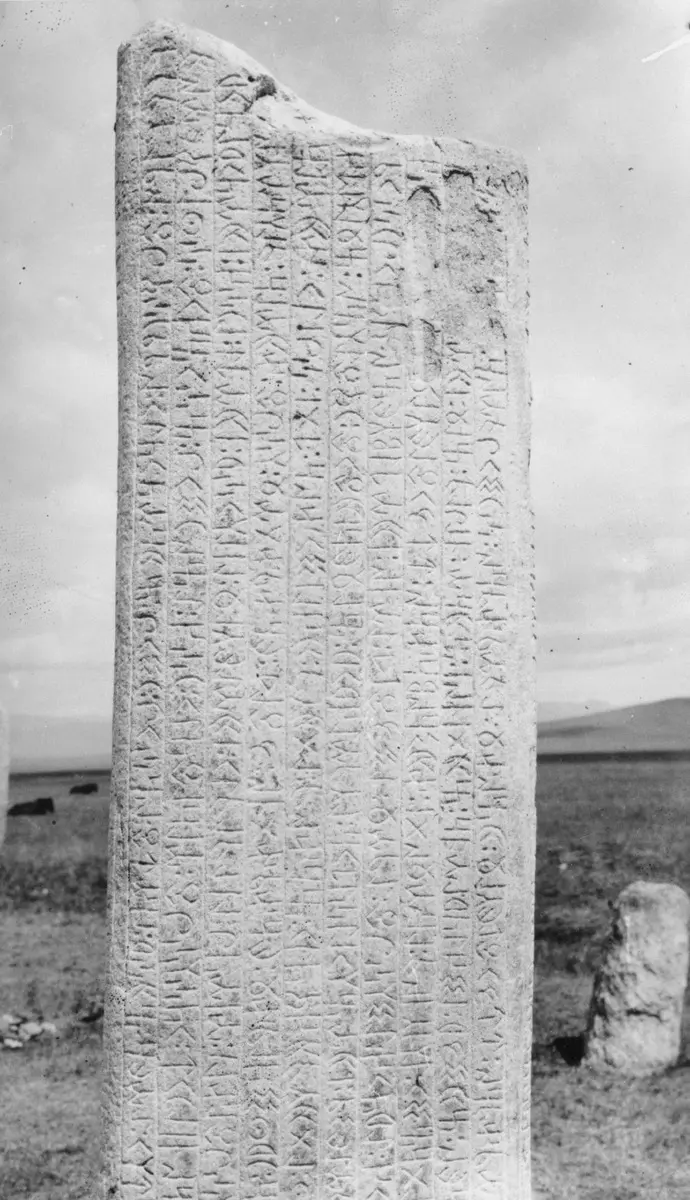
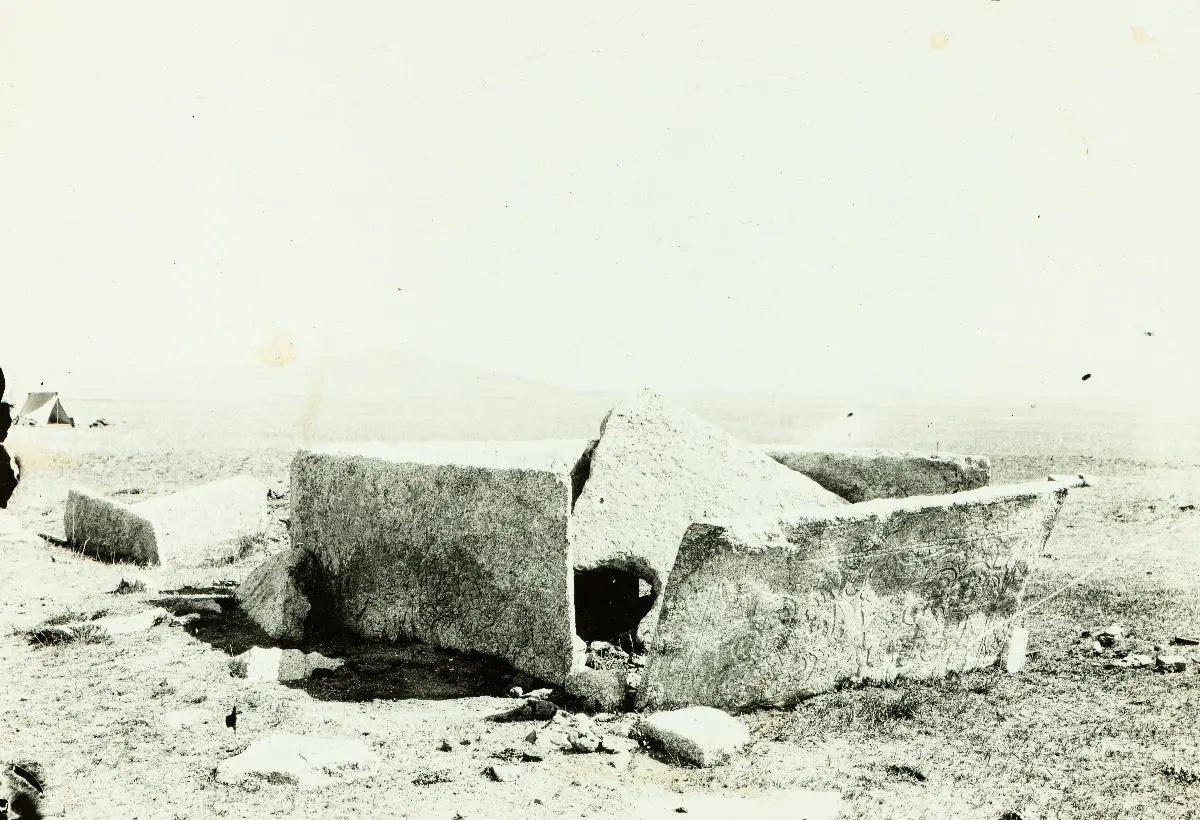
His inscription is the counsellor’s theory of the state. Turkic Atlas sets the text out in full under the inscription. Its refrain is “his khan is brave, his counsellor is wise”. It occurs five times, three of them in the mouths of the enemy.[1] The stone has been taken as a defence. Tonyukuk was spared in 716 because he was the khan’s father-in-law, but he had been removed from office. His inscription lists his services to the state one by one, and it dwells on the deeds of Ilterish and Kapgan.[47] The closing lines say that without Ilterish and without Tonyukuk “there would be no clan, no people, no man, and no master at all”. They also say that Bilge Khan now sits on the throne because the two of them toiled.[1] One translation ends the list with the master. Another takes the last word as an adverb and has “neither tribes, nor people, nor human beings at all”.[48] The Kül Tegin inscription, cut a few years later by the dynasty, gives the same restoration to Heaven and to the khan’s father and uncle. It gives the same battles to Kül Tegin. It does not name the counsellor.[5] The Tonyukuk stone does not name Kül Tegin, and the Kül Tegin stone does not name Tonyukuk.[49] The Bilge Khan stone names the counsellor once, in a list, and tells none of his deeds.[6] That is the state of the evidence. It says something about the court of Bilge Khan that no chronicle records.
References
- ^ a b c d e f g h i j k l Tonyukuk inscription
- ^ Tonyukuk inscription; Tekin 1994, vii, 23
- ^ Tonyukuk inscription; Tekin 1968, p. 289–290
- ^ a b c d e f g h i j k l m n o p q r s t u v w x y z aa ab Jiu Tangshu (Old Book of Tang), juan 194
- ^ a b c d Kül Tegin inscription
- ^ a b Bilge Khan inscription; Tekin o. J., p. 79–80
- ^ a b c Tonyukuk inscription; Tekin 1968, p. 283
- ^ Ögel 2015, p. 391
- ^ Tekin 1994, p. 25
- ^ Erhan 2011, p. 22
- ^ Taşağıl 2004, p. 13–14
- ^ a b Golden 1992
- ^ Taşağıl 2004, p. 13
- ^ Tezcan 1975–1976 (Ankara 1976), p. 174
- ^ Tekin 1994, p. 27
- ^ Tekin 1994, p. 5, 32
- ^ Tekin 1994, p. 8–9
- ^ Orkun 1994, p. 104–105
- ^ Taşağıl 2004, p. 14
- ^ Tonyukuk inscription; Tekin 1968, p. 285
- ^ Tonyukuk inscription; Tekin 1968, p. 289
- ^ Tonyukuk inscription; Tekin 1994, p. 21
- ^ Tonyukuk inscription; Tekin 1994, p. 9
- ^ a b Ögel 2000, p. 181
- ^ Tonyukuk inscription; Tekin 1968, p. 285–286
- ^ László 1950, p. 38
- ^ Tonyukuk inscription; Tekin 1968, p. 286
- ^ Tonyukuk inscription; Tekin 1968, p. 286–287
- ^ a b c Tonyukuk inscription; Tekin 1968, p. 287
- ^ Tonyukuk inscription; Tekin 1968, p. 288
- ^ Tonyukuk inscription; Tekin 1968, p. 288–289
- ^ Tekin 1994, p. 21
- ^ Orkun 1994, p. 117
- ^ Taşağıl 2004, p. 41–42
- ^ a b Tekin 1994, ix
- ^ a b Taşağıl 2004, p. 43
- ^ Ögel 2000, p. 177, 179
- ^ Barthold 2004, p. 18
- ^ Kwanten 1979, p. 46
- ^ Roux 1994, p. 18
- ^ Xin Tangshu (New Book of Tang), juan 215
- ^ Ögel 2000, p. 45–48
- ^ Taşağıl 2004, p. 46–47
- ^ Taşağıl 2004, p. 47
- ^ Radloff 1899; Thomsen 1924
- ^ Ögel 1993, p. 78–79
- ^ Tekin o. J., p. 14–15
- ^ Tekin 1968, p. 290, 334
- ^ Tonyukuk inscription; Kül Tegin inscription
Sources
- Tonyukuk inscription
- Jiu Tangshu (Old Book of Tang), juan 194
- Xin Tangshu (New Book of Tang), juan 215 (after Jiu Tangshu)
- Kül Tegin inscription
- Bilge Khan inscription
Literature
- Wilhelm Radloff, Die alttürkischen Inschriften der Mongolei. Zweite Folge: Die Inschrift des Tonjukuk (1899)
- Friedrich Hirth, Nachworte zur Inschrift des Tonjukuk. Beiträge zur Geschichte der Ost-Türken im 7. und 8. Jahrhundert nach chinesischen Quellen (1899)
- E. Denison Ross (after Vilhelm Thomsen), The Orkhon Inscriptions; The Tonyukuk Inscription. Being a Translation of Professor Vilhelm Thomsen's Final Danish Rendering (1930)
- Peter B. Golden, An Introduction to the History of the Turkic Peoples (1992)
- Talât Tekin, A Grammar of Orkhon Turkic (1968)
- Talât Tekin, Tunyukuk Yazıtı (1994)
- Hüseyin Namık Orkun, Eski Türk Yazıtları (1994)
- Talât Tekin, Orhon Yazıtları. Kül Tigin, Bilge Kağan, Tunyukuk (o. J.)
- Ahmet Taşağıl, Gök-Türkler, Bd. III (2004)
- Bahaeddin Ögel, Türk Kültür Tarihine Giriş I: Türklerde köy ve şehir hayatı (2000)
- Bahaeddin Ögel, Türk Kültür Tarihine Giriş VII: Türklerde ordu, ordugah ve otağ (2000)
- Bahaeddin Ögel, Büyük Hun İmparatorluğu Tarihi I (2015)
- Bahaeddin Ögel, Türk Mitolojisi (Kaynakları ve açıklamaları ile destanlar) I (1993)
- V. V. Barthold, Orta Asya Türk Tarihi Dersleri (Orta Asya Türk Tarihi Hakkında Dersler) (2004)
- Luc Kwanten, Imperial Nomads. A History of Central Asia, 500–1500 (1979)
- Jean-Paul Roux, Türklerin ve Moğolların Eski Dini (1994)
- Ferenc László, Dokuz Oğuzlar ve Gök Türkler (1950)
- Aydın, Erhan, Yenisey Yazıtlarında Geçen Unvanlar ve Unvan Niteleyicileri (2011)
- Semih Tezcan, Tonyukuk Yazıtında Birkaç Düzeltme (1975–1976 (Ankara 1976))
What links here47
- Persons
- Ashide Yuanzhen · Bars Beg · Bilge Khan · Ilterish Khan · Kül Tegin · Pofu Katun · Right Shad (d. 741) · Sulu Khan · Tengri Khan
- States
- Second Göktürk Khaganate
- Conflicts
- Göktürk war of restoration, 679–687 · Kapgan's wars with the Tang, 698–716 · Kapgan's western war, 709–713 · The revolt of the subject peoples, 714–716
- Battles & Events
- Battle of Bolchu · Bilge Khan's Tent Banquet (725) · Göktürk campaign against the Kirghiz (710) · The coup of 716
- Peoples
- Az · Basmïl · History of the Turkic peoples
- Lineages
- Ashide
- Institutions and Titles
- Apa Tarkan · Baga · Katun · Livestock Raids · Ordu · Roof Tiles of the Uyghur Khaganate · Seasonal Pastures · Tarkhan · The Economy of the Steppe Empires · Tölis and Tardush · Women among the Turkic Peoples
- Foods
- Steppe Diet
- Customs & Pastimes
- Hunting among the Göktürks · Mounted Archery · The New Year on the Steppe
Cite this article
Yavuz, Emre-E. “Tonyukuk.” Turkic Atlas, revised 8 November 2026. https://turkicatlas.org/persons/tonyukuk/
Last revised: 8 November 2026

