
Shelun made the Rouran a khaganate. According to some scholars, the word is his: before Shelun, the steppe had known the chanyu of the Xiongnu and the chiefs of the Xianbei. In their view, he took a title that no one had used before, and every ruler of the steppe for the next eight hundred years took it from him, the Göktürk first among them. The Wei Shu is the only account of his life. It tells the story as the rise of a bandit.[1]
Flight and fratricide
In Shelun’s youth, the Rouran were a subject people of the Tuoba. They were divided into two parts: an eastern part under Pihouba and a western part under his younger brother Yunhedi, Shelun’s father.[1] When Yunhedi went over to the Wei’s enemy Liu Weichen, the Wei emperor Daowu hunted the Rouran across the desert in the Dengguo years. He broke them at the foot of Mount Chuang south of the great sands and took half the people.[1] Among the prisoners, Daowu captured Yunhedi’s sons Heduohan and Shelun with several hundred of their kin. The captives were distributed among the Wei tribes.[1]
In 394 Heduohan and Shelun took their people and fled west, abandoning their father. The Wei general Zhangsun Fei rode after them with light horse. He caught them at Mount Bana in Shangjun. He killed Heduohan and destroyed his following.[1] Shelun escaped with a few hundred men to his uncle Pihouba. Pihouba settled him on the southern edge of his country, five hundred li from his court. He set four of his own sons to watch Shelun.[1]
The history tells what followed with something like admiration. Shelun seized the four sons and attacked his uncle. The uncle’s other sons fled to the Hulü tribe of the Gaoche. After a month, Shelun released the hostages, “wishing to gather them all and destroy them”. Then he fell on Pihouba by surprise and killed him.[1] Fifteen of the dead man’s sons went over to the Wei and were made generals and marquises.[1] Shelun feared a Wei army and plundered the tribes west of Wuyuan. He then crossed the great desert to the north.[1]
A modern account tells the same story as a rise within the family.[2] In this account, Shelun fled to his uncle and grew in power among his kin. He killed his cousins and, at last, the uncle. With both the family and the Wei against him, he crossed the Gobi and gathered new followers on the way.[2]
Founding of the khaganate
North of the desert, Shelun invaded the Gaoche, the Turkic-speaking Tiele. He went deep into their country and absorbed their tribes. His power grew.[1] The Gaoche chapter of the same history shows how close this rise came to failing.[1]
The Gaoche chief Beihouli judged that Shelun’s newly gathered people were poor in arms and horses. He attacked and overran Shelun’s camp. His men, greedy for the spoil, divided the tents and took the women.[1] Shelun watched from a height. He gathered a thousand of the scattered men and fell on the Gaoche at dawn. Barely two or three in ten of them escaped.[1]
Shelun moved north to the Ruoluo river. There he laid down a military law.[1] A thousand men made an army under a general. A hundred made a banner under a captain.[1] The first man into the enemy received the spoils. A man who flinched was killed with a stone to the head or flogged on the spot.[1] The Rouran had no writing. The commanders counted their men roughly with sheep droppings and later learned to notch wood.[1] A Xiongnu remnant to the north-west, rich and strong under a chief named Bayeji, attacked Shelun. Shelun met them on the Egen river and broke them. Afterwards he absorbed them entirely.[1]
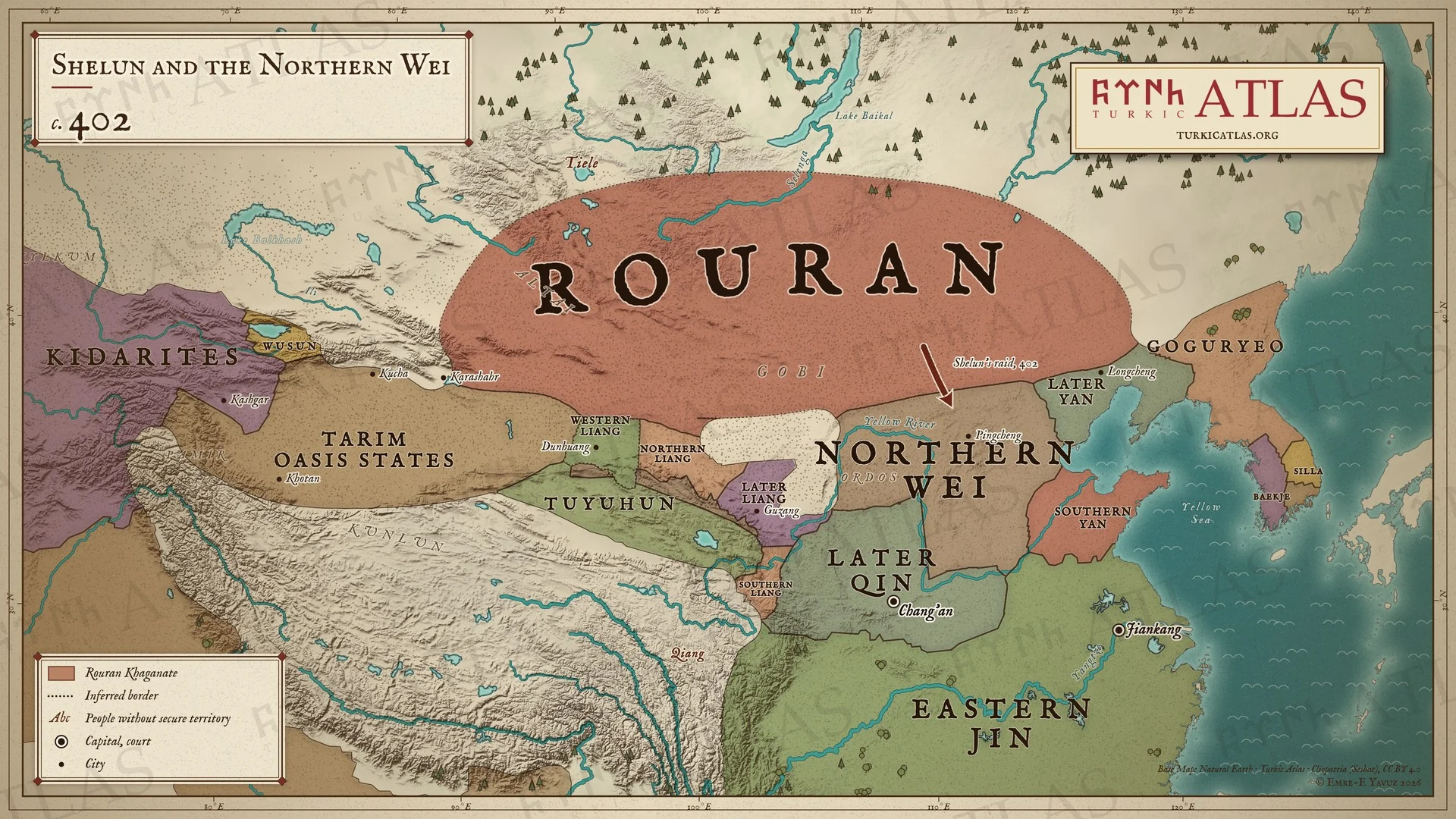
The history then gives the extent of his state.[1] In the west it extended to the land of Karashahr, in the east to the land of Korea, in the north across the desert to the Hanhai, and in the south to the great sands. His usual court lay north of Dunhuang and Zhangye.[1] The small states, suffering his raids, submitted to him.[1] A modern account describes the Rouran state in these years as reaching from Liaodong in the east to the Tian Shan in the west, and from Lake Baikal in the north to the Great Wall in the south.[3] He called himself Qiudoufa Khan. The Wei glossed the title as “to drive and to open out”. Khan, they added, meant what the Chinese meant by emperor.[1][4] The Bei Shi writes the title Doudai Khan, with the same gloss.[5][6] The chapter adds that among the Rouran, a ruler’s or minister’s title was taken from his conduct and ability in his lifetime, as the Chinese give a posthumous name. It was not changed after death.[1]
The history gives no year for the title. It does give the order of events. The Wei Shu tells of Shelun’s conquests after the year 394, then says that he styled himself Qiudoufa Khan, and only then tells of his raid of 402.[1] The Bei Shi keeps the same order.[5] Some scholars take this order to place the adoption of the title between 394 and 402.[7][6] By contrast, his reign is dated 402 to 410. The khaganate is conventionally dated from about 400.[8] Some scholars hold that the Gaoche had migrated to northern and western Mongolia to escape or soften the severity of Tuoba rule. They hold that many nomads, caught between the Tuoba and the expanding Rouran, chose the less confining ties of the latter.[8]
Whether Shelun was the first to bear the title is disputed. Some scholars hold that he was. They take the earlier cases in the Chinese annals for later projections onto earlier chiefs. In their view, Shamohan, the Tuoba ancestor of 261, bore han as part of a personal name. The cry “Chu, khan” that the Song Shu gives the Tuyuhun is a story of the Song period. The tale of the Qifu ancestor Qifu Khan was made up from a tribal name.[9] They add that the Tang compiler Du You already remarked on the Rouran title that khan began there.[10][11] Others find the title among the Xianbei already in 261 and again in 278, more than a century before Shelun.[12]
The emperor Daowu’s verdict on him is preserved. The Rouran, he told his minister Cui Xuanbo, had once been stupid.[1] When they raided, they harnessed cows to flee and drove the bulls after them. When the cows lay down, an outsider advised them to change to bulls. They refused, saying that if the mother could not walk the calf could not either, and so they were captured.[1] Now Shelun had learned from China. He had made laws, drawn up battle lines and become a danger on the frontier. “The Daoists say that when a sage is born a great robber arises; it is true.”[1]
War with the Wei and death
In 402, Shelun heard that Daowu had marched against Yao Xing of the Later Qin. He broke into the frontier, entered the Canhe marsh and reached Mount Chai and the northern lake of Shanwu. Ten thousand Wei horse pursued him and did not catch him.[1] He made a marriage alliance with Yao Xing.[1] In the Tianci years, his cousins Yuedai and Dana plotted to kill him and set Dana up. The plot was discovered, and the plotters fled to the Wei. The Wei made them generals.[1] Shelun raided the frontier again in the summer of 406 and in the winter of 409.[1] In 410 the emperor Mingyuan marched against him. Shelun fled and died on the road.[1]
A modern account tells the end differently. Shelun had captured one of the emperor’s advisers in a raid. In May 410, Mingyuan led an army in person to free him. Shelun died of his wounds in the battle.[2]
His son Duba was too young to lead. The tribes set up Shelun’s brother Hulü instead.[1]
Assessment
Everything the Rouran state was for a century and a half, Shelun made in about fifteen years. He made the title, the army of thousands and hundreds, the seat north of the Gobi, the subjection of the Gaoche and the claim to the whole steppe from Karashahr to Korea. One modern account compares the Rouran state in its stance towards the Wei beyond the Wall with the Xiongnu of Modu in their stance towards the Han.[3] The Wei Shu meant its story of the runaway slave’s descendant as a slight. The history it goes on to tell undoes that slight. A bandit could found this state, and it lasted until 552. It was therefore a state. What he founded the Göktürks inherited whole. Turkic Atlas says how under the khaganate.
References
- ^ a b c d e f g h i j k l m n o p q r s t u v w x y z aa ab ac ad ae af ag Wei Shu, juan 103
- ^ a b c Yavuz 2025
- ^ a b Kurakichi 1926, p. 15
- ^ Kurakichi 1926, p. 7
- ^ a b Bei Shi (History of the Northern Dynasties), juan 98
- ^ a b Kurakichi 1945, p. 504
- ^ Kurakichi 1926, p. 7–8
- ^ a b Golden 1992
- ^ Kurakichi 1926, p. 1–7
- ^ Tongdian
- ^ Kurakichi 1926, p. 8
- ^ Mau-tsai 1958, Turkish edition
Sources
- Wei Shu, juan 103
- Bei Shi (History of the Northern Dynasties), juan 98 (after Wei Shu, Zhou Shu and Sui Shu)
- Tongdian (after Sui Shu and Zhou Shu)
Literature
- Peter B. Golden, An Introduction to the History of the Turkic Peoples (1992)
- Emre-E. Yavuz, The Gokturk Empire: 2nd Edition (2025)
- Shiratori Kurakichi, A Study on the Titles Kaghan and Katun (1926)
- Shiratori Kurakichi (übers. İbrahim Gökbakar), Kaghan Unvanının Menşei (1945)
- Liu Mau-tsai, Çin Kaynaklarına Göre Doğu Türkleri (1958, Turkish edition)
What links here19
- Persons
- Buluzhen Khan · Datan Khan · Futu Khan · Hulü Khan · Mugulü
- States
- Northern Wei · Rouran Khaganate
- Battles & Events
- Proclamation of Bumin Khan (552)
- Places
- Mumocheng
- Lineages
- Yujiulü
- Institutions and Titles
- Tally Sticks and the Golden Arrow
- Languages
- Chinese transcriptions of Turkic
- Sources
- Wei Shu
- Controversies
- The origin of the title Khan
Cite this article
Yavuz, Emre-E. “Shelun Khan.” Turkic Atlas, revised 8 November 2026. https://turkicatlas.org/persons/shelun-khan/
Last revised: 8 November 2026

