
In 552 Bumin, the leader of the Ashina, took the title Illig Khan after he had destroyed the army of the Rouran.[1] He gave his wife the title katun.[1] The Zhou Shu compares the two titles with the chanyu and the yanzhi of the Xiongnu of old.[1] With the proclamation the Göktürks, until then subjects of the Rouran, had a khan of their own.
The victory
In the first month of the first year of the Wei emperor Fei, which is 552, Bumin attacked the Rouran. He crushed them north of Huaihuang.[1] Anagui, the Rouran khan, killed himself.[1] His son Anluochen fled to the Qi. The rest of the Rouran raised Anagui’s uncle Dengshuzi as their ruler.[1] The Zhou Shu goes on without a break: Bumin thereupon called himself Illig Khan.[1] The Zizhi tongjian enters the victory and the title together under the first month of 552.[2]
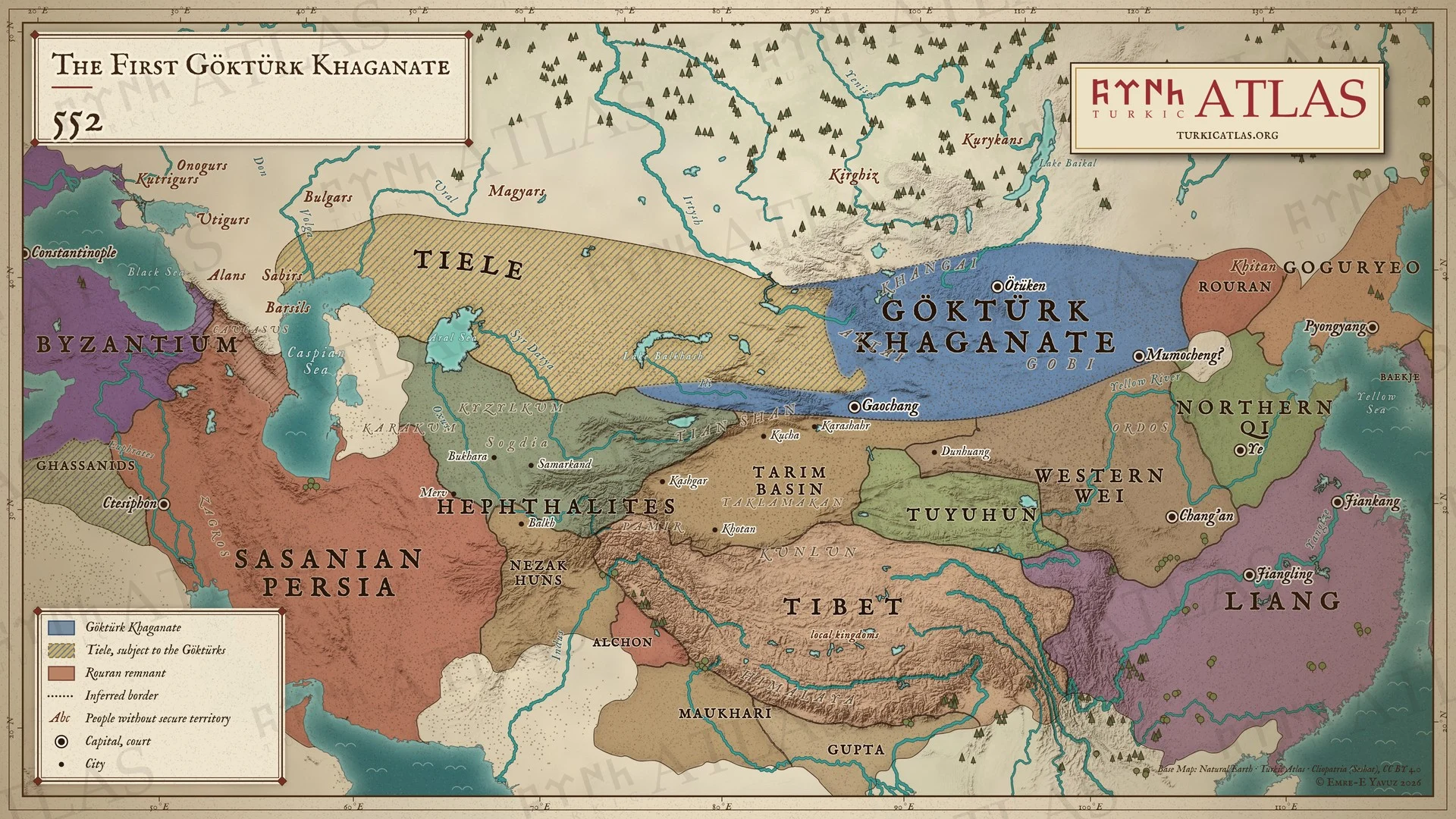
One account follows Bumin into the sacred forest of Ötüken in April 552, the old centre of Rouran power.[3] The same account has him take the khan’s title there, and with it the name Illig Khan.[4] The Chinese histories do not say where the proclamation took place.[1]
The title
The Zhou Shu writes the title 伊利可汗 and calls it the equivalent of the chanyu, the title of the Xiongnu rulers.[1] The Bei Shi repeats the sentence and adds that Bumin also exchanged envoys with the Qi.[5] The Sui Shu knows him only by the title. At the end of the Wei, it says, there was an Illig Khan who struck the Tiele, asked the Rouran for a bride and broke them.[6] The Tongdian adds in a note that the Rouran ruler Shelun had already called himself khan in the time of the Wei emperor Taiwu. The Göktürks took the title over from the Rouran.[7] A modern translation doubts this tradition, because the title khan is already recorded among the Xianbei in 261 and 278.[8]
The Chinese histories do not explain the first element, 伊利.[9] Modern scholars differ. Some render the title “ruler of the lands”.[4] Others identify 伊利 with the Turkic illig, “having a realm”, and understand the title as “the khan who has a realm”.[10]
Katun, tegin and shad
The Zhou Shu gives the wife’s title as 可賀敦 and compares it with the yanzhi, the consort of the Xiongnu ruler.[1] Some scholars compare the Chinese transcription with the Sogdian xwatēn, “wife of the ruler”.[11] The Chinese histories do not name the woman.[1] Bumin had married Changle, a princess of the Western Wei, in the sixth month of 551.[1] One account names her as the wife who became katun and calls the katun a kind of co-empress.[12]
In the same entry the Zizhi tongjian adds two more titles. The khan’s sons and younger brothers were called tegin, and those who led troops apart from him were called shad.[2] The Tongdian gives the same two titles directly after the proclamation and follows them with the great offices of the state.[7]
Aftermath
Bumin did not hold the title long. The Zhou Shu follows the proclamation directly with his death and the accession of his son Keluo, who took the title Issik Khan.[1] Two centuries later the Göktürks still began their own history with him. The Kül Tegin inscription says that over the sons of men sat the forefathers Bumin Khan and Istemi Khan, who held and ordered the realm and the law of the Göktürk people.[13]
The first word of the title returned a generation later. When Bumin’s grandson Ishbara was raised to the throne in 581, his title began with the same 伊利.[14] The title of 552 stands at the head of the line of Göktürk khans.
References
- ^ a b c d e f g h i j k l m Zhou Shu (Book of Zhou), juan 50
- ^ a b Zizhi tongjian (Comprehensive Mirror in Aid of Governance), juan 164
- ^ Yavuz 2025, p. 227
- ^ a b Yavuz 2025, p. 254
- ^ Bei Shi (History of the Northern Dynasties), juan 99
- ^ Sui Shu (Book of Sui), juan 84
- ^ a b Tongdian, juan 197
- ^ Mau-tsai 1958, Turkish edition, p. 18
- ^ Zhou Shu (Book of Zhou), juan 50; Tongdian, juan 197
- ^ Golden 1992, p. 115
- ^ Golden 1992, p. 148
- ^ Yavuz 2025, p. 448
- ^ Kül Tegin inscription
- ^ Sui Shu (Book of Sui), juan 84; Tongdian, juan 197; Zizhi tongjian (Comprehensive Mirror in Aid of Governance), juan 175
Sources
- Zhou Shu (Book of Zhou), juan 50
- Bei Shi (History of the Northern Dynasties), juan 99 (after Wei Shu, Zhou Shu and Sui Shu)
- Sui Shu (Book of Sui), juan 84
- Tongdian, juan 197 (after Sui Shu and Zhou Shu)
- Zizhi tongjian (Comprehensive Mirror in Aid of Governance), juan 164, 175 (after Wei Shu, Zhou Shu, Sui Shu and Bei Shi)
- Kül Tegin inscription
Literature
- Emre-E. Yavuz, The Gokturk Empire: 2nd Edition (2025)
- Peter B. Golden, An Introduction to the History of the Turkic Peoples (1992)
- Liu Mau-tsai, Çin Kaynaklarına Göre Doğu Türkleri (1958, Turkish edition)
What links here2
- Battles & Events
- Battle of Mount Mulai (553)
- Institutions and Titles
- Illig
Cite this article
Yavuz, Emre-E. “Proclamation of Bumin Khan (552).” Turkic Atlas, revised 8 November 2026. https://turkicatlas.org/events/proclamation-of-bumin-khan-552/
Last revised: 8 November 2026

