
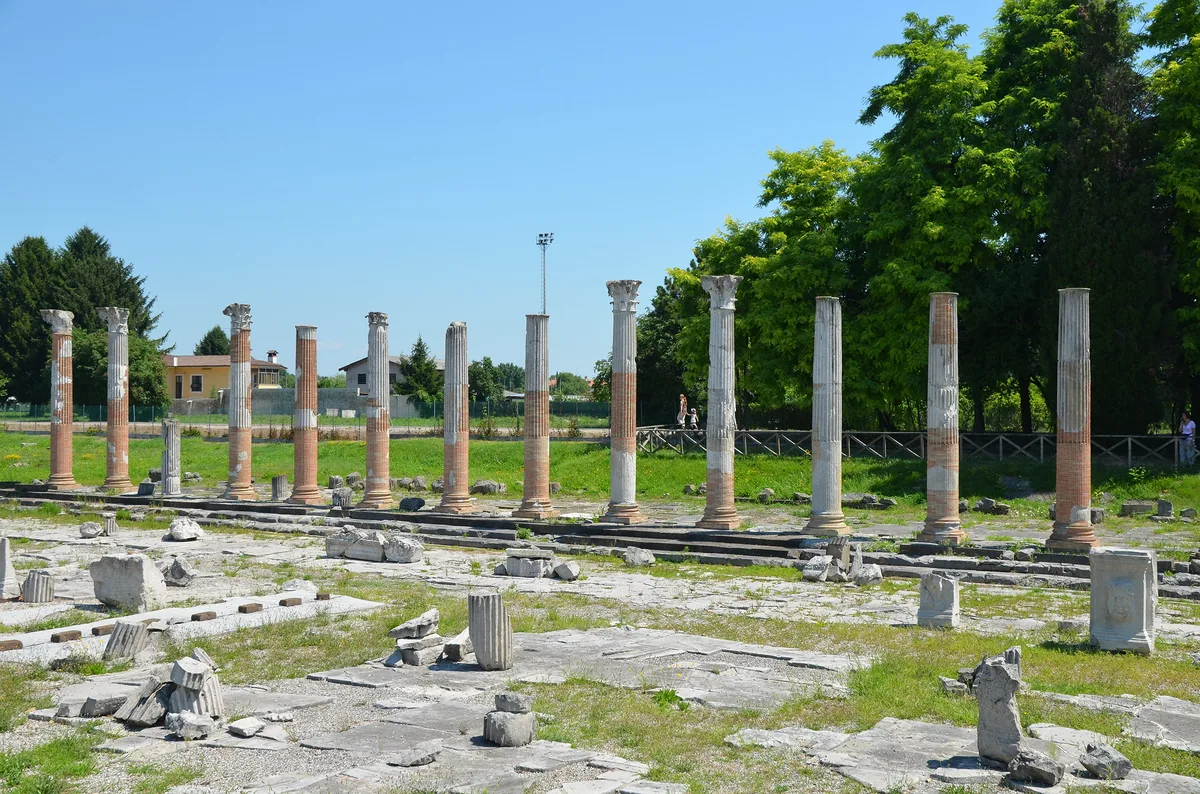
Aquileia was the chief city of Venetia, at the head of the Adriatic.[1] It was the first city that Attila attacked when he invaded Italy in 452. It fell to the Huns after a long siege.[2][3] The first fighting for Italy took place either in the valley of the Isonzo or before its walls.[4]
The city
Jordanes calls Aquileia the metropolis of Venetia.[1] It stood on a point or tongue of land by the Adriatic. On its eastern side the river Natissa, flowing down from Mount Piccis, washed its walls.[1] The Natissa is the modern Natisone. Mount Piccis is named nowhere else.[5] The city had often been besieged, but it was said never to have been stormed or forced to surrender.[6] Attila, coming down from the Julian Alps, could not bypass so strong a fortress. Its garrison seems to have been strengthened in expectation of the siege.[4]
The siege of 452
In 452 Attila moved against the Romans of the western empire. His first move was to besiege Aquileia.[1][7] The siege was long and fierce. The bravest soldiers of the Romans held out within the walls. Attila’s army grew discontented and wanted to withdraw.[8] Attila was walking round the walls, weighing whether to break camp. He saw the white storks that nest in the gables of the houses carrying their young out of the city into the country, against their custom.[9] He told his soldiers that the birds foresaw the future and were leaving a city that was about to perish. “Do not think this a meaningless or uncertain sign,” he said.[10]
His men attacked again. They built engines of war and forced their way into the city. They plundered it, divided the spoil and laid it waste so cruelly that, Jordanes writes, scarcely a trace of it was left to be seen.[10] The chronicle of Cassiodorus records under 452 that Attila entered Aquileia after hard fighting. The chronicle of Prosper says nothing of its capture.[5]
Attila may have sent for those of his subject peoples who were skilled in siegecraft. They built the engines before which the city fell.[6] Another explanation is that the engines were built by Roman deserters or prisoners, and that only then were the walls breached and the city stormed.[4] Within a few years even the order of events was forgotten. The Chronicle of 511 has the Huns take Aquileia on their way back from Gaul.[11] If the story of the storks holds a kernel of truth, the city fell at the end of August or early in September.[12] According to Pliny the storks leave Italy after 23 August, and the siege is said to have lasted three months.[12] It is doubtful, however, that the story permits such a dating. The story is better seen as a sign of the awe in which Attila’s subjects held him.[12]
The storks
The story of the storks is taken to come from Priscus, whom Jordanes followed here.[12] It may be a story invented to explain the pause in the siege and its renewal, of the kind that Priscus told when he had no genuine information.[6] A second traces it to a Chinese history.[13] In 384 the general Lü Guang, besieging Kucha, dreamed that a golden image flew away over the city walls. He read it as a sign that the Buddha and the gods were deserting the defenders.[13] Stories of this kind are unknown in Europe. In that case it was the Huns who brought them from the East.[13]
After the fall
From Aquileia the Huns raged through the other cities of Venetia. Milan and Ticinum suffered the same fate in the invasion of Italy.[14] Aquileia may have been razed and never risen again, so that in the following century hardly a trace of it could be seen.[15][6] Another suggestion is that it was so thoroughly destroyed that its historic site became hard to determine.[16] A third counts Jordanes’s words an exaggeration.[4] Those who could not flee in time were killed or carried off. Within a few years, however, the city was again the seat of a bishop, and by the middle of the sixth century it had long been rebuilt.[17] Its walls were not restored. Theoderic the Ostrogoth in 489 and the general Narses in 552 marched past it.[17] In the sixth century a basilica with a splendid mosaic floor was built there. The metropolitan of Aquileia ranked with those of Milan and Ravenna.[18]
The people of the devastated cities fled to the islands of the lagoon at the mouths of the Piave and the Brenta, where Venice later grew.[16][5] In March 458 Nicetas, bishop of Aquileia, asked Pope Leo for advice about the men and children whom the Huns had carried off and who had come back from captivity.[19] Leo ruled that wives who had remarried in their absence should return to their first husbands.[19] The destruction of the city was long remembered.[6]
References
- ^ a b c d Jordanes; Mierow 1915, § 219, p. 112
- ^ Jordanes; Mierow 1915, § 219–221, p. 112–113
- ^ Maenchen-Helfen 1973, p. 135–136
- ^ a b c d Maenchen-Helfen 1973, p. 136
- ^ a b c Mierow 1915, p. 174
- ^ a b c d e Thompson 1948, p. 145
- ^ Maenchen-Helfen 1973, p. 135
- ^ Jordanes; Mierow 1915, § 220, p. 112
- ^ Jordanes; Mierow 1915, § 220, p. 112–113
- ^ a b Jordanes; Mierow 1915, § 221, p. 113
- ^ Maenchen-Helfen 1973, p. 132–133
- ^ a b c d Maenchen-Helfen 1973, p. 133
- ^ a b c Maenchen-Helfen 1973, p. 134
- ^ Jordanes; Mierow 1915, § 222, p. 113
- ^ Bury 1923, p. 294–295
- ^ a b Yavuz 2025, p. 102
- ^ a b Maenchen-Helfen 1973, p. 136–137
- ^ Maenchen-Helfen 1973, p. 137
- ^ a b Maenchen-Helfen 1973, p. 142
Sources
- Jordanes (after Priscus and Ammianus Marcellinus)
Literature
- Charles Christopher Mierow, The Gothic History of Jordanes in English Version, with an Introduction and a Commentary (1915)
- Otto J. Maenchen-Helfen, The World of the Huns: Studies in Their History and Culture (1973)
- E. A. Thompson, A History of Attila and the Huns (1948)
- J. B. Bury, History of the Later Roman Empire from the Death of Theodosius I to the Death of Justinian, vol. I (1923)
- Emre-E. Yavuz, The Gokturk Empire: 2nd Edition (2025)
What links here3
- Persons
- Attila
- States
- Hunnic Empire
- Conflicts
- Hunnic invasion of Italy, 452
Cite this article
Yavuz, Emre-E. “Aquileia.” Turkic Atlas, revised 8 November 2026. https://turkicatlas.org/places/aquileia/
Last revised: 8 November 2026

