
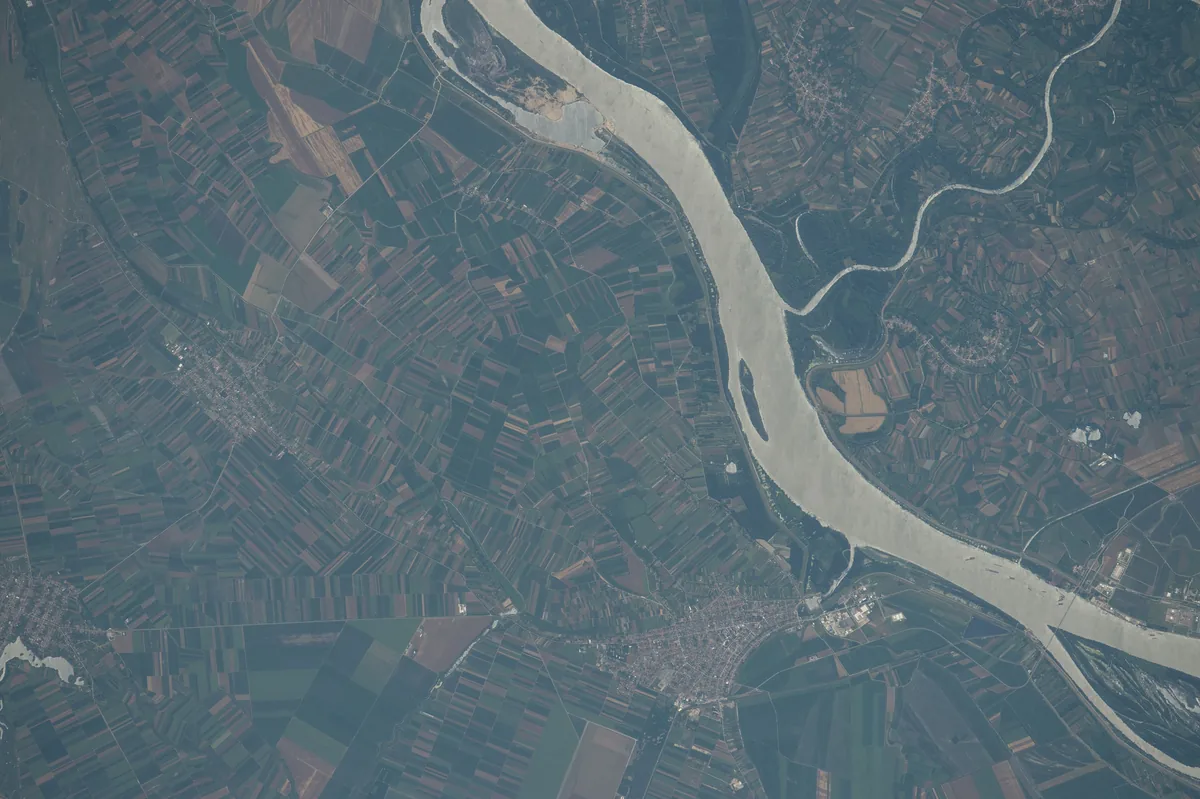
Margus was a Roman city on the Danube in Moesia Superior, near the point where the river Margus, the modern Morava, joins it.[1][2] Priscus calls it a city of the Moesians in Illyricum on the Ister, opposite the fort of Constantia on the other bank.[3] The site lies near the modern village of Dubravica, east of Belgrade.[4][2] Outside its walls the brothers Bleda and Attila made their first treaty with the eastern empire of Theodosius II. A few years later its own bishop handed the city over to them.[5]
The city
Its position near the mouth of the Morava made Margus an important trading centre.[1] More than a century and a half before the Huns came, an obscure soldier named Diocles had risen to fame there by defeating the emperor Carinus.[1] The road from Sirmium through Singidunum, Margus and Viminacium to Naissus was, for military purposes, the only one that joined Pannonia Secunda and Moesia Superior to Thrace. Margus was the key to the valley of the Morava.[6] Beyond Margus the road ran on along the Danube to Viminacium, then turned south up the Morava toward Naissus.[7]
Some scholars hold that the Hun kings had their residence on the far bank opposite Margus from the time of Uldin. The residence, they say, stayed there until the 440s.[8] Others reject this, because Uldin led only a fraction of the Huns and ruled no great state north of the Danube.[8]
The treaty
After the death of the Hun king Rua, the Roman envoys Plintha and Epigenes came to Margus, where the royal Scythians had gathered.[3] The two sides met outside the city on horseback. The Huns would not talk dismounted. The Romans, mindful of their dignity, would not speak on foot to men in the saddle.[3] The treaty of Margus doubled the yearly tribute to 700 pounds of gold. It bound the Romans to return the fugitives. It promised markets held on equal terms and in safety for both peoples.[3] One reckoning dates it to 435. A second reckoning dates it after November 438.[9][10]
The bishop and the fall of the city
In 441 the Huns fell on the Romans at a crowded market on the Danube and killed many of them.[11][12] When the Romans protested, the Huns answered that they were avenging wrongs. They said that the bishop of Margus had crossed into their land. He had searched out the royal treasury and the hidden treasures and plundered them. Unless the Romans handed him over together with the fugitives, there would be war.[11] In one translation of the Greek the bishop had robbed the royal tombs.[13] The Romans denied the charge.[14] The Huns refused any arbitration. They crossed the Danube and did great damage to the towns and forts along the bank. They took Viminacium.[14]
Many now said that the bishop should be handed over, so that the whole Roman state would not run the risk of war for the sake of one man.[14] The bishop suspected that he would be surrendered.[14] He slipped away to the enemy without the townspeople knowing. He promised to betray the city if the kings of the Scythians rewarded him generously.[14] They promised every reward. Both sides gave their hands and swore oaths.[14] He came back with a large force of barbarians and hid it in ambush on the opposite bank. At night, at a signal, it rose. The bishop handed the city over to the enemy.[14] Priscus does not name the city at this point. The summary of the fragment in the edition calls it Margus.[15] “And from that time,” Priscus writes, “the affairs of the barbarians grew greater and better day by day.”[14]
Together with Margus the Huns took the fortress of Constantia across the river.[16] Some scholars place the fall of Margus in 441, in the first campaign of the Balkan wars. Others place it in 442, after a truce. They hold that the fall opened the way up the Morava to Naissus.[17][6] The edition of Priscus dates the fragment to 442.[15] Margus shared the fate of Viminacium, but it was never rebuilt.[16] Procopius knows nothing of it. What became of its bishop is unknown.[16]
Margoplanum
Jordanes names a city called Margoplanum, which lay between the Danube and the Margus.[18] Near it Pitza, a count of the Ostrogothic king Theoderic, came with two thousand foot and five hundred horse to help Mundo against Sabinian, the master of the soldiers of Illyricum. Pitza destroyed the army of Illyricum.[18] Mundo traced his descent from the Attilani of old.[19] The Goths came to his aid in 505.[20] The form Margoplanum occurs nowhere else. The city was probably one of the two towns of Upper Moesia, Margus or Horrea Margi.[21]
References
- ^ a b c Thompson 1948, p. 74
- ^ a b Bury 1923, p. 267
- ^ a b c d Priscus; Müller 1851, fr. 1, p. 72
- ^ Maenchen-Helfen 1973, p. 90
- ^ Priscus; Müller 1851, fr. 1–2, p. 72–73
- ^ a b Maenchen-Helfen 1973, p. 116
- ^ Bury 1923, p. 267–268
- ^ a b Thompson 1948, p. 60
- ^ Thompson 1948, p. 75
- ^ Maenchen-Helfen 1973, p. 93
- ^ a b Priscus; Müller 1851, fr. 2, p. 72
- ^ Maenchen-Helfen 1973, p. 109–110
- ^ Maenchen-Helfen 1973, p. 110
- ^ a b c d e f g h Priscus; Müller 1851, fr. 2, p. 73
- ^ a b Müller 1851, p. 70
- ^ a b c Thompson 1948, p. 81
- ^ Thompson 1948, p. 80–81
- ^ a b Jordanes; Mierow 1915, § 300, p. 137–138
- ^ Jordanes; Mierow 1915, § 301, p. 138
- ^ Mierow 1915, p. 185
- ^ Mierow 1915, p. 186
Sources
Literature
- Karl Müller (ed.), Fragmenta Historicorum Graecorum, Bd. IV (darin: Menandri Protectoris fragmenta, griechisch mit lateinischer Übersetzung) (1851)
- Charles Christopher Mierow, The Gothic History of Jordanes in English Version, with an Introduction and a Commentary (1915)
- Otto J. Maenchen-Helfen, The World of the Huns: Studies in Their History and Culture (1973)
- E. A. Thompson, A History of Attila and the Huns (1948)
- J. B. Bury, History of the Later Roman Empire from the Death of Theodosius I to the Death of Justinian, vol. I (1923)
What links here6
- Persons
- Attila
- Conflicts
- Attila's Balkan wars
- Battles & Events
- Treaty of Margus
- Places
- Naissus · Viminacium
- Institutions and Titles
- Diplomacy of the Steppe Empires
Cite this article
Yavuz, Emre-E. “Margus.” Turkic Atlas, revised 8 November 2026. https://turkicatlas.org/places/margus/
Last revised: 8 November 2026

