
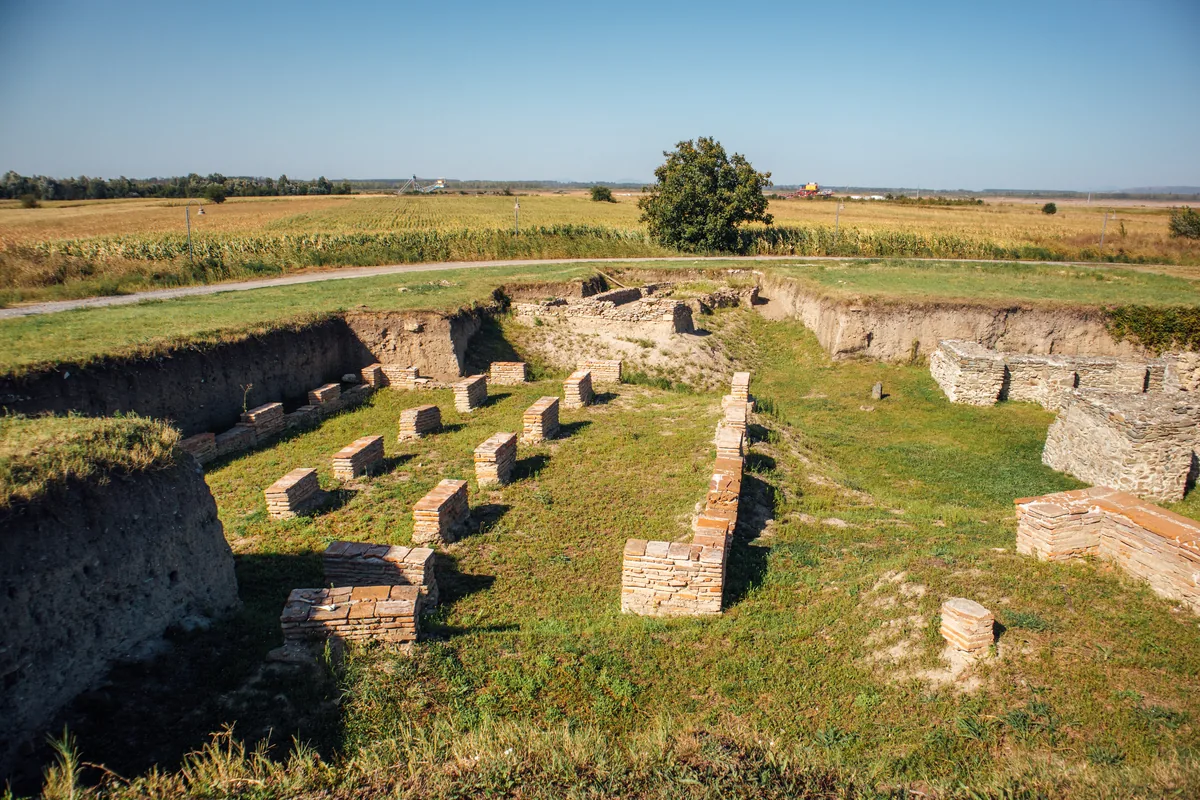
Viminacium was a Roman city on the Danube in Moesia Superior, close to the modern Kostolac.[1][2] Priscus calls it a city of the Moesians in Illyricum on the Ister.[3][4] In 441 it was the first great city that the Huns took in the Balkan wars. They razed it to the ground.[5]
The city
Viminacium was an important station of the Danube flotilla.[2] It lay on the road from Sirmium through Singidunum, Margus and Viminacium to Naissus. For military purposes this was the only road that joined Pannonia Secunda and Moesia Superior to Thrace.[6] Coming from Margus along the Danube, the traveller turned south at Viminacium and went up the Morava toward Naissus.[7]
The fall of 441
In 441 the Huns fell on the Romans at a frontier market and demanded that the bishop of Margus and the fugitives be handed over to them.[8][9] The Romans denied their charges.[3] The Huns refused any arbitration and turned to war.[3] They crossed the Danube and did great damage to the towns and forts along the bank. Among other places they took Viminacium.[3] Priscus says nothing more of how the city fell.[10] Two modern accounts place its fall in 441, at the opening of the war. The edition of Priscus dates the fragment to 442.[11][6][12]
The city was razed to the ground. Procopius, writing a century later, says that the old city of Viminacium had long ago been destroyed from the very bottom of its foundations. The site stayed desolate until Justinian rebuilt it.[10] The local magistrates had found time to bury the city treasury before the end. They never came back for it. A find of no fewer than 100,000 coins has since rewarded the archaeologists.[10] The citizens who survived the storm were led away into captivity.[10] After the fall of Viminacium many said that the bishop of Margus should be handed over, so that the whole Roman state would not run the risk of war for one man.[3] The bishop went over to the Huns and betrayed his city to them.[3]
The merchant of Viminacium
In 449 Priscus travelled with the embassy of Maximinus. He was waiting outside the house of Onegesius at Attila’s residence when a man in Scythian dress greeted him in Greek. The man’s head was shaved all round.[4][13] He was a Greek by birth. He had gone to Viminacium as a merchant, lived there a long time and married a rich wife.[4] When the city was taken he lost his fortune. Because he was rich, he fell to Onegesius in the division of the booty. The leading men after Attila, he explained, set aside the richer captives for themselves.[4]
He later fought bravely against the Romans and against the Akatziri.[4] He handed over to his master everything he had won in war, as the custom of the Scythians required. He thus regained his freedom.[4] He married a barbarian wife and had children by her. He shared Onegesius’s table and thought his new life far better than his old.[4] Life among the Romans, he told Priscus, was ruined in war by the cowardice of the generals and by tyrants who did not let everyone bear arms.[4] In peace it was ruined by harsh taxes, by laws that did not bind the rich and powerful, and by having to pay the judge to obtain justice.[14] Priscus answered with a long defence of the Roman order.[15] The Greek wept. He said that the laws and the constitution of the Romans were good, but that the magistrates, less upright than those of old, were ruining the state.[15]
His story helps to date events at the Hun court.[16] He may have been taken in 441. In that case he fought against the Romans in 442 or more probably 443 and against the Akatziri in 445. From this the death of Bleda is dated to 445.[16] A second dating has him fight the Romans in 443 and 447 and the Akatziri in 448.[17] He can also be seen as a witness to the trade of the frontier towns. He had prospered in Viminacium in the 430s, and the wars of the 440s ruined the traders of these towns.[18] Captives of the Huns could serve their masters in war until they bought their freedom with their share of the booty, as he did. Most captives, however, were sold to Roman slave dealers.[19]
References
- ^ Maenchen-Helfen 1973, p. 110
- ^ a b Bury 1923, p. 268
- ^ a b c d e f Priscus; Müller 1851, fr. 2, p. 73
- ^ a b c d e f g h Priscus; Müller 1851, fr. 8, p. 86
- ^ Thompson 1948, p. 80, 185
- ^ a b Maenchen-Helfen 1973, p. 116
- ^ Bury 1923, p. 267–268
- ^ Priscus; Müller 1851, fr. 2, p. 72
- ^ Maenchen-Helfen 1973, p. 109–110
- ^ a b c d Thompson 1948, p. 80
- ^ Thompson 1948, p. 185
- ^ Müller 1851, p. 70
- ^ Maenchen-Helfen 1973, p. 105
- ^ Priscus; Müller 1851, fr. 8, p. 86–87
- ^ a b Priscus; Müller 1851, fr. 8, p. 87–88
- ^ a b Maenchen-Helfen 1973, p. 104–105
- ^ Thompson 1948, p. 184–185
- ^ Thompson 1948, p. 175, 212
- ^ Maenchen-Helfen 1973, p. 199
Sources
Literature
- Karl Müller (ed.), Fragmenta Historicorum Graecorum, Bd. IV (darin: Menandri Protectoris fragmenta, griechisch mit lateinischer Übersetzung) (1851)
- Otto J. Maenchen-Helfen, The World of the Huns: Studies in Their History and Culture (1973)
- E. A. Thompson, A History of Attila and the Huns (1948)
- J. B. Bury, History of the Later Roman Empire from the Death of Theodosius I to the Death of Justinian, vol. I (1923)
What links here6
- Persons
- Attila
- States
- Hunnic Empire
- Conflicts
- Attila's Balkan wars
- Peoples
- Huns
Cite this article
Yavuz, Emre-E. “Viminacium.” Turkic Atlas, revised 8 November 2026. https://turkicatlas.org/places/viminacium/
Last revised: 8 November 2026

