
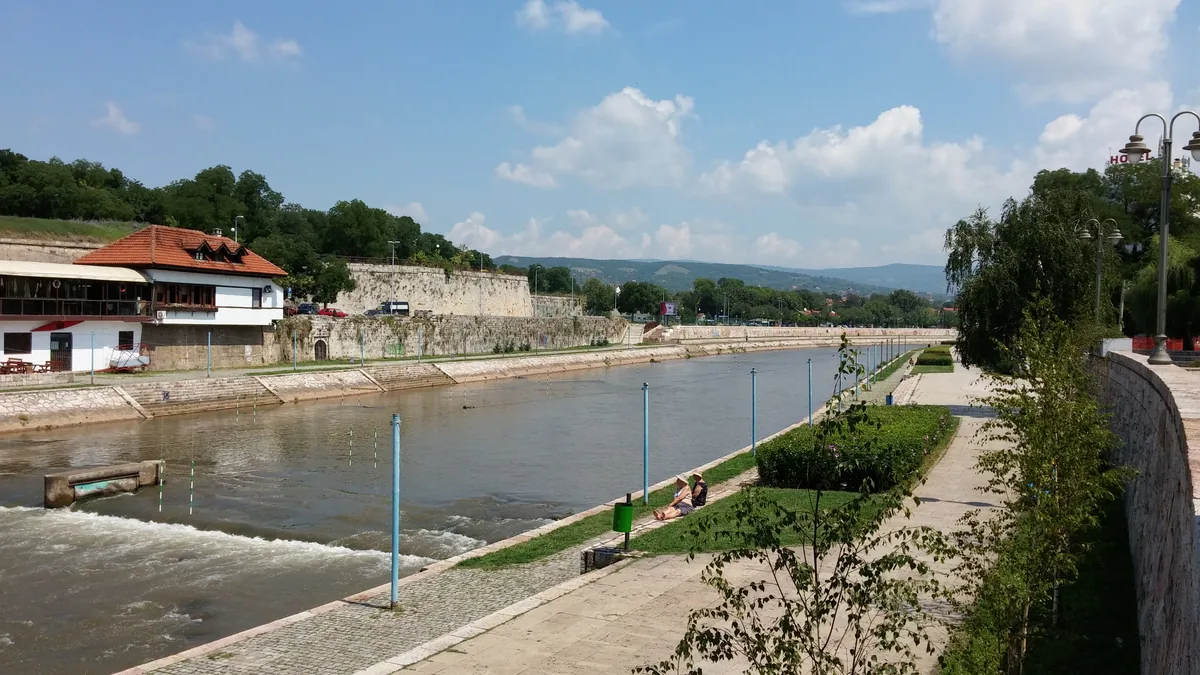
Naissus, the modern Niš, was a Roman city on the right bank of the Nišava in Dacia Mediterranea. It was the birthplace of the emperor Constantine.[1] The Huns took and destroyed it in the Balkan wars of the 440s.[2][3] Attila then demanded it as the market and frontier town between his realm and the empire.[2] Priscus found it deserted when he passed through in 449.[4][5]
The city
Naissus held a position of great strategic importance. It was the seat of an imperial arms factory and was thickly populated.[1] Many roads met there. Its walls were so strong that no enemy had ever taken it before the Huns.[6] For military purposes, the road from Sirmium through Singidunum, Margus and Viminacium to Naissus was the only one that joined Pannonia Secunda and Moesia Superior to Thrace.[3] From the Danube the way led up the valley of the Morava to Naissus. From there it led south-east to Serdica and on to Constantinople.[1][6]
The capture
The chronicler Marcellinus records under 441 that the kings of the Huns broke into Illyricum and laid waste Naissus, Singidunum and other cities.[7] Some scholars place the fall of Naissus in 442. Once Margus, the key to the Morava valley, had fallen, the Huns pushed south and took the city.[3] Others place the fall in 443. The Huns then rode up the Morava after destroying Ratiaria on the Danube.[1]
The accounts of the fall differ as well. Some scholars hold that the inhabitants made a brave defence. Even so, the city yielded to Attila’s machines and the missiles of a countless host.[8] A second holds that the Huns now had rams and other siege engines and used them freely. As a result, Naissus fell without great effort.[9] A third holds that an encounter outside the walls was enough to seal the city’s fate.[1] Priscus wrote an account of the siege of Naissus.[10] Some scholars count this account among the weaknesses of his work. It doubts his statement that the Huns built a bridge to bring their forces up to the city.[11] Others hold the account unreliable. It finds it impossible to decide whether the account belongs to 442 or to 447.[3]
Attila’s demand
Attila’s envoy Edeco carried a letter to Constantinople. In it Attila wrote that he no longer wanted the market held on the bank of the Danube as before, but at Naissus.[2] He had taken and destroyed that city. He fixed it as the boundary between the lands of the Scythians and of the Romans. It lay five days’ journey from the Danube for a man travelling light.[2] Attila also demanded a strip of land along the Danube. It ran from the Paeonians to Novae in Thrace and was five days’ journey wide. The Romans were to stop farming it.[2] The edition dates the letter to 448.[12] Some scholars date Edeco’s arrival in Constantinople to the spring of 449.[13]
Two views hold that a peace concluded in 448 made Naissus the new frontier. As a result, the Danube, with its ruined fortresses, no longer bounded the eastern empire.[14][15] In Priscus it stands as Attila’s demand.[2] Some scholars hold that after 447 the yearly market of the Romans and the Huns was in fact moved from the Danube to Naissus.[16]
Priscus at Naissus
In 449 the embassy of Maximinus came to Naissus on its way to Attila. Priscus was in its company.[4][5] The enemy had overturned the city and razed it to the ground. The envoys found it empty of people, except for some sick persons lying in the ruins of the churches.[4] They camped on open ground a little way from the river. All along the bank the ground was full of the bones of those who had fallen in the war.[4] Some scholars count six years since the capture, in which nothing had been done to bring the ruins back to life. The buildings with which Constantine had adorned his birthplace lay in rubble.[17]
The next day the envoys went to Agintheus, the commander of the forces in Illyricum, who lived not far from Naissus.[4] He handed over five fugitives to the envoys, to make up the seventeen of whom the emperor had written to Attila. He comforted them with a few words as they went.[18] From the mountains of Naissus the party travelled toward the Danube through a narrow valley with many bends.[19] Naissus itself lay desolate until Justinian restored it in the following century.[1]
References
- ^ a b c d e f Thompson 1948, p. 83
- ^ a b c d e f Priscus; Müller 1851, fr. 7, p. 76
- ^ a b c d Maenchen-Helfen 1973, p. 116
- ^ a b c d e Priscus; Müller 1851, fr. 8, p. 78
- ^ a b Maenchen-Helfen 1973, p. 124
- ^ a b Bury 1923, p. 268
- ^ Maenchen-Helfen 1973, p. 111
- ^ Bury 1923, p. 274
- ^ Yavuz 2025, p. 95
- ^ Thompson 1948, p. 10
- ^ Thompson 1948, p. 10, 83–84
- ^ Müller 1851, p. 76
- ^ Thompson 1948, p. 98
- ^ Thompson 1948, p. 97–98
- ^ Bury 1923, p. 275–276
- ^ Maenchen-Helfen 1973, p. 187
- ^ Thompson 1948, p. 105
- ^ Priscus; Müller 1851, fr. 8, p. 78–79
- ^ Priscus; Müller 1851, fr. 8, p. 79
Sources
Literature
- Karl Müller (ed.), Fragmenta Historicorum Graecorum, Bd. IV (darin: Menandri Protectoris fragmenta, griechisch mit lateinischer Übersetzung) (1851)
- Otto J. Maenchen-Helfen, The World of the Huns: Studies in Their History and Culture (1973)
- E. A. Thompson, A History of Attila and the Huns (1948)
- J. B. Bury, History of the Later Roman Empire from the Death of Theodosius I to the Death of Justinian, vol. I (1923)
- Emre-E. Yavuz, The Gokturk Empire: 2nd Edition (2025)
What links here7
- Persons
- Attila
- States
- Hunnic Empire
- Conflicts
- Attila's Balkan wars
- Battles & Events
- Embassy of Maximinus to Attila · Peace of Anatolius
- Places
- Margus · Viminacium
Cite this article
Yavuz, Emre-E. “Naissus.” Turkic Atlas, revised 8 November 2026. https://turkicatlas.org/places/naissus/
Last revised: 8 November 2026

