
- 400
- 500
- 600
- 700
- 800
- 900
- Rouran 400–554
- First Göktürk 552–630
- Tang rule 630–682
- Second Göktürk 682–744
- Uyghur 744–840
- Kirghiz 840–924
- Huns 370–469
- Western Göktürk 552–659
- Türgesh 699–766
- Karluk 766–800
- Khazar 650–969
Ammianus Marcellinus wrote a history of the Roman empire in Latin. It runs from the reign of Nerva to the death of the emperor Valens at Adrianople in 378.[1] Its last book opens with the first full description of the Huns that any writer of the time gave. The same book tells the war in which the Huns broke the Alans and the Goths north of the Black Sea.[2] No other source of the fourth century looked at the Huns as closely.[2]
Author
At the close of the work Ammianus calls himself “a former soldier and a Greek”.[1] He came from Antioch. Some time before 378 he went to Rome, and he spent the rest of his life there.[3] He lived from about 330 to about 400.[2] He most probably finished the history in the winter of 392 to 393. At that time war was coming between the eastern emperor Theodosius and the western usurper Eugenius, and Hun horsemen would again serve in the eastern army.[4] He ends by leaving what came after Valens to “abler men, in the prime of life and learning”.[1]
The Hun chapter
Ammianus begins with a statement of cause. The seed of all the ruin of the following war, he writes, was the people of the Huns, “but little known from ancient records”. They lived beyond the Sea of Azov near the frozen ocean, and they exceeded every measure of savagery.[5] From birth their children’s cheeks were cut deep with iron, so that the beard would be blunted by the scars when it grew. The men therefore grew old beardless.[6] They had compact, strong limbs and thick necks.[6] They ate the roots of wild plants and the half-raw flesh of any animal. They warmed the flesh a little by placing it between their thighs and the backs of their horses.[7]
They had no buildings and avoided roofs as men avoid tombs.[8] They dressed in linen or in the sewn skins of field mice. They wore a tunic until it fell apart.[9] They wore round caps and goatskins on their legs. Their shoes made them poor fighters on foot.[10] They were almost fastened to their horses, which were hardy but ugly. On horseback they bought and sold, ate and drank, held council and slept.[11] No king ruled them. They followed the leadership of their chief men.[12]
They went into battle in wedge formations with a savage noise. They scattered on purpose and then struck again with great slaughter.[13] From a distance they fought with missiles tipped with sharpened bone, and close up with swords. They also threw twisted strips of cloth over their enemies to bind them.[14] No one among them ploughed. They lived in wagons, in which the women wove their clothes and bore and raised the children.[15] They were faithless in truces and bound by no religion. They burned with a boundless desire for gold.[16]
The chapter goes on to the Alans, whom Ammianus calls the old Massagetae.[17] He makes their name a common name for the many peoples whom they had defeated and drawn under it.[18] The Alans lived in wagons with bark covers and lived on meat and milk. They were tall and handsome, with fair hair. They were like the Huns in everything but milder in their way of life.[19] They worshipped a naked sword fixed in the ground as their god of war. They foretold the future with willow twigs.[20] These customs are those of the Alans. Of the Huns, Ammianus says that they had no religion at all.[16]
The war with the Goths
The next chapter tells how the Huns overran the Alans on the Don, called the Tanaites. They killed many and joined the survivors to themselves by treaty.[21] With the Alans they broke into the wide and rich lands of Ermenrichus, a most warlike king. Ermenrichus is the Hermanaric of the Gothic tradition.[21] He resisted for a time and then ended his fear by a voluntary death.[22] His successor Vithimiris held out against the Alans with the help of other Huns whom he had hired, until he fell in battle. The generals Alatheus and Saphrax then led the Greuthungi back to the Dniester in the name of his small son.[23]
Athanaric, the judge of the Tervingi, camped on the Dniester and sent scouts twenty miles ahead.[24] The Huns passed the scouts by and crossed the river by a ford in the moonlight. They fell on Athanaric himself, who fled to the mountains and began a wall from the river Gerasus to the Danube.[25] Among the Goths the rumour spread that a race of men never seen before had risen from a hidden corner of the earth. The greater part of them looked to Thrace, across the Danube, for refuge.[26] The book gives no year for any of this. The attack on Hermanaric is usually placed in 375, but it cannot be dated.[27]
The Huns appear twice more. In the autumn of 377 the Goths were hard pressed in the Roman provinces of Scythia and Moesia. They won some of the Huns and Alans to their side with the hope of rich booty.[28] After Adrianople the Goths, joined with Huns and Alans, camped before Perinthus.[29] At Adrianople itself Ammianus names a band of Alans with the Gothic horse, and no Huns.[30]
Value as a witness
Ammianus does not claim to have seen a Hun. He marks the Hun and Alan material as learned or heard. In book 31 he names eleven Gothic leaders and not one Hun.[31] His account of the war north of the Danube rests largely on what Goths told him. One of his informants may have been Munderichus, who fought the Huns at the Dniester and was later commander of the Arabian frontier.[31][32]
He described the Huns in phrases taken from older writers on the Scythians and the Parthians. Pompeius Trogus gave him the people who neither plough nor keep a home, and the nomads who do all their business on horseback. Pomponius Mela gave him the half-raw meat.[33] He made an exception into the rule with the bone-tipped missiles, since the Hun arrowheads that are known are of iron.[34] His Huns without kings do not fit his own narrative of a people that destroyed the realm of Hermanaric.[35]
Two of the best-known details depend on the reading of the text. Where the editions print the horses’ backs, the main manuscript has a different word. “Horses” is the reading of a later manuscript.[36] The bent legs of the Huns depend on a reading. One text adopts it, and another does not.[37]
Modern accounts still rate it as the best account of its time. It tells how the Huns looked and dressed. It describes their horses, weapons, tactics and wagons as accurately as any writer did.[38] Where Jordanes and Ammianus disagree about the war between the Goths and the Huns, modern accounts follow Ammianus.[39]
Later use
Eunapius took half of his description of the Huns from Ammianus. Jerome’s half-raw meat also goes back to Ammianus.[40] Cassiodorus wrote a Gothic history that is lost and survives in Jordanes. He copied the cut cheeks and changed their purpose. In his version the children were to learn to bear wounds before they tasted milk.[41]
Editions
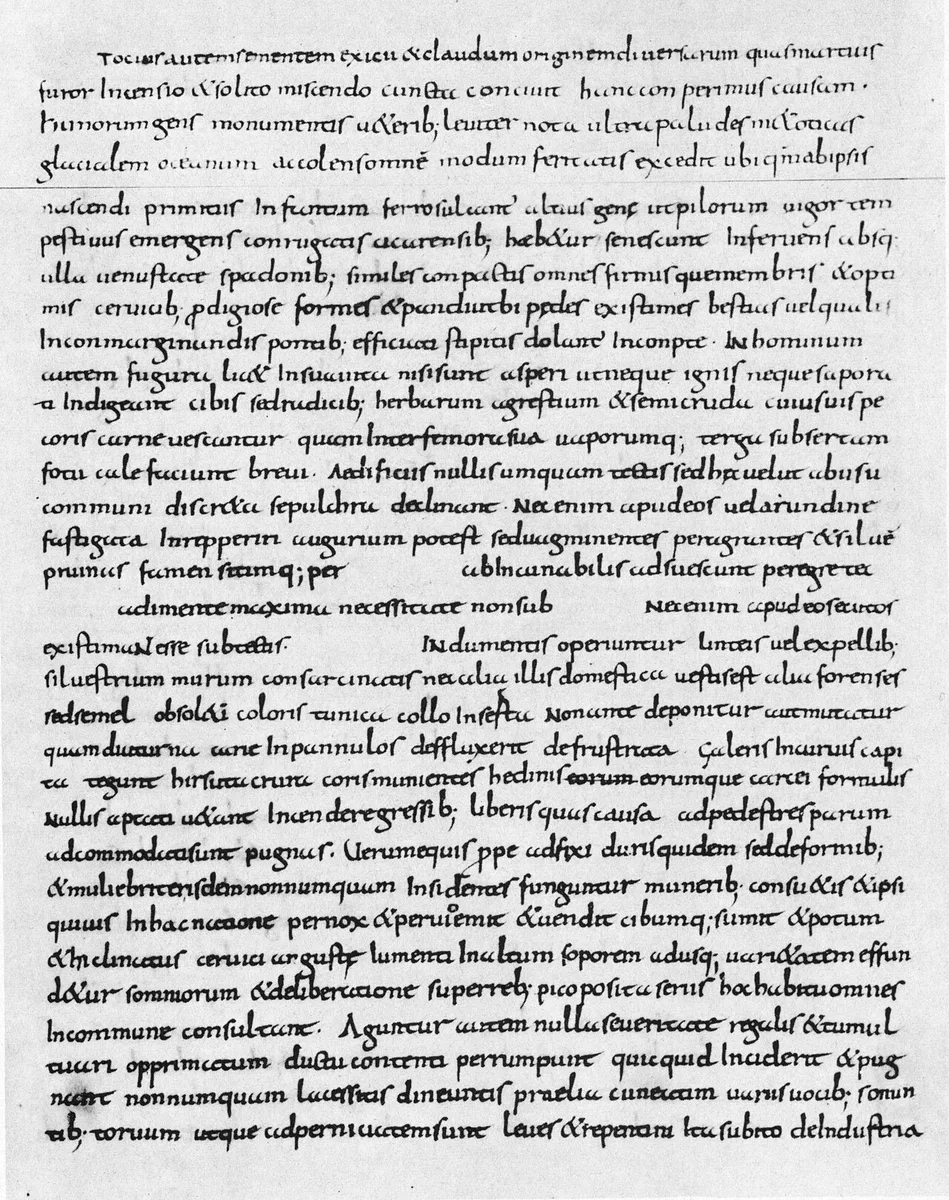
The repository holds the Latin of book 31 from la.wikisource, without an apparatus. It also holds the edition of John C. Rolfe in the Loeb Classical Library. Its third volume of 1939 prints books 27 to 31 with Clark’s text and an English translation.[42]
The passage
Totius autem sementem exitii et cladum originem diversarum, quas Martius furor incendio insolito miscendo cuncta concivit, hanc comperimus causam.
Hunorum gens monumentis veteribus leviter nota, ultra paludes Maeoticas glacialem oceanum accolens, omnem modum feritatis excedit.
Ubi quoniam ab ipsis nascendi primitiis infantum ferro sulcantur altius genae, ut pilorum vigor tempestivus emergens, corrugatis cicatricibus hebetetur, senescunt imberbes absque ulla venustate, spadonibus similes,
compactis omnes firmisque membris et opimis cervicibus, prodigiose deformes et pandi, ut bipedes existimes bestias, vel quales in commarginandis pontibus effigiati stipites dolantur incompte.
The seed of all the ruin and the origin of the various disasters that the fury of Mars stirred up, throwing everything into confusion with unwonted fire, we have found to be this.
The people of the Huns, little known from ancient records, living beyond the Maeotic marshes next to the icy ocean, exceeds every measure of savagery.
Since among them the cheeks of infants are cut deeply with iron from the very first days of life, so that the vigour of the hair, coming up in due time, is blunted by the wrinkled scars, they grow old beardless and without any grace, like eunuchs,
all with compact, strong limbs and thick necks, monstrously ugly and bowed, so that you would take them for two-legged beasts, or for the figured stumps that are crudely hewn for the edges of bridges.
[43] Ammianus Marcellinus; Rolfe 1939, xxxi.2.1–2, p. 380–381
Nemo apud eos arat nec stivam aliquando contingit.
Omnes enim sine sedibus fixis, absque lare vel lege aut victu stabili dispalantur, semper fugientium similes, cum carpentis in quibus habitant:
ubi coniuges taetra illis vestimenta contexunt, et coeunt cum maritis, et pariunt, et ad usque pubertatem nutriunt pueros.
Nullusque apud eos interrogatus respondere unde oritur potest, alibi conceptus natusque procul, et longius educatus.
Per indutias infidi et inconstantes, ad omnem auram incidentis spei novae perquam mobiles, totum furori incitatissimo tribuentes.
Inconsultorum animalium ritu, quid honestum inhonestumve sit, penitus ignorantes, flexiloqui et obscuri, nullius religionis vel superstitionis reverentia aliquando districti,
auri cupidine immensa flagrantes, adeo permutabiles et irasci faciles ut eodem aliquotiens die a sociis nullo irritante desciscant, itidemque propitientur, nemine leniente.
No one among them ploughs, and none ever touches a plough-handle.
For they all wander without fixed abodes, without hearth or law or settled way of life, always like fugitives, with the wagons in which they live.
There their wives weave for them their hideous garments, and lie with their husbands, and bear children, and rear the boys to puberty.
And no one among them, if asked, can say where he comes from, for he was conceived in one place, born far from it, and brought up still farther away.
In truces they are faithless and unstable, very ready to move at every breath of a new hope that presents itself, giving everything over to their most excited rage.
Like thoughtless animals, wholly ignorant what is honourable or dishonourable, ambiguous and obscure in speech, never held in check by reverence for any religion or superstition,
They burn with an immense desire for gold, and are so changeable and quick to anger that several times in one day they break away from their allies with no one provoking them, and are reconciled in the same way, with no one soothing them.
[44] Ammianus Marcellinus; Rolfe 1939, xxxi.2.10–11, p. 385–387
In hominum autem figura licet insuavi ita victu sunt asperi, ut neque igni neque saporatis indigeant cibis,
sed radicibus herbarum agrestium et semicruda cuiusvis pecoris carne vescantur, quam inter femora sua equorumque terga subsertam fotu calefaciunt brevi.
Aedificiis nullis umquam tecti, sed haec velut ab usu communi discreta sepulcra declinant.
Nec enim apud eos vel arundine fastigatum reperiri tugurium potest.
Indumentis operiuntur linteis vel ex pellibus silvestrium murum consarcinatis; nec alia illis domestica vestis est, alia forensis.
Sed semel obsoleti coloris tunica collo inserta non ante deponitur aut mutatur, quam diuturna carie in pannulos diffluxerit defrustata.
But although they have the form of men, however ugly, they are so rough in their way of life that they need neither fire nor seasoned food,
They live on the roots of wild plants and on the half-raw flesh of any kind of cattle, which they put between their own thighs and the backs of their horses and warm for a short while with the heat.
They are never covered by any buildings, but avoid them like tombs set apart from common use.
For among them not even a hut roofed with reed can be found.
They cover themselves with clothing of linen or of the skins of wild mice sewn together, and they have no one dress for the house and another for outdoors.
But once a tunic of faded colour has been pulled over the neck, it is not taken off or changed until, worn away by long decay, it has fallen into little rags.
[45] Ammianus Marcellinus; Rolfe 1939, xxxi.2.3–5, p. 381–383
Ex ipsis quivis in hac natione pernox et perdius emit et vendit, cibumque sumit et potum, et inclinatus cervici angustae iumenti, in altum soporem ad usque varietatem effunditur somniorum.
Et deliberatione super rebus propositis seriis, hoc habitu omnes in commune consultant.
Aguntur autem nulla severitate regali, sed tumultuario primatum ductu contenti, perrumpunt quicquid inciderit.
Any one of them in this nation, by night and by day, buys and sells, takes food and drink, and, bent over the narrow neck of his beast, sinks into so deep a sleep that it runs on into a variety of dreams.
And when deliberation is held on weighty matters put before them, they all consult in common in this posture.
They are led by no royal strictness, but, content with the disorderly leadership of their chief men, they break through whatever stands in their way.
[11] Ammianus Marcellinus; Rolfe 1939, xxxi.2.6–7, p. 383–385
Igitur Huni pervasis Halanorum regionibus, quos Greuthungis confines Tanaitas consuetudo cognominavit, interfectisque multis et spoliatis, reliquos sibi concordandi fide pacta iunxerunt,
eisque adhibitis confidentius Ermenrichi late patentes et uberes pagos repentino impetu perruperunt, bellicosissimi regis, et per multa variaque fortiter facta, vicinis nationibus formidati.
Qui vi subitae procellae perculsus, quamvis manere fundatus et stabilis diu conatus est, impendentium tamen diritatem augente vulgatius fama, magnorum discriminum metum voluntaria morte sedavit.
Cuius post obitum, rex Vithimiris creatus, restitit aliquantisper Halanis, Hunis aliis fretus, quos mercede sociaverat partibus suis.
Verum post multas quas pertulit clades, animam effudit in proelio, vi superatus armorum.
The Huns, then, having overrun the territories of those Halani who border on the Greuthungi and whom usage has surnamed Tanaites, and having killed and plundered many of them, joined the rest to themselves by a pledge of agreement,
and with these joined to them they broke more boldly, in a sudden onslaught, into the wide and rich districts of Ermenrichus, a most warlike king, dreaded by the neighbouring nations for his many and varied deeds of valour.
Struck by the force of the sudden storm, he tried for a long time to stand firm and steady, but as rumour spread more widely and heightened the dreadfulness of what threatened, he ended his fear of great perils by a voluntary death.
After his death Vithimiris was made king and resisted the Halani for a time, relying on other Huns whom he had allied to his side for pay.
But after many defeats that he suffered, he poured out his life in battle, overcome by force of arms.
[46] Ammianus Marcellinus; Rolfe 1939, xxxi.3.1–3, p. 395–397
References
- ^ a b c Ammianus Marcellinus; Rolfe 1939, xxxi.16.9, p. 505
- ^ a b c Maenchen-Helfen 1973, p. 1
- ^ Maenchen-Helfen 1973, p. 11, 13
- ^ Maenchen-Helfen 1973, p. 10
- ^ Ammianus Marcellinus; Rolfe 1939, xxxi.2.1, p. 381
- ^ a b Ammianus Marcellinus; Rolfe 1939, xxxi.2.2, p. 381
- ^ Ammianus Marcellinus; Rolfe 1939, xxxi.2.3, p. 381–383
- ^ Ammianus Marcellinus; Rolfe 1939, xxxi.2.4, p. 383
- ^ Ammianus Marcellinus; Rolfe 1939, xxxi.2.5, p. 383
- ^ Ammianus Marcellinus; Rolfe 1939, xxxi.2.6, p. 383
- ^ a b Ammianus Marcellinus; Rolfe 1939, xxxi.2.6–7, p. 383–385
- ^ Ammianus Marcellinus; Rolfe 1939, xxxi.2.7, p. 383–385
- ^ Ammianus Marcellinus; Rolfe 1939, xxxi.2.8, p. 385
- ^ Ammianus Marcellinus; Rolfe 1939, xxxi.2.9, p. 385
- ^ Ammianus Marcellinus; Rolfe 1939, xxxi.2.10, p. 385–387
- ^ a b Ammianus Marcellinus; Rolfe 1939, xxxi.2.11, p. 387
- ^ Ammianus Marcellinus; Rolfe 1939, xxxi.2.12, p. 387
- ^ Ammianus Marcellinus; Rolfe 1939, xxxi.2.13, p. 387–389
- ^ Ammianus Marcellinus; Rolfe 1939, xxxi.2.18, 21, p. 391–393
- ^ Ammianus Marcellinus; Rolfe 1939, xxxi.2.23–24, p. 393–395
- ^ a b Ammianus Marcellinus; Rolfe 1939, xxxi.3.1, p. 395–397
- ^ Ammianus Marcellinus; Rolfe 1939, xxxi.3.2, p. 397
- ^ Ammianus Marcellinus; Rolfe 1939, xxxi.3.3, p. 397
- ^ Ammianus Marcellinus; Rolfe 1939, xxxi.3.4–5, p. 397–399
- ^ Ammianus Marcellinus; Rolfe 1939, xxxi.3.6–7, p. 399
- ^ Ammianus Marcellinus; Rolfe 1939, xxxi.3.8, p. 399–401
- ^ Maenchen-Helfen 1973, p. 20
- ^ Ammianus Marcellinus; Rolfe 1939, xxxi.8.2–4, p. 437
- ^ Ammianus Marcellinus; Rolfe 1939, xxxi.16.3, p. 501
- ^ Ammianus Marcellinus; Rolfe 1939, xxxi.12.17, p. 471–473
- ^ a b Maenchen-Helfen 1973, p. 11
- ^ Ammianus Marcellinus; Rolfe 1939, xxxi.3.5, p. 397–399
- ^ Maenchen-Helfen 1973, p. 13–15
- ^ Maenchen-Helfen 1973, p. 13
- ^ Maenchen-Helfen 1973, p. 12
- ^ Rolfe 1939, p. 382
- ^ Rolfe 1939, p. 380
- ^ Maenchen-Helfen 1973, p. 15
- ^ Maenchen-Helfen 1973, p. 17
- ^ Maenchen-Helfen 1973, p. 9, 15
- ^ Maenchen-Helfen 1973, p. 16
- ^ Rolfe 1939
- ^ Ammianus Marcellinus; Rolfe 1939, xxxi.2.1–2, p. 380–381
- ^ Ammianus Marcellinus; Rolfe 1939, xxxi.2.10–11, p. 385–387
- ^ Ammianus Marcellinus; Rolfe 1939, xxxi.2.3–5, p. 381–383
- ^ Ammianus Marcellinus; Rolfe 1939, xxxi.3.1–3, p. 395–397
Literature
- John C. Rolfe, Ammianus Marcellinus, with an English Translation, vol. III: Books XXVII–XXXI (1939)
- Otto J. Maenchen-Helfen, The World of the Huns: Studies in Their History and Culture (1973)
Drawn on by
Articles resting on this source 15
Alans · Balamber · Bone and Horn Working · Goths · Hermanaric · Hunnic conquest of the Goths · Hunnic Empire · Huns · Jordanes · Millet · Scapulimancy · Steppe Diet · Sword of Mars · The Huns and the Xiongnu · Wagons of the Steppe Peoples
What links here13
- Persons
- Balamber · Hermanaric
- States
- Hunnic Empire
- Conflicts
- Hunnic conquest of the Goths
- Institutions and Titles
- Bone and Horn Working · Wagons of the Steppe Peoples
- Religions
- Sword of Mars
- Foods
- Steppe Diet
- Sources
- Jordanes
- Controversies
- The Huns and the Xiongnu
Cite this article
Yavuz, Emre-E. “Ammianus Marcellinus.” Turkic Atlas, revised 7 November 2026. https://turkicatlas.org/sources/ammianus-marcellinus/
Last revised: 7 November 2026


