
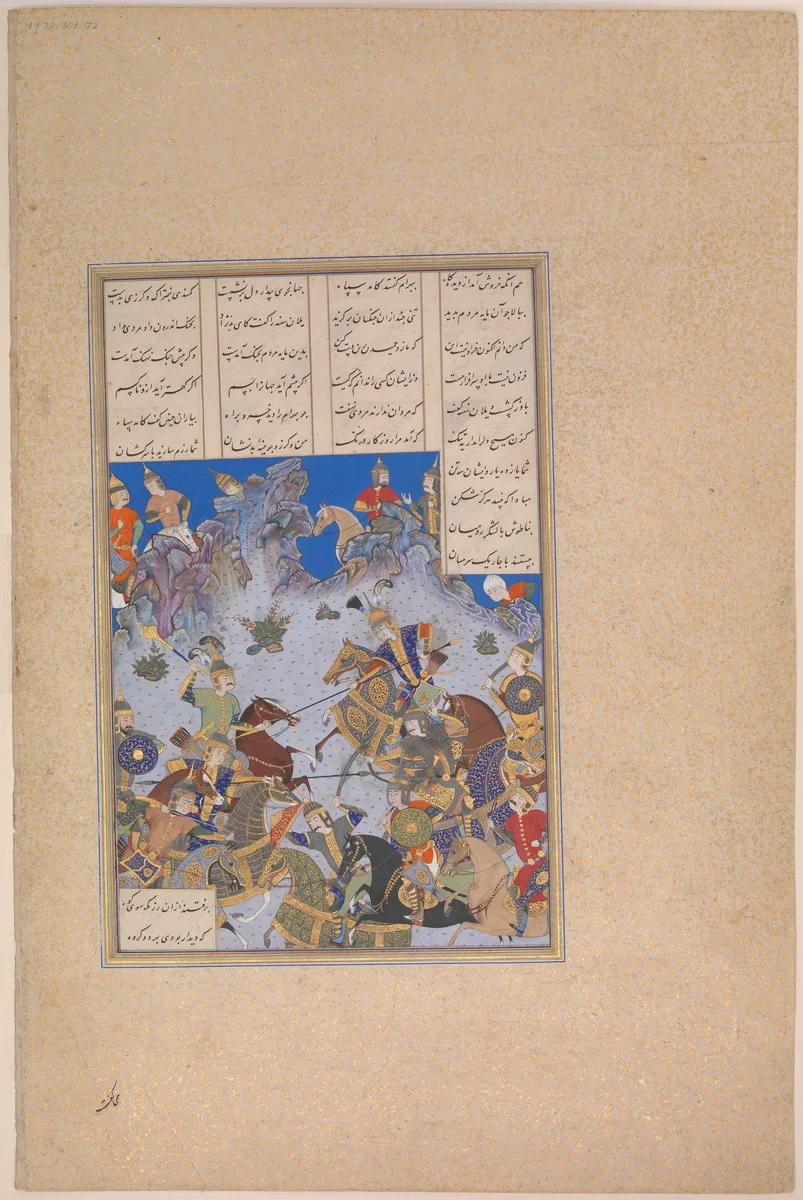
The Book of Kings is a verse epic, not a chronicle. It was completed four centuries after the war of 588, for which it is used. It is nonetheless the only source for the details of that war, and the Göktürks left no record at all.
Content
The epic tells of Bahram Chobin’s campaign against the Göktürks and his pursuit of them to the Oxus. It says he killed their king with an arrow, a typical topos of Persian storytelling. It gives the numbers as twelve thousand Persians against three hundred thousand Göktürks, an exaggerated claim.[1] The eighth book tells the war.[2]
Dependence on other works
Modern accounts commonly pass over the epic in favour of Tabari, Masʿudi and Theophylact.[3] They hold that the epic’s Sasanian books rest on the same lost court tradition as Tabari. The two therefore do not count as independent witnesses.
Bibliographical details
The epic is cited by book. Here the citation is book 8.[2]
Reliability
The Book of Kings is verse, and it was written to be recited. That is not a reason to discard it. It is a reason to read its numbers differently from a chronicle’s.
The ratio of three hundred thousand Göktürks to twelve thousand Persians is not a count. An epic uses such a ratio to make a victory worth singing. The arrow that kills the enemy king at the decisive moment is not a report. It is a figure that recurs across Persian storytelling. Both belong to the poem’s narrative conventions. The war article therefore treats them as legend.
What the epic does give is a narrative: a campaign with a shape, a route and an outcome. It gives this better than the prose sources do. For the war of 588 nothing else has a shape at all.[2]
The dependence question
Modern accounts hold that Tabari, Masʿudi and the epic rest on the same lost Middle Persian royal chronicle for the Sasanian period.[3] If that is right, their agreement is one witness and not three. The war of 588 is then single-attested, however many books report it.[3]
The war article follows this view. Its list of sources notes the dependence instead of counting the sources up.
There is a second reason not to count the epic as an independent voice. It names a Persian enemy the way the Persian tradition named it. That tradition used Turk for peoples who were not Göktürk, as the Peroz narrative in Tabari does explicitly.[4] The epic cannot settle whether the enemy of 588 was the western Göktürks or a Hephthalite remnant under Göktürk overlordship. The question is one the epic never poses.
References
Literature
- Emre-E. Yavuz, The Gokturk Empire: 2nd Edition (2025)
- Peter B. Golden, An Introduction to the History of the Turkic Peoples (1992)
- Theodor Nöldeke, Geschichte der Perser und Araber zur Zeit der Sasaniden. Aus der arabischen Chronik des Tabari übersetzt und mit ausführlichen Erläuterungen und Ergänzungen versehn (1879)
Articles resting on this source 6
Afrasiab · Bagha Khan · Bahram Chobin · Göktürk–Persian war, 588–589 · Herat · Sasanian Persia
What links here4
- Persons
- Afrasiab
- Sources
- aṯ-Ṯaʿālibī
Cite this article
Yavuz, Emre-E. “Shahnameh.” Turkic Atlas, revised 8 November 2026. https://turkicatlas.org/sources/shahnameh/
Last revised: 8 November 2026

