
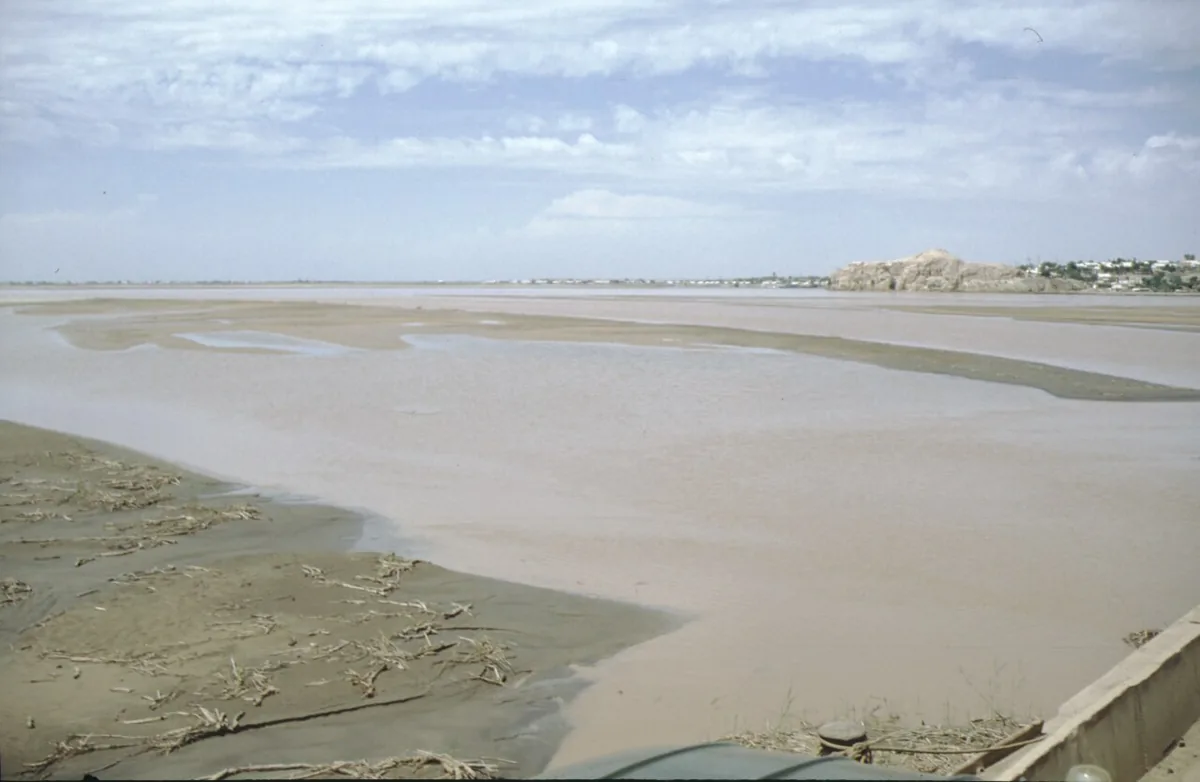
The Oxus runs out of the Pamirs across Central Asia. For the history of the Göktürks it is less a river than a line. After Istemi and Khosrow I had destroyed the Hephthalite realm between them, the lands were divided along the river. The country north of it went to the Göktürks, the country south of it to Persia.[1]
The line held badly. The war of 588 was fought across it, and the Göktürks crossed it without difficulty. The boundary was never a wall.[1] The small states on its banks paid the khan and traded through Sogdiana. The Iron Gate south of Samarkand marks the furthest point the inscriptions claim on the far side.[2]
Names of the river
- Amu DaryaEnglish
- ὮξοςGreek
- JayḥūnArabic
- VehrotArmenianSebeos 10
- 烏滸ChineseSui Shu 83
The Sasanian Persians called the river Weh-rōd, “the good river”. The surviving parts of the Avesta do not know this name.[3] Sebeos has Bahram Chobin cross “the great river which is called Vehrot” and reach a place named Kazbion. The translators take the Vehrot for the Oxus.[4][3] The Chinese histories name a river Wuhu, south of which the Sui Shu and the Wei Shu place the Hephthalite capital. The river is identified as the Oxus.[5][6][7] An older reading of the Wei Shu had Ma-hu, the Murghab of Merv, and put the capital in Badghis on that ground. The reading Wuhu has replaced it.[7] The article on the Hephthalites sets out where the capital lay.
References
- ^ a b Yavuz 2025
- ^ Tonyukuk inscription; Tekin 1968, p. 289
- ^ a b Markwart 1938, p. 34
- ^ Sebeos, ch. 10; Howard-Johnston 1999, p. 15
- ^ Sui Shu (Book of Sui), juan 83; Wei Shu, juan 102
- ^ Markwart 1938, p. 47–48
- ^ a b Herrmann 1925, p. 573
Sources
- Menander Protector
- Tabari
- Sui Shu (Book of Sui), juan 83, 84
- Tonyukuk inscription
- Sebeos, ch. 10
- Wei Shu, juan 102
Literature
- Peter B. Golden, An Introduction to the History of the Turkic Peoples (1992)
- Emre-E. Yavuz, The Gokturk Empire: 2nd Edition (2025)
- Étienne de la Vaissière, Sogdian Traders: A History (2005)
- Aydogdy Kurbanov, The Hephthalites: Archaeological and Historical Analysis (2010)
- Talât Tekin, A Grammar of Orkhon Turkic (1968)
- Josef Markwart, Wehrot und Arang. Untersuchungen zur mythischen und geschichtlichen Landeskunde von Ostiran (1938)
- Albert Herrmann, Die Hephthaliten und ihre Beziehungen zu China (1925)
- R. W. Thomson (trans.), James Howard-Johnston (commentary), The Armenian History attributed to Sebeos (1999)
What links here49
- Persons
- Bagha Khan · Bahram Chobin · Bumin Khan · Istemi · Kapgan Khan · Kayen · Khosrow I · Mukan Khan · Natra · Parmudha · Šāba · Shegui Khan · Tardu Shad · Tardush
- States
- Sasanian Persia · The Tibetan Empire · The Umayyad Caliphate · Western Göktürk Khaganate · Yabgus of Tokharistan
- Conflicts
- Göktürk Expansion along the Silk Road · Göktürk–Persian war, 588–589 · The Göktürk Civil War · The Göktürk–Hephthalite war, 555–563 · The Göktürk–Sasanian Trade Conflict · The Göktürk–Sui wars, 582–603
- Battles & Events
- Battle of Bukhara · Maniakh's embassy to Constantinople, 568 · Smbat Bagratuni's war with the khan · The embassies to Ctesiphon, 568
- Places
- Bactria · Badghis · Bukhara · Dzungaria · Gurgan · Herat · Huo · Khorasan · Merv · Syr Darya · Transoxiana
- Religions
- Islam
- Sources
- Shahnameh · Sui Shu (Book of Sui)
- Controversies
- Climate and the steppe empires
Cite this article
Yavuz, Emre-E. “Oxus.” Turkic Atlas, revised 8 November 2026. https://turkicatlas.org/places/oxus/
Last revised: 8 November 2026

