
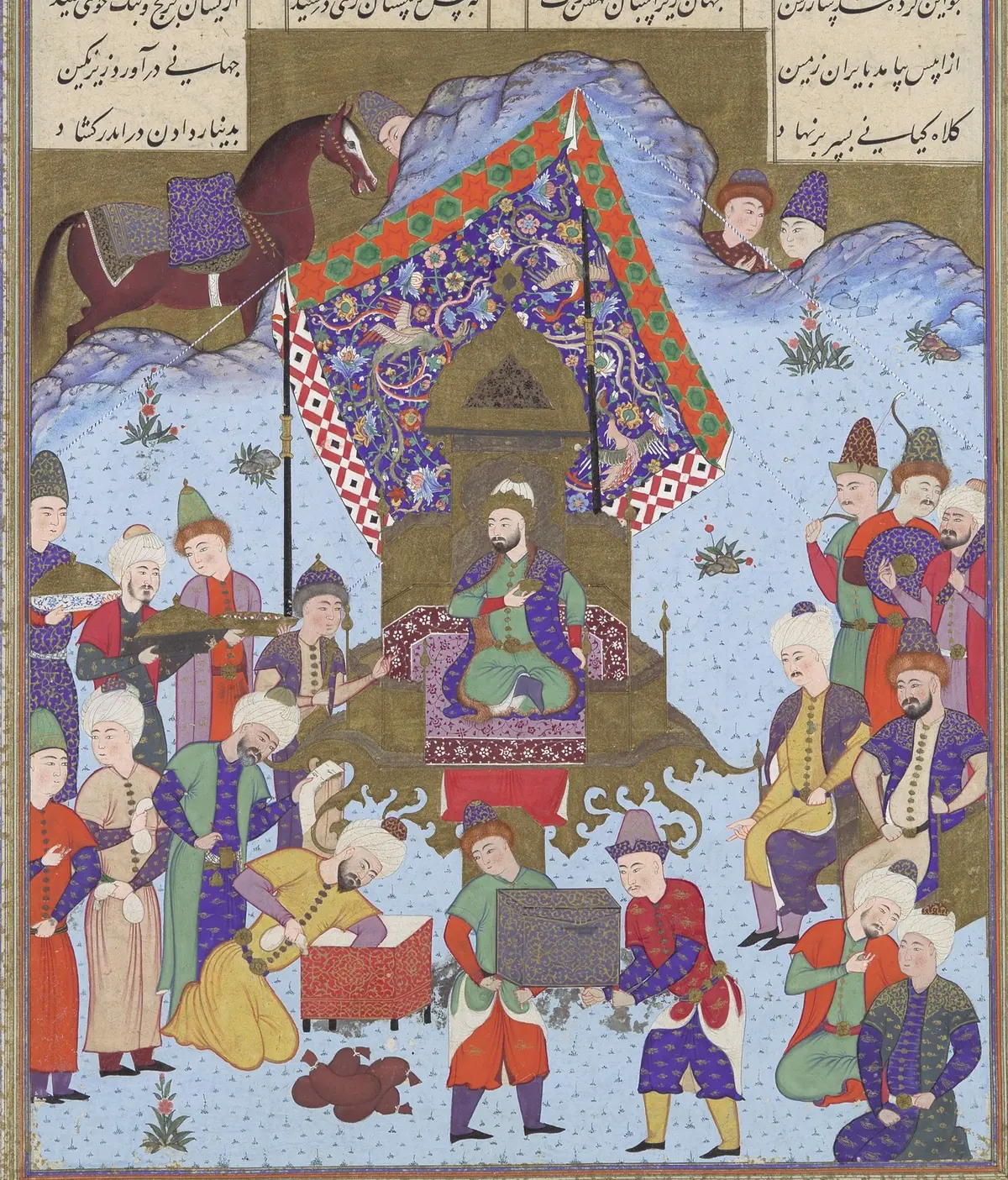
Afrasiab is the king of Turan in the Iranian tradition. For centuries that tradition made him the great enemy of Iran. He appears first in the Avesta as Fraŋrasyan, “the Turanian”. Three times he dives into the sea to seize the royal Glory, and three times he fails.[1] The Shahnameh makes him the son of Pashang. Pashang invades Iran after the death of Minuchihr.[2] Afrasiab fights the Iranian kings through several reigns, until his grandson Kay Khosrow puts him to death.[3] In the Turkic tradition of the eleventh century he is Alp Er Tunga, and Kashgari’s Dīwān preserves a lament for him.[4] The ruin mound of old Samarkand bears his name. The paintings found there in 1965 are known as the Afrasiab paintings.[5]
Name
- Alp Är ToŋaOld TurkicDīvān Lughāt al-Turk
- FraŋrasyanAvestan
- FrāsiyāvMiddle Persian
- AfrāsiyābPersianShahnameh
The Avestan form is Fraŋrasyan.[6] The Pahlavi Bundahishn writes Frāsiyāv, as the English translation of the Shahnameh quotes it.[7] Afrāsiyāb is the form of the Shahnameh, and Afrasiab or Afrasiyab is the usual English spelling.[2] The Turkic name Alp Er Tunga stands in a quatrain that Kashgari quotes. In his own translation Kashgari renders it as King Afrāsiyāb.[4]
Afrasiab in the Avesta
The Yashts, the hymns of the Avesta, know Fraŋrasyan as the Turanian murderer and ruffian.[8] In the Zamyad Yasht he tries to seize the Glory in the sea Vouru-Kasha. The Glory is the royal splendour that belongs to the Aryan nations and to Zarathushtra.[6] He strips himself naked and plunges in. The Glory flees. Each time it flees, an arm of the sea comes into being. The first is the lake Husravah, the second the lake Vanghazdau, and the third the water Awzh-danva.[1] Between the attempts he threatens to defile all corn and liquors.[6]
In the Aban Yasht he sacrifices to the goddess Ardvi Sura Anahita in his cave under the earth. He offers a hundred horses, a thousand oxen and ten thousand lambs, and asks her for the Glory.[8] The goddess refuses.[8]
Two hymns tell his end. In the Drvaspa Yasht, Haoma asks the goddess for the power to bind the Turanian murderer. He wants to drag him bound to king Husravah, who is to kill him behind the lake Chaechasta, the deep lake of salt waters.[9] The killing avenges Husravah’s father Syavarshana and Aghraeratha.[10] The Zamyad Yasht has Husravah put Fraŋrasyan and Keresavazda in bonds for the same reason.[11] Husravah is the Kay Khosrow of the later epic, Syavarshana is Siyavash and Keresavazda is Garsivaz.[8]
The Yashts call him the Turanian. They do not speak of Turks.[12]
Afrasiab in the Shahnameh
In the Shahnameh, the Book of Kings, Afrasiab is the son of Pashang, king of Turan.[2] When Minuchihr dies, Pashang sends him into Iran with an army. The Iranians are defeated and their king Nowzar is taken prisoner. Afrasiab kills Nowzar and takes the crown of Iran.[2] His brother Aghrirath sets the Iranian prisoners free. Afrasiab has him put to death.[2]
The central episode is the story of Siyavash, a son of the Iranian king Kay Kavus. Siyavash leads an army against Afrasiab. Afrasiab, frightened by a dream, sues for peace. Kay Kavus rejects the terms his son has granted.[13] Siyavash, his honour touched, goes over to Afrasiab and is received with honour. He marries Afrasiab’s daughter Farangis and rises to great dignities.[13] Afrasiab’s brother Garsivaz envies him. Siyavash is killed.[13] Farangis bears his son, Kay Khosrow, who grows up at the Turanian court.[13]
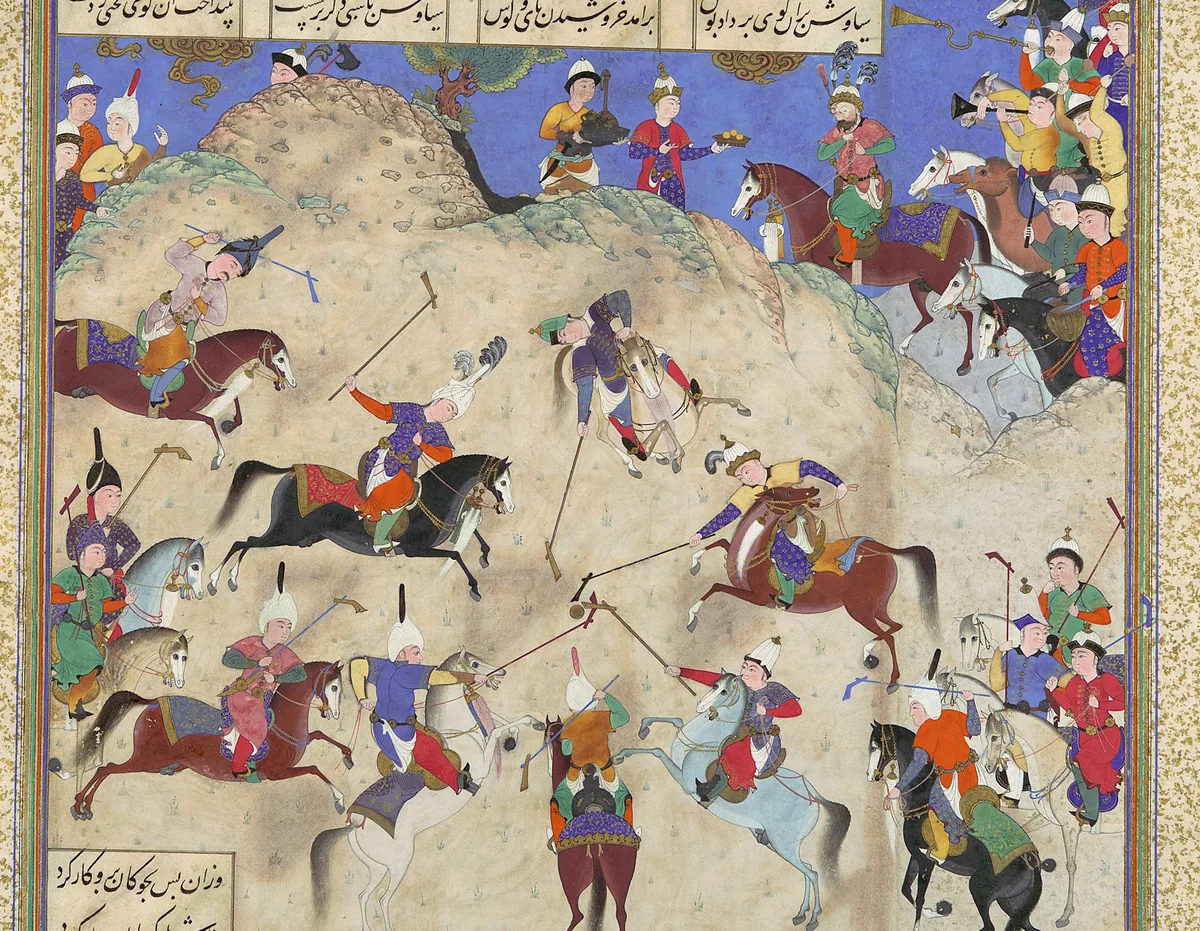
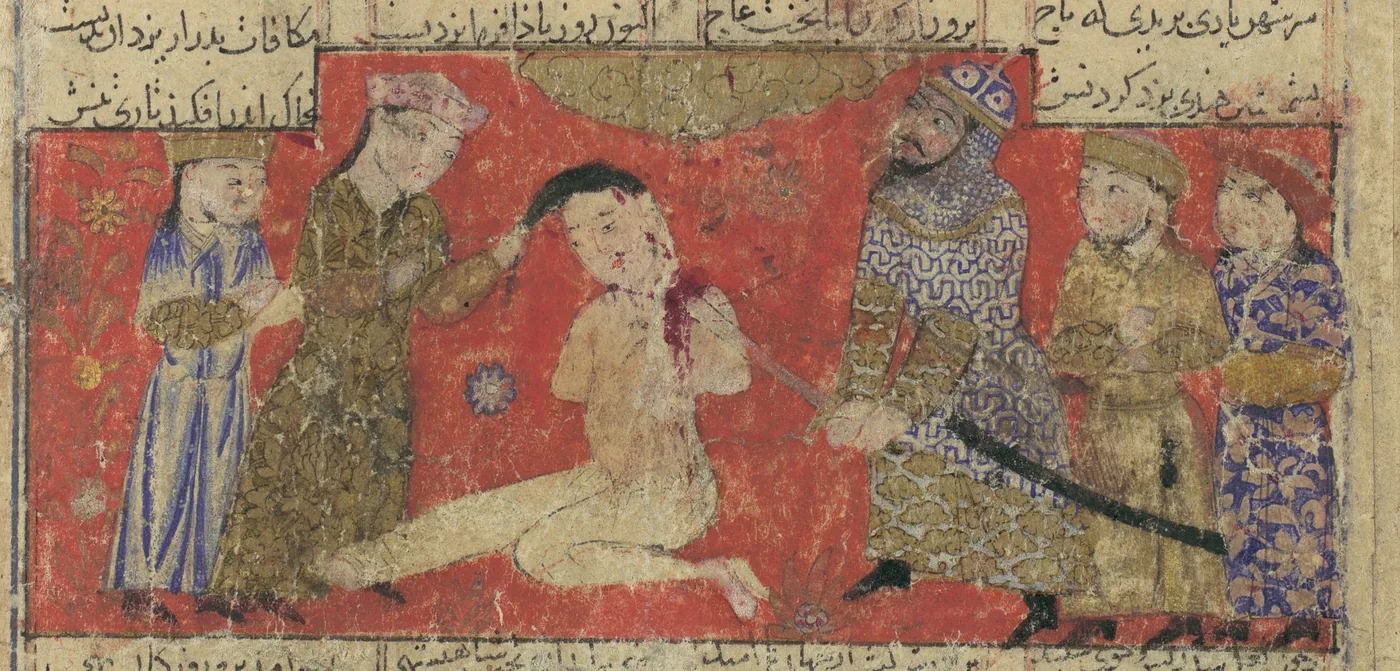
Kay Khosrow is therefore Afrasiab’s grandson.[13] As king of Iran he wages the great war against him. Afrasiab is defeated again and again. He flees from one stronghold to the next and at last takes refuge in a cave.[3] The cave lies near the lake Khanjast in Azerbaijan, and he makes it his palace and his home. The hermit Hum overhears his laments and seizes him. Afrasiab escapes by a trick and plunges into the lake. He is drawn out of the water by a stratagem. Kay Khosrow puts him to death, together with his brother Garsivaz.[14] With his death the feud that began with the murder of Iraj comes to its end.[15]
Alp Er Tunga in the Turkic tradition
Kashgari came from the Karakhanid house and wrote his Dīwān in the 1070s.[16] Under the word alp, “brave”, he quotes a verse and translates it:[4]
alp är toŋa öldi mü / ēsīz ažūn qaldi mu / öḏläg ȫčin aldi mu / amdi yüräk yirtilūr. “Has King Afrāsiyāb died? Does the wicked world remain (empty of him)? Has Time exacted its revenge upon him? Now the heart bursts.”[4]
The quatrain is a lament. It treats Alp Er Tunga as a Turkic king whose death is mourned in Turkic verse.[4] Kashgari’s translation shows that in his time the Turkic hero and the king of Turan were one and the same figure.[4] Contemporary Islamic sources called the Karakhanid dynasty the house of Afrasiab. The Turanian ruler was identified with the Turkic hero Alp Er Tunga.[17] The Karakhanid khans therefore claimed a place in the Iranian epic, on the side of Turan.[17]
The Kutadgu Bilig is a second witness. It was finished at the same court in 1069–1070, a few years before Kashgari wrote. It calls the hero Toŋa Alp Er and gives the Iranian name beside it.[18] It also quotes a saying of his: the human heart is flesh, and it goes bad unless it is guarded.[19] This saying is the poet’s own verse, like the other sayings the book puts in the mouths of Turkic authorities.[20]
The mound of Samarkand
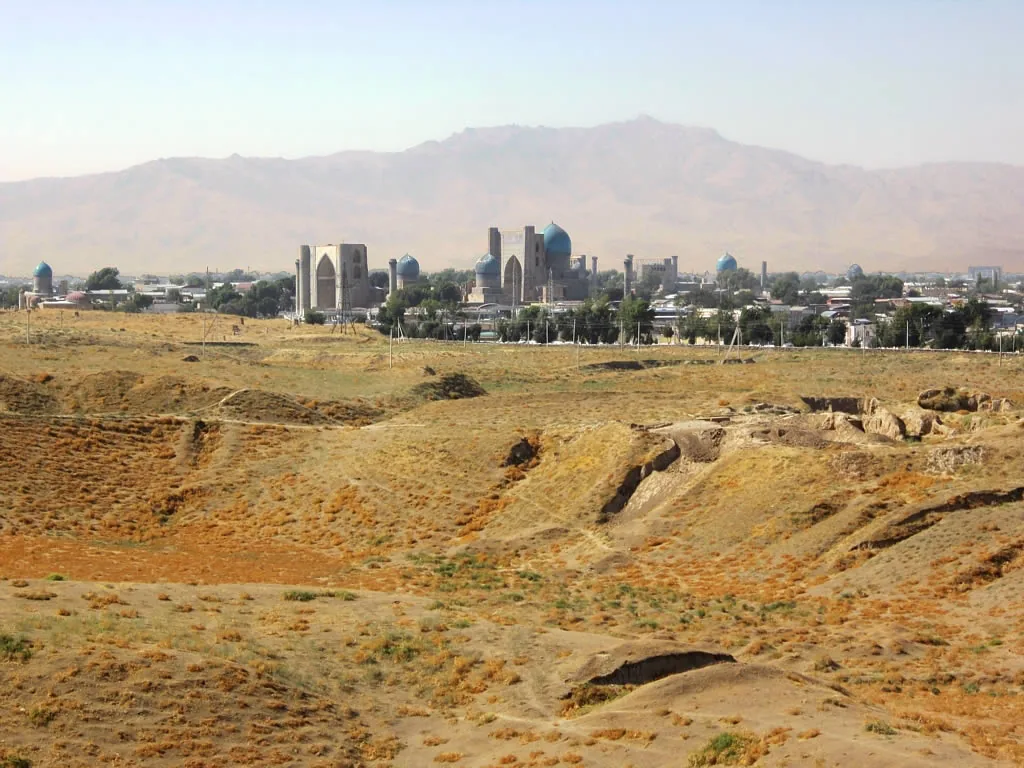
The mound on which old Samarkand stood, north-east of the later city, is called Afrasiab, or Afrosiab. It covers some 289 hectares.[5] The palace complex excavated there dates from the middle of the seventh century. The hall with the paintings of the embassies to the Sogdian king measures eleven metres by eleven.[5] The paintings show no image of the legendary king. They take his name only from the mound.
Legend and history
No historical king stands behind Afrasiab. The Avesta places him in a mythical world of seas and hidden Glory. The Shahnameh places him in the age of the legendary kings before the Sasanians.[12] What has a history is the use made of him. The hymns curse him. The epic makes him Iran’s enemy through generations. The Turkic dynasty of the eleventh century took his name as its own.
References
- ^ a b Darmesteter 1883, p. 300–301
- ^ a b c d e Shahnameh; Warner 1905, p. 337
- ^ a b Shahnameh; Warner 1909, p. 135
- ^ a b c d e f Dīvān Lughāt al-Turk; al-Kāshgharī 1072–1074, p. 92
- ^ a b c Centre 2001
- ^ a b c Darmesteter 1883, p. 300
- ^ Warner 1905, p. 338
- ^ a b c d Darmesteter 1883, p. 64
- ^ Darmesteter 1883, p. 114
- ^ Darmesteter 1883, p. 115
- ^ Darmesteter 1883, p. 304
- ^ a b Darmesteter 1883
- ^ a b c d e Shahnameh; Warner 1906, p. 188
- ^ Shahnameh; Warner 1909, p. 136
- ^ Warner 1909, p. 136
- ^ Dīvān Lughāt al-Turk
- ^ a b Golden 1992, p. 214
- ^ Kutadgu Bilig; Dankoff 1983, couplets 277, 280
- ^ Kutadgu Bilig; Dankoff 1983, couplets 5861–5862
- ^ Dankoff 1983, p. 8–11
Sources
Literature
- James Darmesteter (trans.), The Zend-Avesta, Part II: The Sīrōzahs, Yasts and Nyāyis (Sacred Books of the East 23) (1883)
- Arthur George Warner and Edmond Warner (trans.), The Sháhnáma of Firdausí, Bd. I (1905)
- Arthur George Warner and Edmond Warner (trans.), The Sháhnáma of Firdausí, Bd. II (1906)
- Arthur George Warner and Edmond Warner (trans.), The Sháhnáma of Firdausí, Bd. IV (1909)
- Maḥmūd al-Kāshgharī, Dīwān Lughat al-Turk (1072–1074)
- Peter B. Golden, An Introduction to the History of the Turkic Peoples (1992)
- Republik Usbekistan / UNESCO World Heritage Centre, Samarkand – Crossroads of Cultures. Nomination Documentation (603rev) (2001)
What links here3
- Religions
- Turkic Mythology
- Customs & Pastimes
- Turkic Songs at the Tang Court
- Sources
- Afrasiab paintings
Cite this article
Yavuz, Emre-E. “Afrasiab.” Turkic Atlas, revised 8 November 2026. https://turkicatlas.org/persons/afrasiab/
Last revised: 8 November 2026

