
- 400
- 500
- 600
- 700
- 800
- 900
- Rouran 400–554
- First Göktürk 552–630
- Tang rule 630–682
- Second Göktürk 682–744
- Uyghur 744–840
- Kirghiz 840–924
- Huns 370–469
- Western Göktürk 552–659
- Türgesh 699–766
- Karluk 766–800
- Khazar 650–969
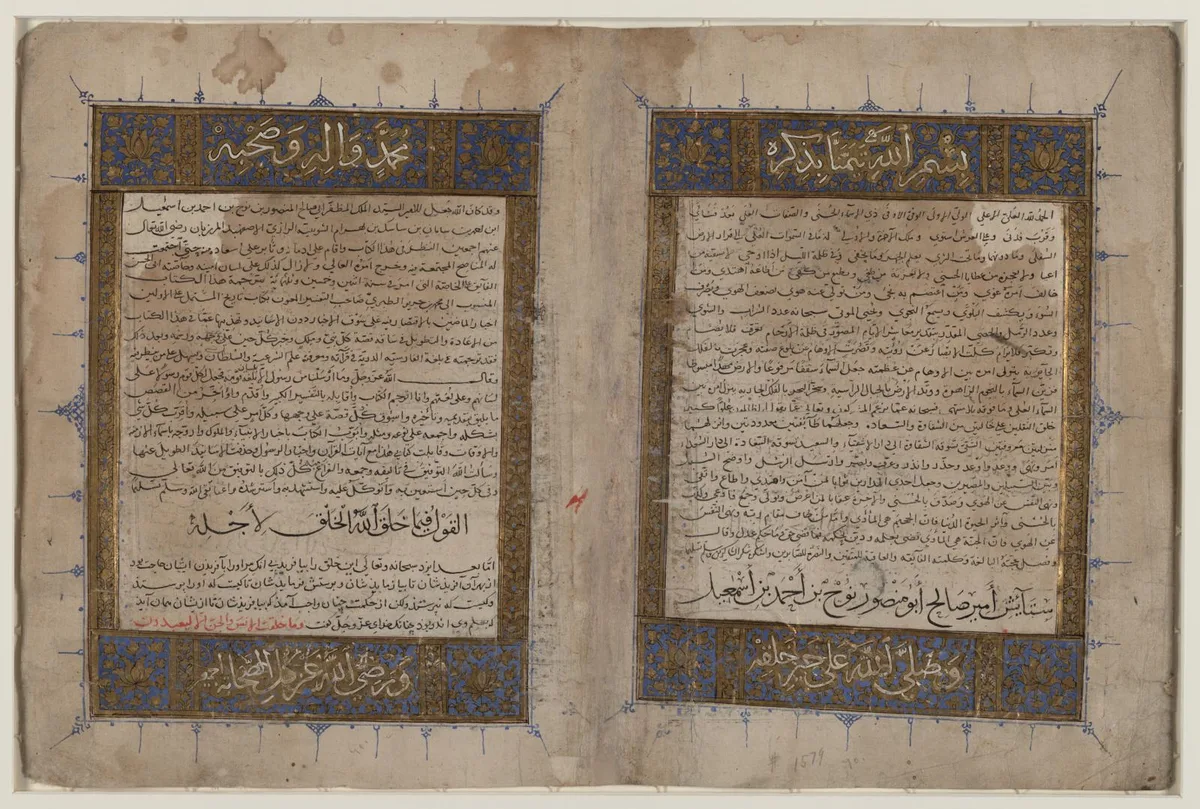
Tabari’s history runs from the creation to his own day. Its Sasanian section was written three centuries after the events. It is the fullest Arabic account of the kings of Persia and their wars, and it preserves the Persian tradition on the Göktürks.
Author and work
Abū Ǧaʿfar Muḥammad ibn Ǧarīr was born in the autumn of 839 at Amul in Tabaristan, the Persian province on the Caspian from which he took his name. He died at Baghdad on 17 February 923.[1] His chronicle is a compilation. Where his sources disagree, he sets their accounts side by side instead of reconciling them. In this way he preserves the older reports more faithfully.[1] The history before Islam makes up perhaps a twentieth of the whole. Its section on the Sasanians goes back in part to good Arabic tradition and for the greater part, at least indirectly, to older Persian sources.[2]
Content
In the war of 588 and 589, the Göktürk king Šāba, “the over-king of the Turks”, came with three hundred thousand warriors in the eleventh year of Hormizd IV. He advanced as far as Badghis and Herat.[3] Bahram Chobin killed him with an arrow. His son Parmūdha surrendered in a fortress.[4] Some scholars place the defeat at Herat in 589 and make Šāba a son of Tardush. An identification of him with a younger son known from the Bukharan tradition cannot be established.[5] After his revolt and defeat Bahram fled to the Göktürks. Assassins whom the khatun set on him murdered him there.[6]
The khagan Sinjibū, “the boldest and mightiest of all the Turks”, killed the king of the Hephthalites and conquered their land, except the parts that had fallen to Khosrow I. The king’s name is given as Warz, with a question mark.[7] The same khagan then marched with a hundred and ten thousand warriors towards the Gate of Ṣūl and demanded payments from Khosrow. He turned back before the Persian fortifications.[8] Sinjibū is the Silziboulos of Menander.[9] He is Istemi.[10] Some scholars date the destruction of the Hephthalites to 557 and make it the work of Khosrow and Sinjibū in alliance. Masʿudi calls the Hephthalite king Akhshunwaz.[10]
Tabari also reports on the Türgesh khan Sulu, probably the Abū Muzāḥim of the Muslim sources, and on the Arab victory at Kharistan in 737.[11]
Dependence on other works
In the Persian history Tabari names no authority except, here and there, Hišām ibn al-Kalbī. Hišām was a collector of Arab historical tradition who died about 820, and he was Tabari’s main source for the Arab princes of Hira.[12] Tabari’s account of the Persian kings shows the same conception and arrangement as the related Arabic works and as the Shahnameh of Ferdowsi, often in almost the same words. Ferdowsi did not take his material from Arabic books. The agreement therefore goes back to a common base: the Middle Persian royal chronicle, the Xwadāy-nāmag.[13] That chronicle reached Tabari only through several intermediaries.[14] Tabari, Dinawari, Masʿudi and Thaʿālibī all drew not on the first Arabic translation of the chronicle but on reworked versions of it.[15] Where they agree, they are one tradition and not several witnesses. On Bahram Chobin, Tabari also used a romance of his life, which passed into Dinawari, Yaʿqubi and the Shahnameh as well.[16] Sebeos, an Armenian history written more than two centuries earlier, stands outside this chain. It already gives the Persian reason for Bahram’s revolt, the quarrel over the booty.[17]
Editions and translations
Theodor Nöldeke translated the Sasanian section into German, with a commentary.[18]
The word Turk
The Sasanian section shows first how loosely the word is used.
In the account of Peroz and Akhshunwar, Tabari calls the enemy Turks throughout. The enemy is the Hephthalites, the Haitāl of the same text, a few lines apart.[19] The boundary Peroz crosses is a tower built by Bahram Gur to mark where Khorasan ended and the lands of the Turks began. The treaty he breaks is one made between Turks and Persians that neither side should pass it. The people who lay the covered trench are the Hephthalites.[19] The commentary to the German translation takes the usage over without comment. It generalises from it about how the Turks make war.[20]
The passage is therefore evidence for the conflation of ethnonyms rather than for the Göktürks. Anything in Tabari that says Turk has to be tested against the date and the geography before it can be counted as a Göktürk attestation.
The Peroz narrative
The Peroz narrative is the fullest account of a steppe war in the Sasanian section. Its tactics recur.
Peroz had bound himself not to go beyond the tower into the land of the Hephthalites. He kept the letter of that by having fifty elephants and three hundred men harnessed to the tower and dragging it forward ahead of him as he marched.[19] Akhshunwar sent word that Peroz should leave undone what his forefathers had left undone. Peroz took no notice and pressed for open battle.[19]
Akhshunwar avoided it. He had a trench dug behind his army. It was ten ells wide and twenty deep, roofed with light timbers and covered with earth. Then he moved his troops to a point not far off.[20] The Persian king rode into it.
A generation later Kawadh, driven out by his brother, fled to the khagan, the king of the Turks, to ask for support and auxiliaries. In that passage the word may mean the Hephthalites again.[21]
References
- ^ a b Nöldeke 1879, xiii
- ^ Nöldeke 1879, xiii-xiv
- ^ Tabari; Nöldeke 1879, p. 269
- ^ Tabari; Nöldeke 1879, p. 271-272
- ^ Golden 1992, p. 132
- ^ Tabari; Nöldeke 1879, p. 287-289
- ^ Tabari; Nöldeke 1879, p. 158-159
- ^ Tabari; Nöldeke 1879, p. 159-160
- ^ Nöldeke 1879, p. 158
- ^ a b Golden 1992, p. 83
- ^ Tabari
- ^ Nöldeke 1879, xiv,xxvii
- ^ Nöldeke 1879, xiv-xv
- ^ Nöldeke 1879, xv
- ^ Zotenberg 1900, xliii-xliv
- ^ Nöldeke 1879, p. 474-476
- ^ Nöldeke 1879, p. 272-273
- ^ Nöldeke 1879
- ^ a b c d Nöldeke 1879, p. 128
- ^ a b Nöldeke 1879, p. 129
- ^ Nöldeke 1879, p. 133
Literature
- Theodor Nöldeke, Geschichte der Perser und Araber zur Zeit der Sasaniden. Aus der arabischen Chronik des Tabari übersetzt und mit ausführlichen Erläuterungen und Ergänzungen versehn (1879)
- Peter B. Golden, An Introduction to the History of the Turkic Peoples (1992)
- Hermann Zotenberg (ed., trans.), Histoire des rois des Perses par Abou Mansour ʿAbd al-Malik ibn Mohammad ibn Ismaʿil al-Thaʿalibi (1900)
Articles resting on this source 51
Alans · Arab–Khazar Wars (642–737) · Bactria · Badghis · Bagha Khan · Bahram Chobin · Balanjar · Balkh · Battle of Ardabil (730) · Battle of Bukhara · Bukhar Khuda · Bukhara · Byzantium · Derbent · Dēwāštīč · Diplomacy of the Steppe Empires · Faghfura · Gate of Sul · Göktürk Expansion along the Silk Road · Göktürk Expansion into Europe · Göktürk–Persian war, 588–589 · Gurgan · Hephthalites · Herat · Hormizd IV · Islam · Istemi · Kayen · Khorasan · Khosrow I · Merv · Murder of Bahram Chobin · Nasr ibn Sayyar · Natra · Nezak Shahs · Oxus · Parmudha · Qutayba ibn Muslim · Šāba · Sasanian Persia · Sogdians · Tardush · Tarkhan · The Abbasid Caliphate · The capture of Samarkand, 712 · The Göktürk–Hephthalite war, 555–563 · The Göktürk–Sasanian Trade Conflict · The Umayyad Caliphate · Toquz Oghuz · Uyghur Khaganate · Western Göktürk Khaganate
What links here30
- Persons
- Bahram Chobin · Faghfura · Hormizd IV · Istemi · Kayen · Khosrow I · Natra · Parmudha
- Conflicts
- Arab–Khazar Wars (642–737) · Göktürk Expansion along the Silk Road · Göktürk Expansion into Europe · Göktürk–Persian war, 588–589 · The Göktürk–Hephthalite war, 555–563 · The Göktürk–Sasanian Trade Conflict
- Battles & Events
- Battle of Ardabil (730) · Battle of Bukhara
Cite this article
Yavuz, Emre-E. “Tabari.” Turkic Atlas, revised 8 November 2026. https://turkicatlas.org/sources/tabari/
Last revised: 8 November 2026

