
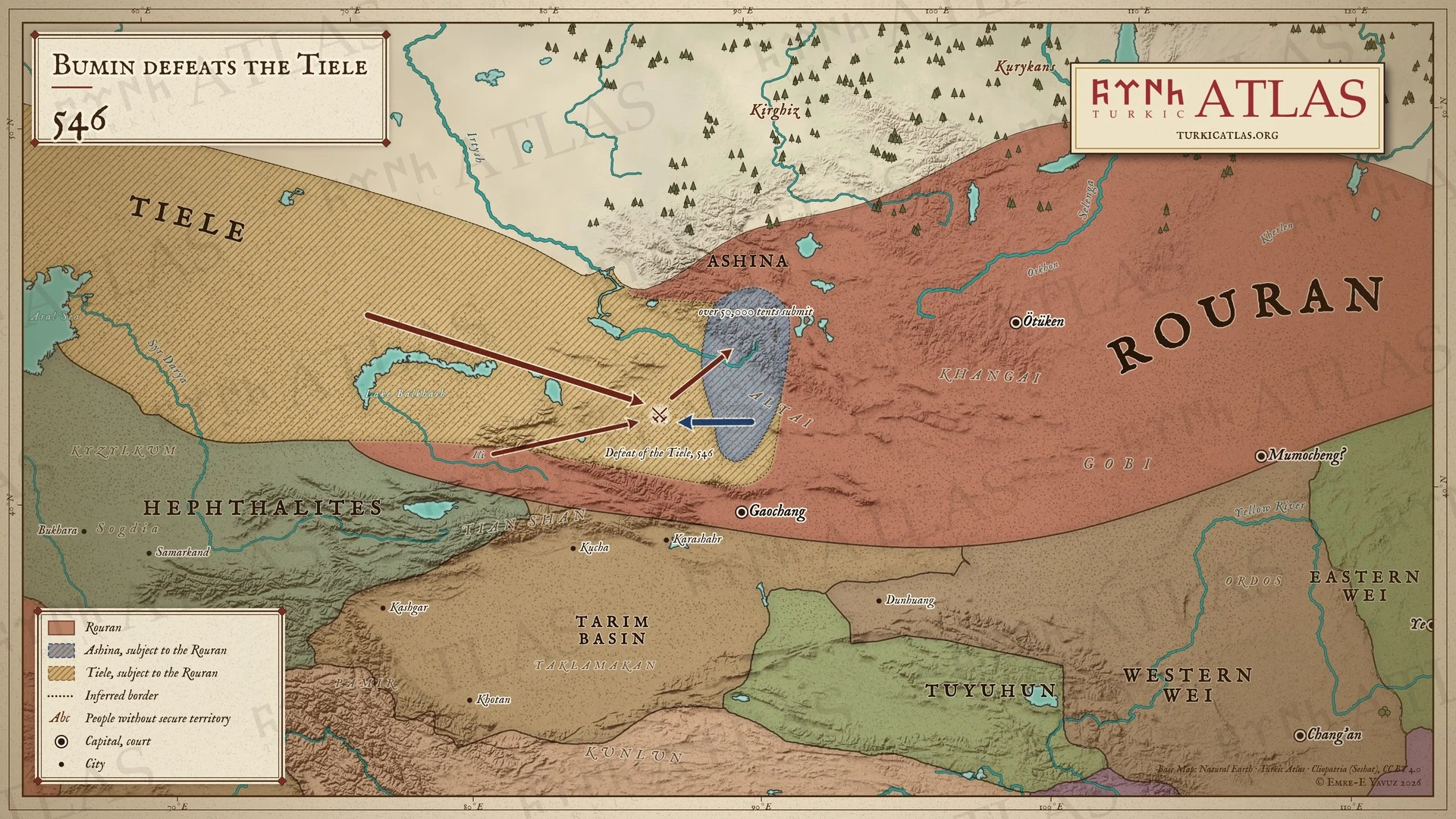
In 546 the Tiele, who ranged west of the Altai across Dzungaria, moved against the Rouran.[1] Their constituent groups were dispersed across a wide belt of steppe and had to assemble before they could strike. The Ashina lay close enough to learn of the plan. Bumin intercepted them on the march and defeated them. More than fifty thousand Tiele submitted to him.[1] The figure counts households or tents. Conversions into a total population are modern extrapolations that vary by a factor of five.
The numbers
No source gives the strength of either force. One reckoning gives Bumin about ten thousand riders and the Tiele host about fifty thousand, with twenty to thirty thousand the more cautious figure. On either reading the Ashina were outnumbered several times over. The victory was won by striking an army that had not finished assembling.
The second number is the one that carries weight for what followed. Fifty thousand tents at five to a tent is about a quarter of a million people. That is the order of magnitude that passed into Bumin’s domain in a single season. The two fifty-thousands should not be run together. The Zhou Shu’s figure counts tents that submitted, while the figure above counts men who fought. That they are close is not a coincidence but the ordinary arithmetic of the steppe, where a tent puts one rider in the field.
Bumin had about ten thousand riders of his own. Set against that, a quarter of a million people was more than a victory. The Ashina had been a subject clan at the Altai with a following counted in thousands. Within a single season they became a power counted in hundreds of thousands, without asking anyone’s leave.
Bumin most likely sent an envoy to the Rouran court with word of the Tiele movement. He marched while the envoy was still on the road. The khan therefore learned of the rising and of its suppression at the same time. The Zhou Shu gives the result and not the sequence.
Aftermath
Bumin took no Tiele territory. The tribal leaders submitted to him personally, and their followings were simply added to his own. Bumin had put down a rebellion against his overlord unasked. He had spared the Rouran the cost of doing it themselves, and he had kept the participants. Anagui had not sent a soldier. The man who had spared him the war now held, on the western edge of his realm, a following many times what the Ashina had been a year before.
In return for this, Bumin asked for a Rouran princess. Anagui refused, and the refusal came with an insult. It started the war.[1] The war is best dated from that refusal, in 546, with the defeat of the Tiele as its first act. Six years later the Tiele were in Bumin’s army when it destroyed the Rouran. They had submitted to him and not to his house. When he died the tie lapsed and had to be made again.
References
Sources
- Zhou Shu (Book of Zhou), juan 50
Literature
- Emre-E. Yavuz, The Gokturk Empire: 2nd Edition (2025)
What links here5
- Conflicts
- Gaoche secession (487) · Rouran Domination of the Turkic Peoples · The Turkic War of Independence
- Battles & Events
- The Rouran Marriage Refusal (546)
- Places
- Dzungaria
Cite this article
Yavuz, Emre-E. “Defeat of the Tiele, 546.” Turkic Atlas, revised 28 October 2026. https://turkicatlas.org/events/defeat-of-the-tiele-546/
Last revised: 28 October 2026

