
The flight of the Avars was the westward retreat of a steppe people before the Göktürks in the middle of the sixth century.[1] After many wanderings the Avars came to the Alans north of the Caucasus. Through them they reached the court of Justinian at Constantinople.[2] They probably arrived in the steppe north of the Black Sea and the Caspian about 557. Their first embassy came to Constantinople in 558.[1] Istemi, who ruled the western Göktürks, swore to attack them once his war with the Hephthalites was over.[3] The Avar question remained a source of conflict between the Göktürks and Constantinople.[4]
The fugitives
The khagans and the ruling nobility of the fugitives most likely came from the nobility of the fallen Rouran state. Some twenty thousand people fled west after 552.[5][6] They rode west in panic, probably past the Göktürk armies.[7] Other scholars differ on who the fugitives were. One has them suffer a severe defeat at the hands of the Göktürks in 555, which set them moving west.[8] Another has them flee from the Rouran or from the Hephthalites, or from both. In this version, they took in further groups on the way.[1]
In the eyes of the Göktürks they were deserters. Menander, the Byzantine historian of the embassies, preserves a saying of Silzibul, “the leader of the Turks”.[3] Silzibul learned of the flight of the Avars and of the damage they had done to Göktürk possessions as they left.[3] He boasted that they were not birds, to escape the swords of the Göktürks through the sky, nor fish, to hide in the depths of the sea. They had to travel the earth.[3] When he had ended the war with the Hephthalites, he would attack the Avars. They would not escape his might.[3] With that boast, Menander says, he went on with the war against the Hephthalites.[3] Silzibul is one of Menander’s forms of the name of Istemi.[9]
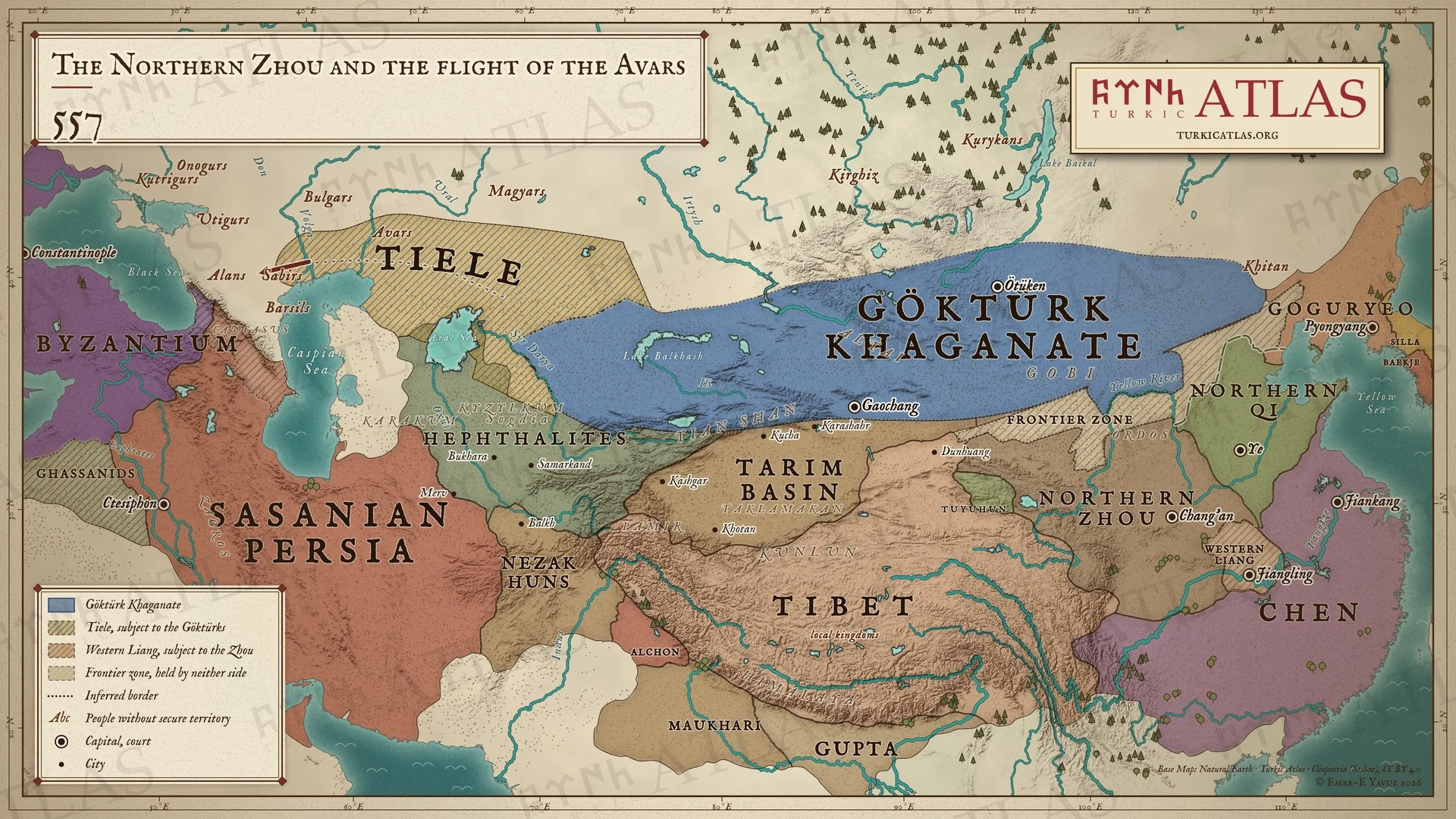
The road to Constantinople
After many wanderings the Avars came to the Alans. They begged Sarosius, the Alan ruler, to make them known to the Romans.[2] Sarosius told Justin, son of Germanus, who commanded the Roman forces in Lazica. Justin told the emperor.[2] Justinian had the embassy sent to Byzantium.[2] Its first envoy, Kandikh, announced the arrival of the greatest and most powerful of the tribes.[2] The Avars, he said, were invincible. They would protect the Roman state in return for the most valuable gifts, yearly payments and very fertile land.[2]
Theophanes the Confessor, a later Byzantine chronicler, enters the arrival under the year from September 557 to August 558.[10] In his words the strange race of the so-called Avars reached Byzantium, and the whole city thronged to look at them.[11] They wore their hair very long at the back, tied with ribbons and plaited. The rest of their dress was like that of the other Huns.[12] They had come as fugitives from their own country to Scythia and Mysia. They asked Justinian to admit them.[12]
Justinian sent them gifts: cords worked with gold, couches and silken garments. He also sent the envoy Valentinos, one of the imperial bodyguard.[13] He urged the Avars to an alliance with the Romans against their enemies.[13] The Avars then crushed the Unigurs and a Hunnic people called the Zali. They destroyed the Sabirs.[13] Some scholars identify this Valentinos with the envoy who went to the Göktürks in 576.[14]
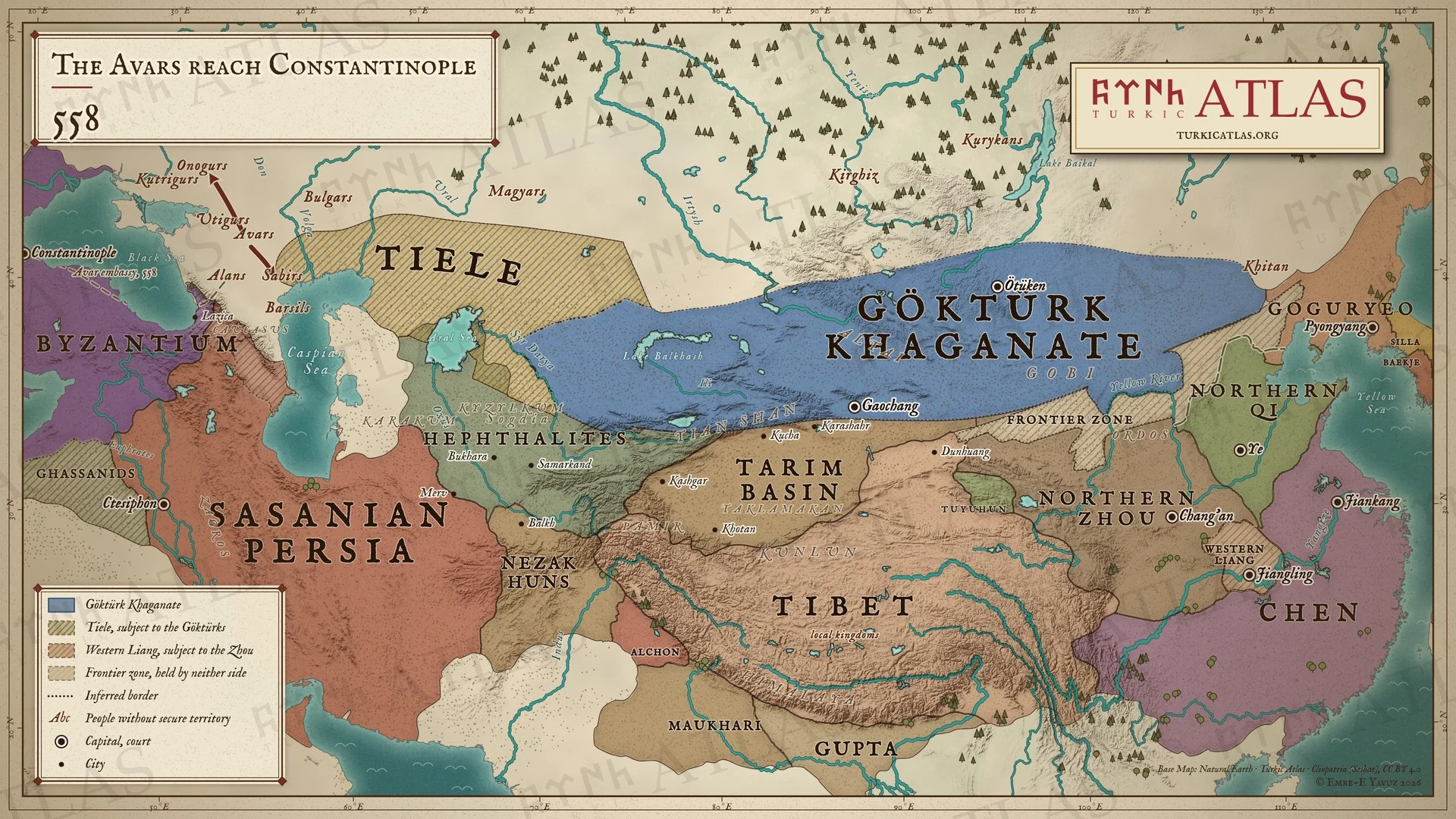
Date
The arrival among the Alans is usually dated to 557 or 558. Some scholars prefer 559 or 560.[14] Others have the Avars reach Justinian’s commander in Lazica in 557, after the defeat of 555.[8] Still others date the first Avar contacts with Rome to 558 or 559. They hold that some Avars had fled before the Göktürk conquest of the Hephthalites in 558.[15]
The Göktürk claim
The Göktürks did not let the matter rest. In 568 their envoys in Constantinople answered Justin II’s question about the Avars. Some still adhered to the Göktürks, and those who had fled numbered about twenty thousand.[16] The Avar question thus stood in the first audience of Maniakh’s embassy. In 576 the Göktürk prince Turxanthos called them “my slaves, the Uarkhonitai”.[17] He charged the emperor with making a treaty with “our slaves who have fled their masters”. Menander adds that he meant the Avars.[17] If they so much as saw his horsewhip, Turxanthos said, they would flee to the lowest reaches of the earth.[17] By then the Avars had driven the Gepids out of Pannonia, in 567 and 568. They had become the dominant force there.[1]
Theophylact’s account
A generation later Theophylact Simocatta told the story another way. Theophylact gives a letter of a Göktürk khan to the emperor Maurice. In it the khan had enslaved the Avar nation in alliance with Stembischagan.[18] Some of the defeated Avars fled to Taugast. Others fled to a people called the Mucri.[19] Theophylact concluded that the Avars of Europe were not true Avars.[20] In his account a small section of the Var and Chunni fled in the reign of Justinian and settled in Europe.[19] The Barselt, the Onogurs and the Sabirs took them for Avars and honoured them with gifts. The fugitives took the name.[21] Some scholars hold that Theophylact misdated the letter. They add that he may have built the story of the name from Menander’s Uarkhonitai.[22]
Consequences
The flight did not end with the first fugitives. In the same digression Theophylact says that the Tarniach and the Kotzager, who also came from the Var and Chunni, fled from the Göktürks into Europe and joined the Avar khan. This is the flight of the Tarniach and Kotzager.[23] The reinforcement came to ten thousand men.[23] Some scholars date this second flight to 582, the year of the revolt of Turum.[24] The pursuit of the Avars opened the Göktürk expansion into Europe. This expansion brought the Göktürks to the Volga, the Caucasus and the Crimea. It took the Göktürk–Rouran Wars from the eastern steppe to the frontier of Rome. Two decades after the flight, the fugitives were still the first grievance that a Göktürk prince put to a Roman envoy.
References
- ^ a b c d Golden 1992, p. 111
- ^ a b c d e f Menander Protector; Blockley 1985, fr. 5.1
- ^ a b c d e f Menander Protector; Blockley 1985, fr. 4.2
- ^ Golden 1992, p. 129
- ^ Golden 2013, p. 62–63
- ^ al. 2022, e6
- ^ Yavuz 2025, p. 227
- ^ a b Scott 1997, p. 340
- ^ Blockley 1985, p. 262
- ^ Theophanes the Confessor; Scott 1997, p. 339
- ^ Theophanes the Confessor; Scott 1997, p. 339–340
- ^ a b Theophanes the Confessor; Scott 1997, p. 340
- ^ a b c Menander Protector; Blockley 1985, fr. 5.2
- ^ a b Blockley 1985, p. 253
- ^ Whitby 1986, p. 188
- ^ Menander Protector; Blockley 1985, fr. 10.1
- ^ a b c Menander Protector; Blockley 1985, fr. 19.1
- ^ Theophylact Simocatta; Whitby 1986, p. 188
- ^ a b Theophylact Simocatta; Whitby 1986, p. 189
- ^ Theophylact Simocatta; Whitby 1986, p. 188–189
- ^ Theophylact Simocatta; Whitby 1986, p. 190
- ^ Whitby 1986, p. 188–189
- ^ a b Theophylact Simocatta; Whitby 1986, p. 191
- ^ Whitby 1986, p. 191
Sources
- Menander Protector
- Theophanes the Confessor (after Theophylact Simocatta)
- Theophylact Simocatta
Literature
- R. C. Blockley, The History of Menander the Guardsman: Introductory Essay, Text, Translation, and Historiographical Notes (1985)
- Peter B. Golden, An Introduction to the History of the Turkic Peoples (1992)
- Peter B. Golden, Some Notes on the Avars and Rouran (2013)
- Guido Alberto Gnecchi-Ruscone et al., Ancient Genomes Reveal Origin and Rapid Trans-Eurasian Migration of 7th Century Avar Elites (2022)
- Cyril Mango, Roger Scott (trans.), The Chronicle of Theophanes Confessor: Byzantine and Near Eastern History AD 284–813 (1997)
- Michael Whitby, Mary Whitby (trans.), The History of Theophylact Simocatta (1986)
- Emre-E. Yavuz, The Gokturk Empire: 2nd Edition (2025)
What links here4
- Conflicts
- The Göktürk–Rouran Wars
- Battles & Events
- Flight of the Tarniach and Kotzager · The khan's letter to Maurice
- Sources
- Menander Protector
Cite this article
Yavuz, Emre-E. “Flight of the Avars (557).” Turkic Atlas, revised 8 November 2026. https://turkicatlas.org/events/flight-of-the-avars-557/
Last revised: 8 November 2026

