
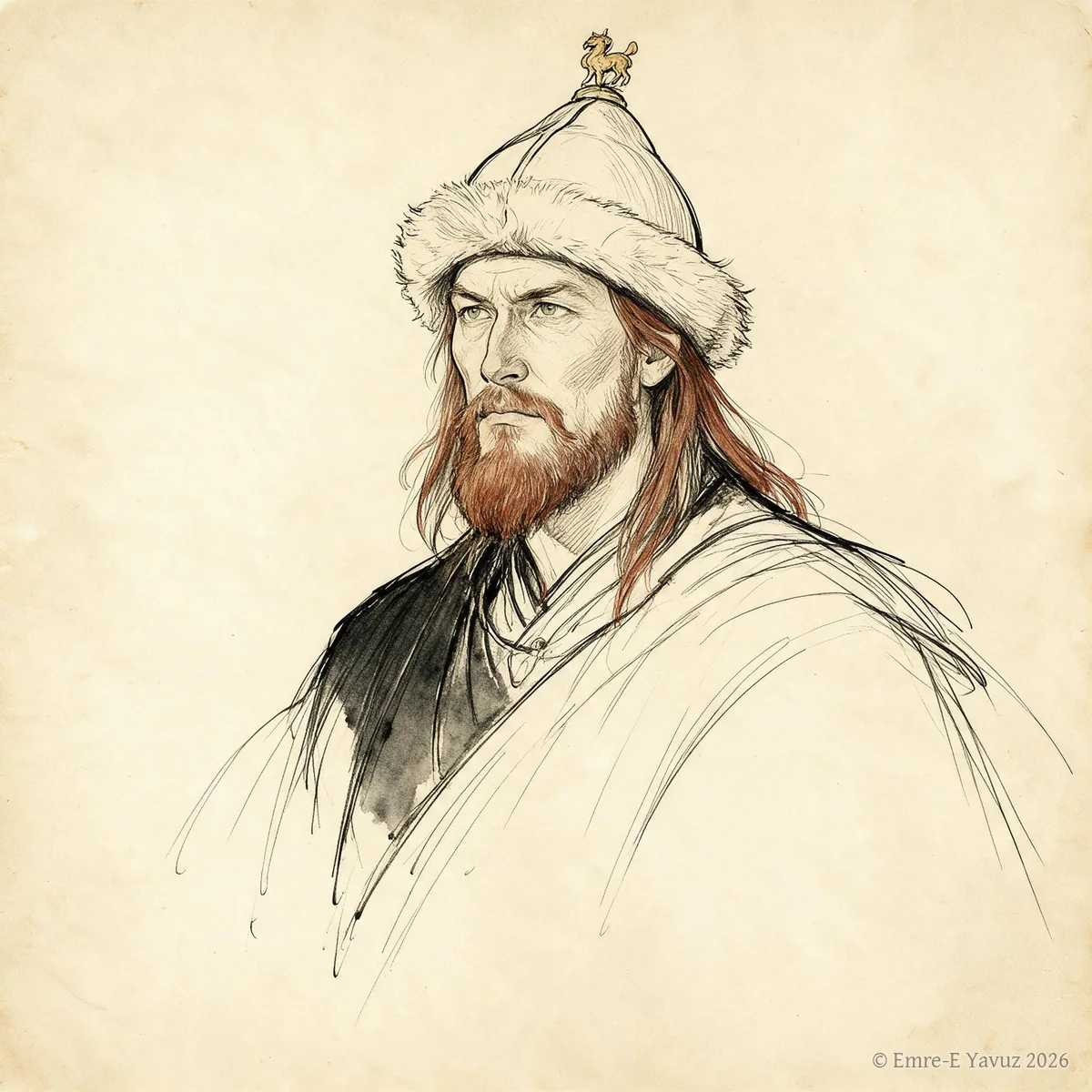
Are is the name the Chinese give to the ruler of the Yenisei Kirghiz. He called himself khan about 820 and destroyed the Uyghur khaganate in 840.[1] No other name for him is recorded.[1]
Name and title
- 阿熱ChineseXin Tangshu 217
- 毗伽頓頡斤ChineseXin Tangshu 217
- 可汗ChineseXin Tangshu 217
- Ažo, Ajo, acoEnglish
The Xin Tang Shu says that the Kirghiz call their lord Are. They take the clan name Are from him.[1] Michael R. Drompp interprets the name as both a surname and a title. He notes that nothing else supports it and that no Old Turkic word corresponds to it.[2] In 2002 Drompp adds that the Chinese sources call the Kirghiz ruler Are, not khan, for the time of Uyghur rule. By contrast, he notes, the Chinese text of the Karabalghasun stele calls a Kirghiz ruler of the same age a khan. He also notes that the Chinese give Are as the clan name of the ruler. The accounts therefore conflict. Are may be a proper name and not a title.[3] Interpretations of the name differ. One identifies it with the Chinese form of the title inal, a second with the Samoyed word for father, a third with the tribal name Az, and a fourth with the Turkic idi, lord. A survey of these interpretations concludes that none is secure.[4] A Kazakh scholar joined those who identify the word with “father”. In his account, aco first meant the head of a large patriarchal family and became the title of a ruler when the state arose.[5] One reply to the identifications with inal and with the tribal name makes three points. The Xin Tang Shu names the heads of tribes after their tribes and the Kirghiz lord by a different word. There is no sound link between inal and the tribe Az. And inal elsewhere names the head of a principality, not of a state.[6] A Chinese report of 931 gives the same two characters as the name of a Turk. The correct form there, however, seems to be A-shu, which has been identified as Asuq.[2]
From the Uyghur grant of the title Bilga Ton Irkin after 758 to the war of 840, the Chinese text calls the Kirghiz ruler Are.[1] More than eighty years lie between the two dates. One reign is unlikely to cover them. The name is therefore best taken as the designation of the ruler and not of one man. The Are of the war is the man who took the title of khan about 820.[7]
Family
His mother was a Türgesh woman who became mother-katun. His wife was the daughter of a Karluk yabgu and became katun.[1] Neither is named. Readers have found a Türgesh mother strange, because the Türgesh khaganate had been destroyed decades before his time.[8] Both ties point to the south-west, to the Karluk and Türgesh lands in the region of Lake Balkhash. The Kirghiz traded with these lands and allied themselves with them.[9] Drompp suggests that these family ties encouraged the Kirghiz ruler to take the title of khan about 820. He suggests the same of the factions at the Uyghur court that weakened Uyghur power.[3]
The war
When the Uyghurs grew weaker, Are called himself khan.[1] The Uyghur chancellor sent against him did not win. The two peoples fought for twenty years.[1] Are told the Uyghur khan that his luck had run out and that Are would take the golden tent, race his horses in front of it and plant his banner there.[1]
In 840 he took the field himself.[1] He burned the Uyghur camp and the golden tent and carried off the treasure. He found the princess Taihe. He then moved his own camp south of Mount Lao.[1] The war is told in the Uyghur–Kirghiz War, and the attack of 840 in the fall of Ordu-Balık.
The court
In winter Are wore a sable cap. In summer he wore a cap with a gold clasp, pointed at the crown and rolled at the brim.[1] He kept a single banner. His people favoured red.[1][10] He lived at the Blue Mountain, in felt tents joined together. A palisade enclosed them, standing where a wall would stand. His tent was called Midizhi. The other chiefs had small tents.[1] The chapter’s description of the Kirghiz is put together from accounts of different dates. These lines may therefore describe his predecessors too.[11]
Envoys and the register of the clan
Are had sent Taihe home with an escort. The Uyghur prince Wujie killed the envoys.[12] Since he had no other way to the Tang court, Are sent a new envoy, Zhuwu Hesu. The emperor Wuzong ranked this envoy above the envoys of Bohai.[1] The Kirghiz claimed descent from the Han general Li Ling, and with it the clan name of the Tang emperors.[13] The court ordered that Are be entered in the register of the imperial clan.[1] Turkic Atlas tells of the envoys under the embassies. It tells of the claim under the descent from Li Ling.
Are asked for troops of the Tang to strike the remnants of Wujie’s Uyghurs. The court chose Li Shi to invest him as Zongying Xiongwu Chengming Khan. Wuzong, however, died before Li Shi set out.[1] In the end the envoy Li Ye conferred the title Yingwu Chengming Khan on the Kirghiz, in 847.[1]
Death
Are was dead by then. One of his own officials killed him in the Huichang years, before 6 February 847. The news reached the Tang court only later.[14] The Xin Tang Shu names no ruler for the investiture of 847.[1] Another account has Are die in 847.[15] Drompp notes that this date is given without evidence.[16] Drompp takes the report of the murder from the sentence of the Xin Tang Shu on the Huichang years: 會昌中,阿熱以使者見殺,無以通於朝. He understands the order of the text as putting the death before the mission of the envoy Zhuwu Alp Sol. The envoy reached the capital on 16 March 843.[16][1] The same words are also taken to say that Are had no means of reaching the court, because his envoys had been killed. Turkic Atlas gives them in this sense under the embassies.[1]
The sources give no year of birth and no age.[1] Turkic Atlas tells of the state he ruled on the Yenisei under the Kirghiz khaganate.
References
- ^ a b c d e f g h i j k l m n o p q r s t u Xin Tangshu (New Book of Tang), juan 217
- ^ a b Drompp 2005, p. 37
- ^ a b Drompp 2002, p. 482
- ^ Mokeev 2019, p. 31–34
- ^ Mokeev 2019, p. 31
- ^ Mokeev 2019, p. 32
- ^ Drompp 2005, p. 36–37
- ^ Barthold 1927, p. 15
- ^ Drompp 1999, p. 402
- ^ Mokeev 2019, p. 30
- ^ Golden 1992, p. 178
- ^ Jiu Tangshu (Old Book of Tang), juan 195; Xin Tangshu (New Book of Tang), juan 217
- ^ Jiu Tangshu (Old Book of Tang), juan 195
- ^ Drompp 2005, p. 158
- ^ Barthold 1927, p. 17
- ^ a b Drompp 1999, p. 403
Sources
- Xin Tangshu (New Book of Tang), juan 217 (after Jiu Tangshu)
- Jiu Tangshu (Old Book of Tang), juan 195
Literature
- Michael R. Drompp, Tang China and the Collapse of the Uighur Empire: A Documentary History (2005)
- Michael R. Drompp, Breaking the Orkhon Tradition: Kirghiz Adherence to the Yenisei Region after A.D. 840 (1999)
- Michael R. Drompp, The Yenisei Kyrgyz from Early Times to the Mongol Conquest (2002)
- Peter B. Golden, An Introduction to the History of the Turkic Peoples (1992)
- Anvarbek Mokeev, Yenisey ve Altay Kırgızlarında siyasi unvan olarak aco ve idi terimlerinin menşesi ve anlamı (2019)
- V. V. Barthold, Kirgizy: istoričeskij očerk [Киргизы: исторический очерк] (1927)
- Colin Mackerras, The Uighur Empire According to the T'ang Dynastic Histories (1972)
What links here18
- Conflicts
- Uyghur–Kirghiz War
- Battles & Events
- Kirghiz Embassies to the Tang (842–848) · Rescue of Princess Taihe (840–843) · Tang investiture of the Kirghiz (847) · The fall of Ordu-Balık, 840
- Places
- Kemijkat
- Lineages
- Are
- Institutions and Titles
- Furs and Musk among the Turkic Peoples · Women among the Turkic Peoples
Cite this article
Yavuz, Emre-E. “Are Khan.” Turkic Atlas, revised 8 November 2026. https://turkicatlas.org/persons/are-khan/
Last revised: 8 November 2026

