
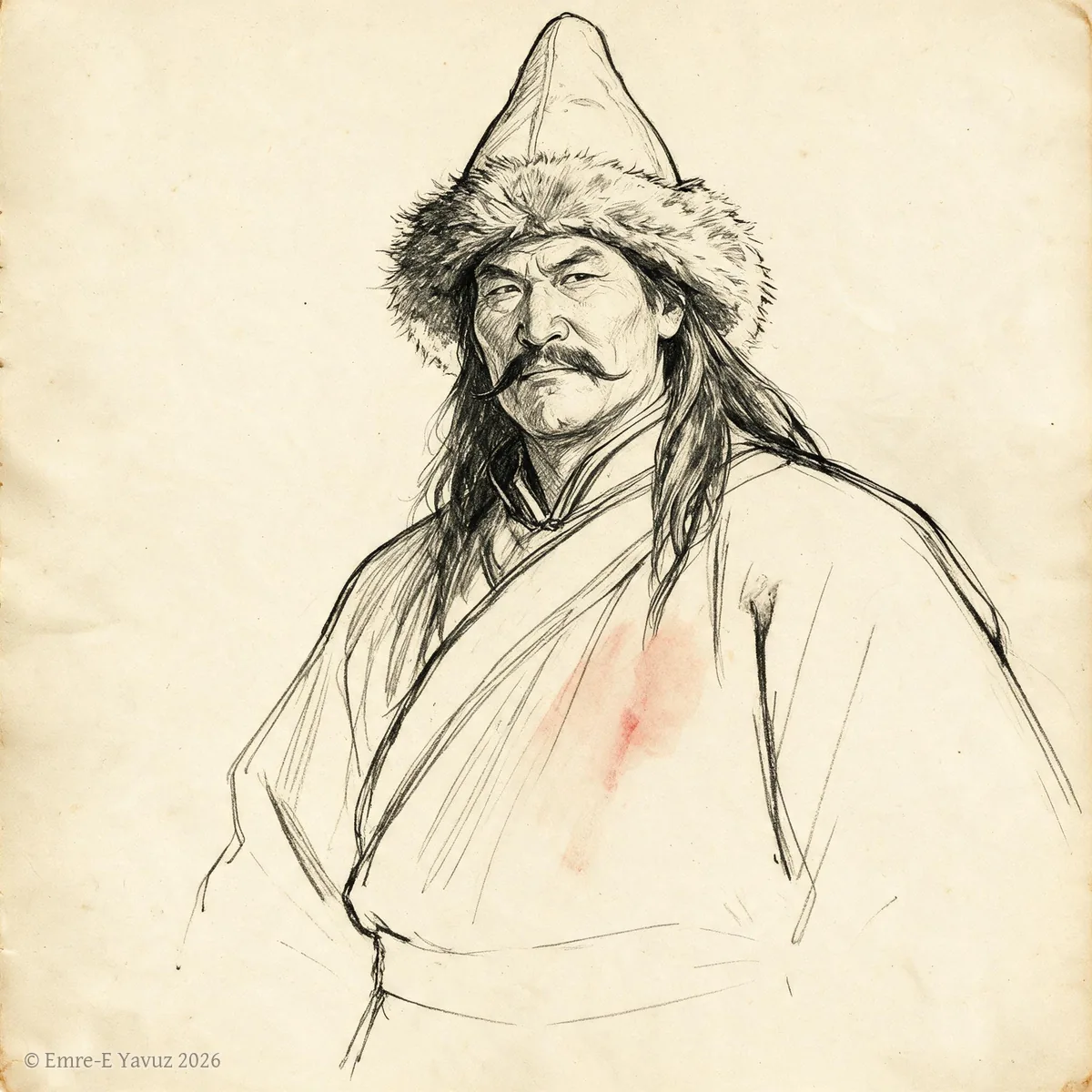
Kutlug Bilge Kül Khan founded the Uyghur Khaganate in a single campaigning season and ruled it for three years. The Chinese histories call him Guli Peiluo.[1]
The coalition of 744
From the late seventh century, the Uyghurs were again under Göktürk overlordship. At the end of Kapgan’s reign they turned on their masters. They had a hand in the khan’s death and in the weakening of his state.[1] From then on they were independent. According to the Old Tang History, they gradually became powerful.[1] The New Tang History names his father. Husu, a kinsman of the earlier chiefs, helped to kill the Tang governor of Liangzhou, fled to the Göktürks and died there. Kutlug Bilge Kül was his son.[2]
In 744 the Uyghurs under Kutlug Bilge Kül, with help from the Basmıl and the Karluks, overthrew the Second Göktürk Khaganate.[1] The coalition proved short-lived. As soon as the Göktürks were beaten, the Karluks and Uyghurs turned on the Basmıl and subjected them. Next came the Karluks: an eastern group of them was brought under Uyghur control.[1]
Of the three allies, two were subjected within months of the victory. This sequence is the foundation of the state, and the khaganate dates from it.[1] By one count, the coalition of the Uyghurs, Karluks and Basmıl drove the last important Göktürk ruler from the steppe in 742.[3] In 744, after he had defeated the Basmıl, Kutlug Bilge Kül took the title Kutlug Bilge Kül Khan.[4] Before the coalition, he had been consolidating the power of his own clan, the Yaglakar, among the Uyghur tribes.[4] According to a modern account, he put the Nine Oguz under his son. The son joined his father’s march against Özmiš Khan in the sheep year, 743, with their forces.[5]
Assessment
Kutlug Bilge Kül was the founder of the state, not its builder. His son Bayanchur consolidated it. Bayanchur subdued the Basmıl and Karluks when they proved recalcitrant. He also built the walled capital and palace on the Orkhon.[6] Bayanchur succeeded his father in 747. His own inscription at Šine-Usu says this in the first person.[6][7][8]
The Chinese title conferred on him in 744 sets the pattern for the whole dynasty. It combines three Turkic elements, Kutlug, Bilge and Kül, with a Chinese epithet, Huairen, at the end.[1] Every khan of the empire down to 840 received a title built the same way. The Chinese element is always the part that changes with the state of relations. The Tang also gave him rank. He became Prince Fengyi, and the year after the title of Huairen Khan he received the rank of general of the Left Guard.[2][9] A modern account calls him the last Uyghur khan who accepted the rank of prince or general from the Tang.[9]
Command of the conquest
The Chinese histories attribute the overthrow of 744 to him. They are right that it was his reign.[10] The Tariat inscription says who was in the field. It names his son, who was appointed commander of a thousand. From 741 onward the son acted in the Göktürk country for his father the khan.[10]
The same stone shows that this arrangement still stood in 747. In that year nine ministers, a thousand commanders and the common people brought their case not to the son who had won the war but to the father, who was khan.[11] The founder reigned for three years. He was not the commander of his own conquest.
References
- ^ a b c d e f g Jiu Tangshu (Old Book of Tang), juan 195
- ^ a b Xin Tangshu (New Book of Tang), juan 217
- ^ İzgi 1989, p. 16–17
- ^ a b Sinor 1990, p. 317
- ^ Sümer 1972, p. 19
- ^ a b Šine-Usu inscription
- ^ Tekin 2003, p. 227–228
- ^ Orkun 1994, p. 163
- ^ a b Jagchid 1989, p. 72
- ^ a b Saadettin 1995, p. 78
- ^ Saadettin 1995, p. 73
Sources
- Jiu Tangshu (Old Book of Tang), juan 195
- Xin Tangshu (New Book of Tang), juan 217 (after Jiu Tangshu)
- Tariat inscription
- Šine-Usu inscription
Literature
- Colin Mackerras, The Uighur Empire According to the T'ang Dynastic Histories (1972)
- Peter B. Golden, An Introduction to the History of the Turkic Peoples (1992)
- Emre-E. Yavuz, The Gokturk Empire: 2nd Edition (2025)
- Gömeç, Saadettin, Terhin Yazıtı'nın Tarihi Açıdan Değerlendirilmesi (1995)
- Denis Sinor (ed.), The Cambridge History of Early Inner Asia (1990)
- Özkan İzgi, Çin Elçisi Wang Yen-te'nin Uygur Seyahatnamesi (1989)
- Faruk Sümer, Oğuzlar (Türkmenler). Tarihleri, boy teşkilâtı, destanları (1972)
- Sechin Jagchid; Van Jay Symons, Peace, War, and Trade Along the Great Wall. Nomadic-Chinese Interaction through Two Millennia (1989)
- Talât Tekin, Orhon Türkçesi Grameri (2003)
- Hüseyin Namık Orkun, Eski Türk Yazıtları (1994)
What links here5
- Persons
- Bayanchur Khan
- Peoples
- Basmïl · The Great Empires of the Steppe · Uyghurs
- Sources
- Šine-Usu inscription
Cite this article
Yavuz, Emre-E. “Kutlug Bilge Kül Khan.” Turkic Atlas, revised 8 November 2026. https://turkicatlas.org/persons/kutlug-bilge-kul-khan/
Last revised: 8 November 2026

