
Ishbara died in 587. He held Tulan to be weak of character, passed him over and willed the throne to his brother Bagha. Tulan served the new khan as yabgu.[1] Bagha fell on a campaign in the west in 588, and his people raised Tulan as khan of the eastern Göktürks.[1] The division of the khaganate was by then complete. Tulan inherited a state whose khan had made himself a vassal of the Sui three years before. He tried to undo this. He sought to restore the independence of the Turkic peoples from the Chinese. The Sui answered with the instrument that had served them against his predecessor, a prince of his own house.
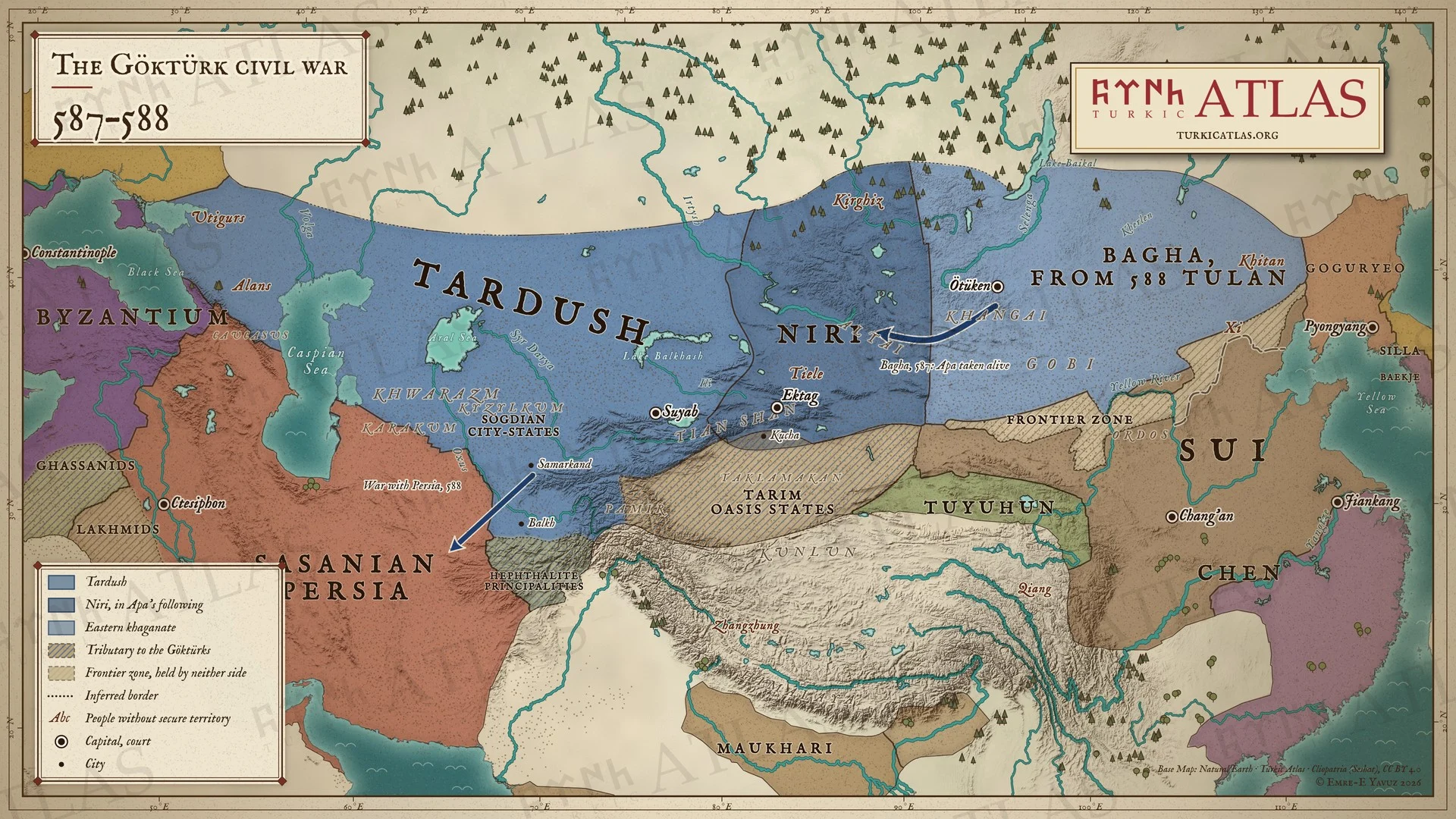
Rivalry with Yami
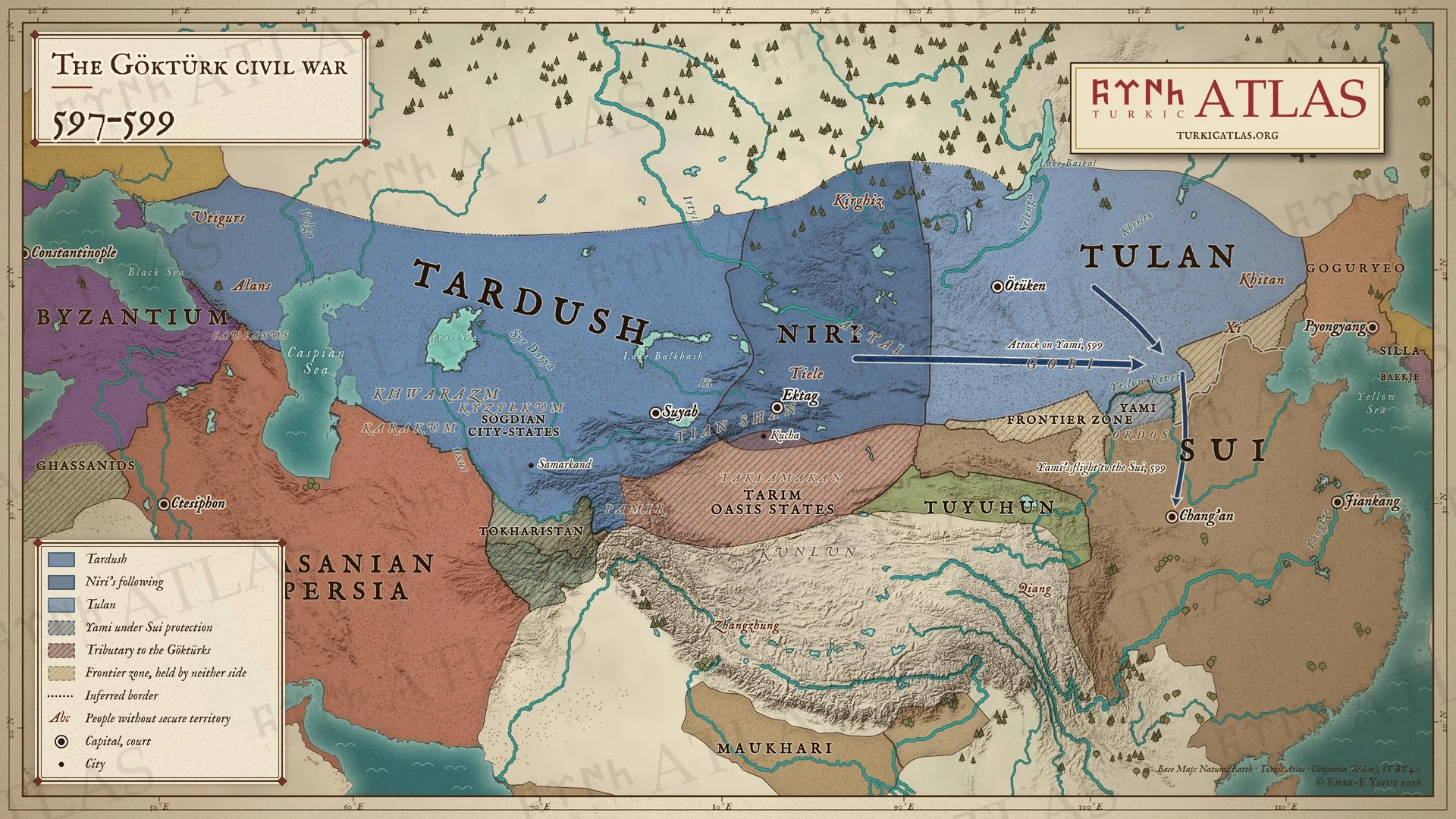
The prince was Yami, Ishbara’s son. Yami held a local command under Tulan and wanted the throne. In 597 Yami sent a secret embassy to the Sui asking for a princess. The Sui official Pei Ju offered one on condition that Qianjin be removed. Qianjin was the Zhou princess who had survived Ishbara and was now Tulan’s wife. Yami had her murdered.[2] Tulan was convinced that Chinese agents had done it, and he attacked the Sui. At every attack the Chinese armies were in the right place at the right time, because Yami and Pei Ju were corresponding.[2] In the Sui Shu, Yami slandered the princess to Tulan, and Tulan himself killed her in his tent.[1] Tulan learned of the betrayal and drove Yami out. Yami found refuge in China, a second princess, and the title of khan, which the Sui emperor conferred as a rival to Tulan.[1]
Tardush and the end of the reign
In 599 Tulan and Tardush, the western yabgu, attacked Yami together. They killed his brothers, sons and nephews and drove him to the Sui court.[1] The Sui sent an army against Tulan. Before it had left the frontier, Tulan was killed by his own followers.[1] One account puts Tulan’s death in 603.[2] Tardush proclaimed himself Bujia Khan, and the eastern realm fell into chaos.[1] Tardush fell, and Yami took over his people. He marched into Ötüken with Göktürk and Chinese troops.[1] The civil war ended with Tardush’s fall. The eastern khaganate spent its last three decades in the orbit of China.
The Chinese histories give his title as Dulan. The Turkic form of his name is not recorded. His relation to Ishbara is given as a brother by the usual reckoning. The Sui Shu names him Yongyulü and makes him Ishbara’s son. In its account, his father’s dying wish passed him over as weak in favour of the uncle Bagha, and he was raised to the throne at that uncle’s death.
References
Sources
- Sui Shu (Book of Sui), juan 84
Literature
- Emre-E. Yavuz, The Gokturk Empire: 2nd Edition (2025)
- Peter B. Golden, An Introduction to the History of the Turkic Peoples (1992)
What links here40
- Persons
- Bagha Khan · Dusuliu · Ishbara Khan · Niri Khan · Pei Ju · Princess Anyi · Princess Qianjin · Qinyu Shad · Rudan Khan · Rudan Tegin · Tardush · Yami Khan · Yintou Tegin
- States
- First Göktürk Khaganate · Sui
- Battles & Events
- Death of Princess Dayi · Death of Tulan Khan · The Archery Match at the Wu'an Hall (599) · The Attack on Yami Khan (599) · The Marriage of Princess Qianjin (580) · The Succession of 587 · The Sui Campaign of 599 · Yangdi's Visit to Yami Khan (607)
- Places
- Dali City · Dujin Garrison · Lingzhou · Mount Dajin · Shuozhou · Xiazhou · Youzhou
- Institutions and Titles
- Border Markets · Captives and the Unfree · Envoys and Embassies · Great Khan · Raw Materials and Trade among the Turkic Peoples · Tegin · The Economy of the Steppe Empires
- Customs & Pastimes
- Göktürk Games
Cite this article
Yavuz, Emre-E. “Tulan Khan.” Turkic Atlas, revised 7 November 2026. https://turkicatlas.org/persons/tulan-khan/
Last revised: 7 November 2026

