
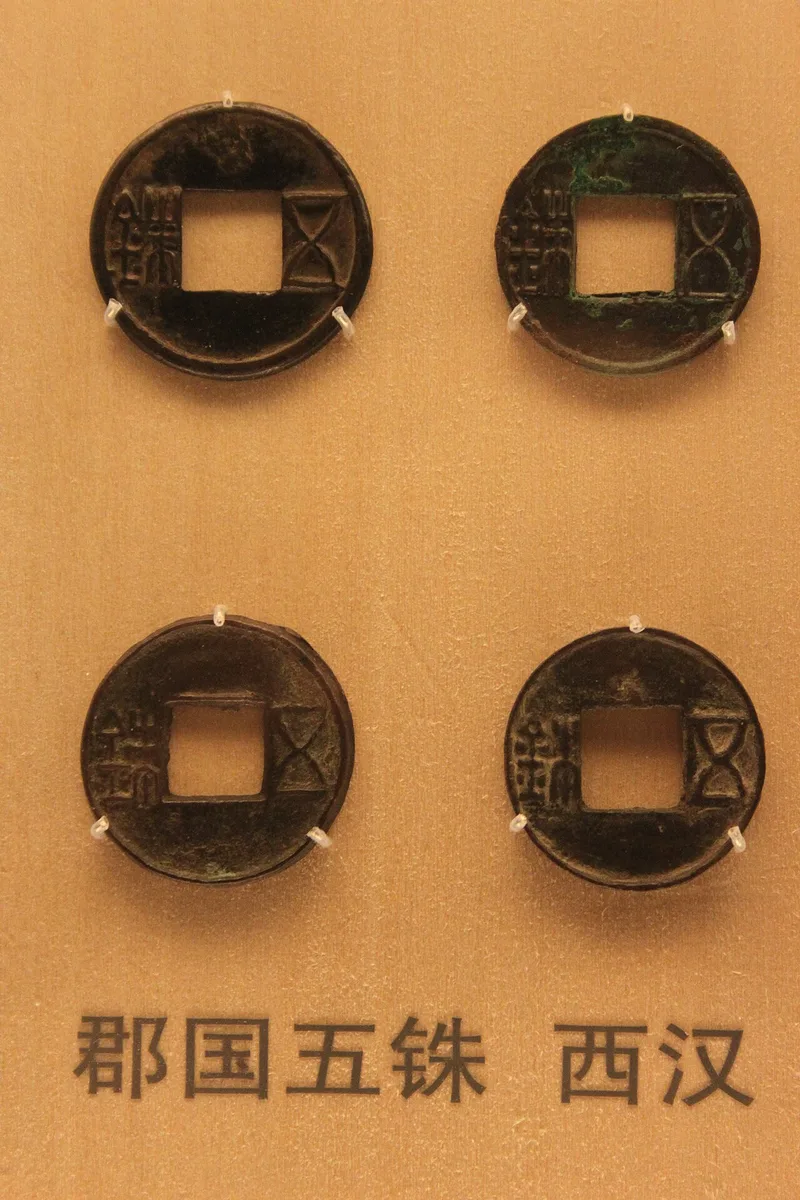
The Han ruled China from 202 BC to AD 220, with a break in the middle when Wang Mang held the throne. The Han were the counterpart of the Xiongnu across two centuries of frontier. They were beaten at Baideng in 200 BC. They paid under the heqin settlement until 133 BC. From Mayi onward they were at war. After AD 48 they were the protector and paymaster of the Southern Xiongnu against their northern kin.[1]
The heqin settlement
After Baideng the court of Gaozu sent Liu Jing with a princess of the imperial house to be the chanyu’s consort. The Han undertook to deliver floss, silk, wine and food each year in fixed amounts. The two houses were to be brothers.[2] Under Wen the settlement was renewed. In 162 BC the emperor had it proclaimed through the empire: the Xiongnu were not to enter the frontier, the Han were not to go out of it, and whoever broke the agreement was to die.[2] Jing renewed it again, reopened the frontier markets and sent a princess as before. The Xiongnu raided from time to time, but never in force.[2] In the early years of Wudi the terms were confirmed and the markets were generously supplied. According to the Han Shu, the Xiongnu from the chanyu down were friendly to the Han and came and went along the Wall.[2]
The war of Wudi
The settlement ended with a ruse. A man of Mayi, sent out by the Han, pretended to sell his city to the chanyu. The Han hid more than three hundred thousand men around it. The chanyu saw cattle spread over the fields without a herdsman. He grew suspicious and turned back. The Han general who had proposed the plan but did not move was put to death.[2] From then on the Xiongnu broke the heqin and raided the frontier. They still wanted the markets, however, and the Han kept them open.[2]
Wudi’s generals took the land south of the Yellow River and built Shuofang commandery there. They gave up the Zaoyang district of Shanggu to the Hu.[2] In one campaign the Han lost two generals and more than three thousand horse. Zhao Xin, a petty king of the Hu, had been made a marquis and a general by the Han. He went back to the chanyu with his force. He advised the chanyu to move north beyond the desert, to draw the Han out and wear them down.[2] In 121 BC the Hunye King killed the Xiutu King and came over to the Han with more than forty thousand people, called a hundred thousand. The Han settled them in five dependent states and made Wuwei and Jiuquan commanderies of their land.[3] In 119 BC the two Han armies crossed the desert. The chanyu escaped north-west with a few hundred riders.[2] The Han Shu states the result in one clause: from then on the Xiongnu withdrew far, and south of the desert there was no royal court.[2] The Han ran canals and field offices from Shuofang west to Lingju, with fifty or sixty thousand officials and soldiers.[2] The Mobei campaign has its own article.
The same chapter gives the cost. On the Xiongnu side, the Han counted eighty or ninety thousand killed or taken. On its own side it counted ten thousand and more dead and more than a hundred thousand horses lost. As a result it had too few horses to go again.[2] When the chanyu asked for heqin, the court was divided. Some wanted the old settlement and others wanted him made a subject. The chief clerk Ren Chang was sent to tell him to become an outer subject and attend at the frontier. The chanyu, enraged, kept him.[2] Fan Ye gives his verdict on Wei Qing and Huo Qubing in the Hou Han Shu, in the biography of Dou Xian. They used the strength of the Han against the Xiongnu year after year until more than half the state’s resources were gone. The cunning enemy was still not beaten.[4]
West of the corridor
The war had a western side. According to the Han Shu, Wudi took Korean and Huimo country in the east. At the same time he set up Jiuquan commandery in the west to cut the Hu from the Qiang. He opened the road to the Yuezhi and Daxia. He gave a princess to the king of the Wusun, to split the Xiongnu from their allies in the west.[2] The closing judgement of the same work on the Western Regions gives the aim as cutting the right arm of the Xiongnu. Wudi opened the four commanderies of Hexi, passed the Jade Gate and reached the western states. He separated the southern Qiang and the Yuezhi from the chanyu, who lost his support and fled far.[5] The same judgement counts the cost: monopolies on wine, salt and iron, a new coinage, and taxes on carts, boats and livestock. The people’s strength gave out and bandits rose. At the end of his reign Wudi gave up the land of Luntai and issued an edict of grief.[5] The mission of Zhang Qian to the Yuezhi, which opened the road, has its own article.
The sources date the four commanderies of Hexi, which held the road, in more than one way. The annals of Wudi in the Han Shu place Wuwei and Jiuquan in 121 BC, made of the land of the Hunye and Xiutu kings. They place Zhangye and Dunhuang in 111 BC, cut from the land of the first two.[6] The chapter on the Western Regions names Jiuquan alone as the first. It says that after settlers had been sent to fill the country, Wuwei, Zhangye and Dunhuang were set apart from it.[5] Two further datings are reported. The geographical treatise of the Han Shu is said to give 104 BC for Zhangye and Jiuquan, 101 for Wuwei and 88 for Dunhuang.[7] The Zizhi tongjian sets up Jiuquan alone in 115 BC. It detaches Wuwei from it later and adds Zhangye and Dunhuang in 111.[7]
Farm colonies followed the war. After the campaign against Dayuan the Han settled a few hundred soldier-farmers at Luntou and put an envoy over them to guard the fields and store grain for the missions sent abroad.[8] It was the first of a chain of colonies along the northern road through the Tarim.[9] In 60 BC the Rizhu King came over to the Han. The officer who received him, Zheng Ji, was given the protection of the northern road in addition to the southern. The post was called Protector General, and its seat was the town of Wulei.[5]
Two parties at the court
Ban Gu closed his chapter on the Xiongnu with a verdict on the Han court. From Gaozu on, he says, every adviser had his own view. The advisers were Liu Jing under Gaozu, Fan Kuai and Ji Bu under the empress Lü, Jia Yi and Chao Cuo under Wen, and Wang Hui, Han Anguo and Dong Zhongshu under Wudi. All of them came down to two parties. The scholars in court dress held to heqin. The men in armour spoke for conquest. Each party, he says, saw only the advantage of the moment, and neither had studied the Xiongnu from beginning to end.[2] In the course of its history the Han had made peace by courtesy, conquered by arms, served the Xiongnu in humility and subdued them by awe.[2]
The submission of the chanyu
The turn came from the Xiongnu side. In 53 BC the chanyu Huhanye, beaten by his brother, followed the counsel to submit. He sent his son to serve at the Han court.[2] In the first month of 51 BC, the third year of Ganlu, he came to Ganquan palace. The Han received him with special rites. His place was above the feudal kings, and he was announced as a subject without being named. The gifts included a gold seal, a robe and cap, a jade-hilted sword, a carriage, and eight thousand bolts of brocade and silk.[2] The court then escorted him home to Shuofang with sixteen thousand horse. It fed him from the frontier granaries.[2] In a later year Huhanye sought permission to guard the frontier from Shanggu to Dunhuang himself, so that the Han could dismiss its garrisons. The court debated the request. An officer who knew the frontier advised against it. The Yinshan had been the Xiongnu’s hunting ground and bow-making country until the Han took it, and old men said that the Xiongnu never passed it without weeping. The emperor refused to dismiss the garrisons.[2] The same chapter records the gift of Wang Zhaojun to the chanyu in the same year.[2]
Wang Mang and the Later Han
The settlement of Huhanye held for sixty years and more. Ban Gu says that Wang Mang’s usurpation opened the rift. The chanyu turned his resentment against the Han, and Wang Mang beheaded his hostage son.[2] The rift began over a seal. In AD 9, in the first year of his reign, Wang Mang sent six envoys to the chanyu with gold and silk to exchange the seal the Han had given the Xiongnu. The old seal read “Seal of the Chanyu of the Xiongnu”, the new one “Stamp of the Chanyu of the Xiongnu of Xin”. One of the envoys was afraid that the chanyu would ask for the old seal once he had read the new one. He broke the old seal with an axe. The next day the chanyu’s marquis objected. The Han, he said, had given a seal and not a stamp. The kings below the chanyu were the ones whose seals bore the word Han and the word stamp. Now “seal” was gone and “Xin” added. The chanyu stood no higher than a subject. The chanyu sent his brother to thank the envoys. He also asked in writing for the old seal.[2][10][11][12] In AD 11 Wang Mang divided the Xiongnu on paper into fifteen chanyus. He sent two officers with ten thousand horse to the Yunzhong frontier to lure out Huhanye’s descendants. Three came: the Right Lihan King Xian, his son Deng and Zhu. Xian was forced to accept the title of Filial Chanyu and Zhu that of Obedient Chanyu, and Zhu and Deng were sent on to Chang’an.[2][13] The reigning chanyu was angry. He said that the former chanyu had received favours from Emperor Xuan and could not betray them. The present Son of Heaven, he said, was not a descendant of Xuan, so by what right did he rule? He sent his commanders into Yunzhong, where they killed many officials and people.[2] After that he ordered the commandants of his left and right wings and the kings of the border to raid, in bands of more than ten thousand, of several thousand and of several hundred.[2][14] Wang Mang answered with twelve army commanders and a levy of 300,000 men, with grain for three hundred days, to advance on ten routes and drive the Xiongnu as far as the Dingling. The land was then to be divided among Huhanye’s fifteen sons.[2][14] His general Yan You objected with five difficulties: the army could not be gathered in a year, the empty border could not feed it, the oxen would die before a hundred days were out, the cold and the wind of the Xiongnu country would break an army that stayed through the seasons, and the baggage would slow the troops so much that the enemy could simply withdraw. Wang Mang did not listen, and the empire was in turmoil.[2][15] In AD 15 Wang Mang sent envoys once more with gold and valuables and persuaded the chanyu to take new names, 恭奴 for the Xiongnu and 善于 for the title of chanyu. Modern accounts understand them as “obedient slaves” and “a good man”.[16][17] The chanyu was glad of the gold and agreed, but the raids went on as before.[2] Dated wooden slips from the frontier posts north of Dunhuang run on from AD 8 to AD 21. The line of posts there was therefore still manned in the last years of his reign, whatever happened in the oases.[18] In the west Wang Mang demoted the kings of the Tarim oases. They revolted and returned to Xiongnu service. The Xiongnu taxed them hard, and in the Jianwu years they sent to ask for a Protector. Guangwu, with the empire barely settled, refused.[19] The split of AD 48 gave the Han a new partner in the Southern Xiongnu.[20] In AD 89 Dou Xian and Geng Bing took eight thousand horse out with the southern riders and broke the northern chanyu. In AD 91 the northern chanyu was beaten again and fled to an unknown place.[20] The Protector of the Western Regions was restored in the Yongping years. It was restored again under Ban Chao, who held the post from Kucha from the third year of Yongyuan.[19] After the death of the emperor He the Western Regions revolted, and the emperor An abolished the Protector. According to the Hou Han Shu, the Han thereupon gave the region up. The northern Xiongnu took the states back and raided the frontier for more than ten years.[19] Ban Yong, the son of Ban Chao, went out with five hundred convict soldiers to Liuzhong and broke Cheshi. Seventeen states submitted. The Wusun and the country west of the Congling, however, were lost.[19] The same work counts that between Jianwu and Yanguang the Western Regions were cut off from the Han three times and opened three times.[19]
The Han as the source
The Han are present in a second way, and it matters more. Three works written under and about the Han, the Shiji, the Han Shu and the Hou Han Shu, carry nearly everything that can be known of the Xiongnu, their offices, their law, their assemblies and their rulers’ own words. The steppe left no text of its own from these centuries. The account that survives is therefore the account of the power that fought it.
Relations with other states
Red is war, blue alliance, gold trade. Where several held at once, the line shows what prevailed; alliance and trade can run side by side. Each line rests on an article. Point at a state to see its weightiest relation, select it to see its events. The slider shows what stood in a given year, and Play runs through the years.
Xiongnu200 BC to 93
- War200 BC to 93The Xiongnu–Han Wars
- War200 BCSiege of Baideng
- Treaty198 BC to 33 BCThe Han–Xiongnu heqin treatiesthe heqin treaties
- Trade198 BC to 33 BCHeqinsilk, grain and the frontier markets
- War133 BCMayi ambush
- War119 BCMobei campaign, 119 BC
- War87 to 93Han campaigns against the Northern Xiongnu
Southern Xiongnu48 to 93
- Alliance48 to 93The Xiongnu–Han Wars
- Alliance87 to 93Han campaigns against the Northern Xiongnu
References
- ^ Shiji, juan 110
- ^ a b c d e f g h i j k l m n o p q r s t u v w x y z aa ab ac Han Shu, juan 94
- ^ Han Shu, juan 94; Han Shu, juan 6
- ^ Hou Han Shu, juan 23
- ^ a b c d Han Shu, juan 96
- ^ Han Shu, juan 6
- ^ a b Chavannes 1913, v–vi
- ^ Shiji, juan 123
- ^ Herrmann 1910, p. 119–121
- ^ Chavannes 1913, p. 128
- ^ Ögel 2015, p. 195–198
- ^ Jagchid 1989, p. 66
- ^ Ögel 2015, p. 202–203
- ^ a b Ögel 2015, p. 203
- ^ Ögel 2015, p. 204–206,208
- ^ Jagchid 1989, p. 31,66
- ^ Ögel 2015, p. 214
- ^ Chavannes 1913, vii
- ^ a b c d e Hou Han Shu, juan 88
- ^ a b Hou Han Shu, juan 89
Sources
- Shiji, juan 110, 123
- Han Shu, juan 6, 94, 96 (after Shiji)
- Hou Han Shu, juan 23, 88, 89
Literature
- Peter B. Golden, An Introduction to the History of the Turkic Peoples (1992)
- Emre-E. Yavuz, The Gokturk Empire: 2nd Edition (2025)
- Édouard Chavannes, Les documents chinois découverts par Aurel Stein dans les sables du Turkestan oriental (1913)
- Albert Herrmann, Die alten Seidenstrassen zwischen China und Syrien. Beiträge zur alten Geographie Asiens, Bd. 1 (1910)
- Bahaeddin Ögel, Büyük Hun İmparatorluğu Tarihi II (2015)
- Sechin Jagchid; Van Jay Symons, Peace, War, and Trade Along the Great Wall. Nomadic-Chinese Interaction through Two Millennia (1989)
What links here31
- Persons
- Ban Chao · Emperor Gaozu of Han · Emperor Wu of Han · Er Chanyu · Hunye King · Huo Qubing · Huyandi Chanyu · Jin Midi · Li Guangli · Li Ling · Meng Tian · Qiedihou Chanyu · Su Wu · Wang Zhaojun · Wei Lü · Wei Qing · Wuwei Chanyu · Xulihu Chanyu · Yizhixie Chanyu · Zhonghang Yue
- States
- Shanshan
- Conflicts
- The Xiongnu–Han Wars
- Battles & Events
- Mobei campaign, 119 BC · The Han–Xiongnu heqin treaties
- Peoples
- Eurasian Nomads
- Controversies
- The Kirghiz descent from Li Ling
Cite this article
Yavuz, Emre-E. “Han dynasty.” Turkic Atlas, revised 8 November 2026. https://turkicatlas.org/polities/han-dynasty/
Last revised: 8 November 2026


