
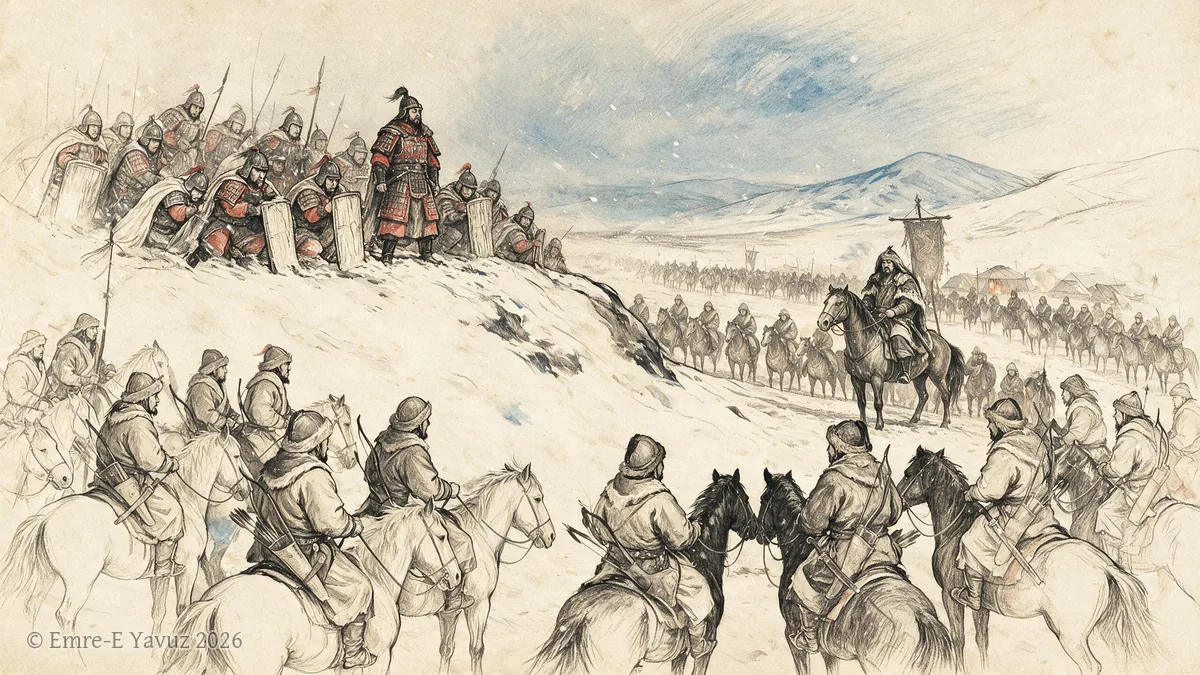
In the winter of 200 BC the founding emperor of the Han dynasty took the field against the Xiongnu in person. The Xiongnu surrounded him on a hill for seven days.[1] He got out alive. The terms his government agreed afterwards governed the frontier for the next seventy years.[1]
The campaign
The Han king Xin had been moved to Dai with his capital at Mayi. The Xiongnu came against Mayi in force, and Xin went over to them. With Xin in hand, Bagatur took his army south over Gouzhu. He struck at Taiyuan and came as far as Jinyang. The emperor Gaozu marched to meet him.[1] The emperor may have taken the field against the Han king who had gone over, and not against the Xiongnu as such. Xin had been a companion of Gaozu in the wars that made the dynasty. The emperor took the field in person against him as soon as he went over. What mattered to the Han, then, was to stop border commanders from joining the Xiongnu and setting up states of their own.[2]
It was an exceptionally hard winter. The Shiji records that it rained and snowed and that two or three men in ten lost fingers to the cold.[1][3] Bagatur then did what steppe commanders did whenever the ground allowed it. He made a show of being beaten and drew the pursuit on. He hid his good troops and let only the weak and the thin be seen. The Han came north after him with three hundred and twenty thousand men, most of them infantry.[1][4] According to the biography of the king Xin, a vanguard of more than ten thousand horse under the Right and Left Worthy Kings had joined Xin’s generals before this. The Han army defeated it several times and pursued it.[5]
The ring
Gaozu reached Pingcheng ahead of his foot. Bagatur loosed four hundred thousand picked horse and shut him up on Baideng. For seven days the forces inside and outside the ring could neither relieve nor supply each other.[1][6] The Han Shu has more than three hundred thousand picked horse in place of four hundred thousand.[7][6] The same text describes the ring by colour. This description is the earliest account of a steppe army drawn up by wings: white horses to the west, bluish-grey to the east, black to the north, red to the south.[1][8] The passage cannot settle whether this was an order of battle, a ritual arrangement by the four directions, or a Chinese writer’s tidying of both.
The opening
Gaozu sent a rich gift in secret to the chanyu’s consort. She said to Bagatur that two rulers ought not to press each other. Even if he took Han territory, she said, the chanyu could not in the end live in it. The Han king, she added, had a divine protection that the chanyu should consider.[1] At the same time, Bagatur had arranged a meeting with Wang Huang and Zhao Li, the generals of the defected Han king Xin. Their troops did not come. He suspected that they had an understanding with the Han. The consort’s words, together with that suspicion, led him to open one corner of the ring.[1] Gaozu ordered every man to draw his bow to the full with an arrow on the string and face outward. He walked the column straight out through the gap and rejoined his main army. Bagatur drew off, and the Han drew off too.[1]
Consequences
The Han sent Liu Jing to conclude the heqin agreement.[1] The raiding did not stop. Xin served as a Xiongnu general afterwards, and Bagatur came and went into Dai as he pleased. The Han then sent Liu Jing again with a woman of the imperial house to be the chanyu’s consort. They also sent fixed yearly quantities of floss, silk, wine, rice and food. An oath made the two rulers brothers. The Shiji notes the result drily: Bagatur then let up a little.[1]
The siege also fixed a Han judgement that outlasted the reign. When the empress Lü wished to answer an insolent letter from Bagatur with war, her generals stopped her with a single argument. Gaozu was wise and warlike, and he was still hard pressed at Pingcheng.[1]
References
Sources
Literature
- Peter B. Golden, An Introduction to the History of the Turkic Peoples (1992)
- Emre-E. Yavuz, The Gokturk Empire: 2nd Edition (2025)
- Bahaeddin Ögel, Büyük Hun İmparatorluğu Tarihi I (2015)
- Owen Lattimore, Inner Asian Frontiers of China (1951)
What links here15
- States
- Han dynasty
- Conflicts
- The Xiongnu–Han Wars
- Battles & Events
- Capture of Ilig Khan (630) · Ilig Khan's Dance at the Weiyang Palace (633) · The Han–Xiongnu heqin treaties
- Places
- Gouzhu Pass · Mayi
- Institutions and Titles
- Diplomacy of the Steppe Empires · Heqin · Warfare of the Steppe Empires · Women among the Turkic Peoples
Cite this article
Yavuz, Emre-E. “Siege of Baideng.” Turkic Atlas, revised 8 November 2026. https://turkicatlas.org/events/battle-of-baideng/
Last revised: 8 November 2026

