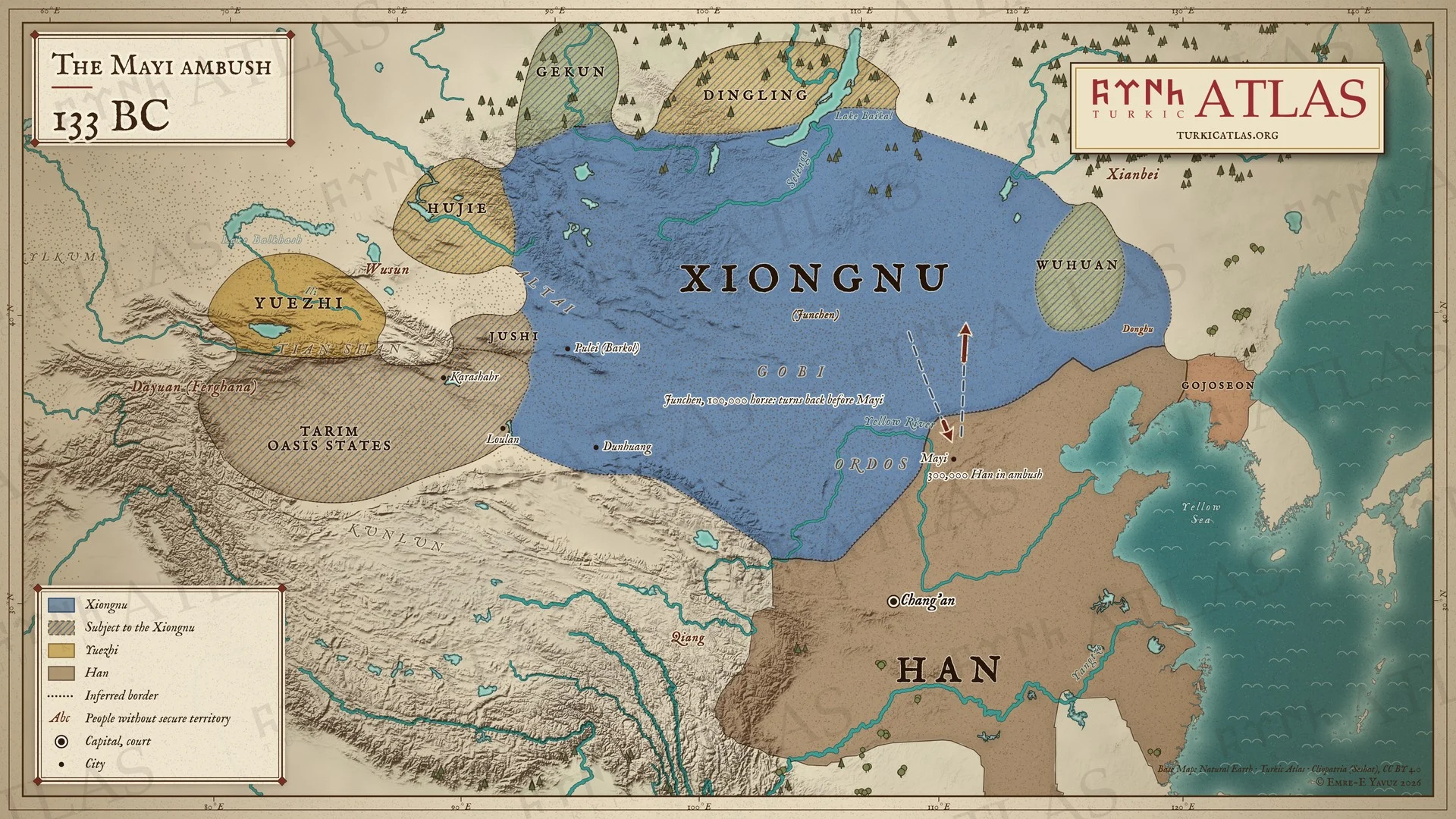
133 BC. The Han hid three hundred thousand men around a frontier town and offered to sell it to the chanyu. He noticed the cattle grazing unattended and turned back, and the heqin settlement ended.
Reading path
The Mayi ambush is the largest battle of the Han–Xiongnu wars that was never fought. In 133 BC the Han put three hundred thousand men in hiding around a frontier town. The chanyu rode away before a single arrow was loosed.[1] The ambush ended the heqin settlement, and the war that followed lasted sixty years.[1]
The plan
The Shiji is explicit that the Han broke the peace. The new emperor had confirmed the treaty, treated the Xiongnu generously, opened the frontier markets and supplied them well. From the chanyu down, the Xiongnu were friendly and came and went below the wall.[1] A man of Mayi named Nie Wengyi, who traded contraband across the line, was used to offer the chanyu the town of Mayi for sale. Junchen believed him and wanted the goods of the town. He came into the Wuzhou pass with a hundred thousand horse. Three hundred thousand Han troops lay in ambush around Mayi under the censor-in-chief Han Anguo, with four generals under him.[1][2][3] To make the offer credible, Nie Wengyi hung the head of a condemned criminal on the wall of Mayi as a sign that the governor was dead. A letter then told the chanyu that the governor of Mayi was dead and that he could come at once.[4][5] Emperor Wu may have planned the ambush to free himself from the payments to the Xiongnu. The exchange had been one-sided since the first treaty, and Wu was distressed by the growing demands for grain, silk and cash.[6]
A hundred li short of the town, the chanyu saw livestock spread over the country with nobody herding it. He thought it strange. Instead of going on, he attacked a watchtower. In the tower was a frontier officer of Yanmen who knew where the Han army lay. The chanyu took him and meant to kill him, but the officer told him what was waiting. Junchen said that he had suspected it all along, and pulled his army out.[1] Riding away, he said that taking the officer had been the work of Heaven, and that Heaven had made him speak. He gave the man the title Heavenly King.[1][7]
The general Wang Hui had been detailed to come out of Dai and strike the Xiongnu baggage. He heard that the chanyu had turned back and that his force was large. He did not move. The Han executed him for having devised the plan and then failed to advance.[1][8]
Consequences
From that point, the Shiji says, the Xiongnu broke off the heqin and attacked the passes on the roads. They raided the Han frontier past counting.[1] One thing did not change. The Xiongnu still wanted the markets and Han goods, and the Han kept the markets open in order to hold them by that.[1][9] On a modern account, the Han often trapped the Xiongnu by the trick of opening a market.[4] Five years later the first of the Han offensives went out: four generals with ten thousand horse each. One of them reached Longcheng, where the Xiongnu held their great assembly of the fifth month.[1]