
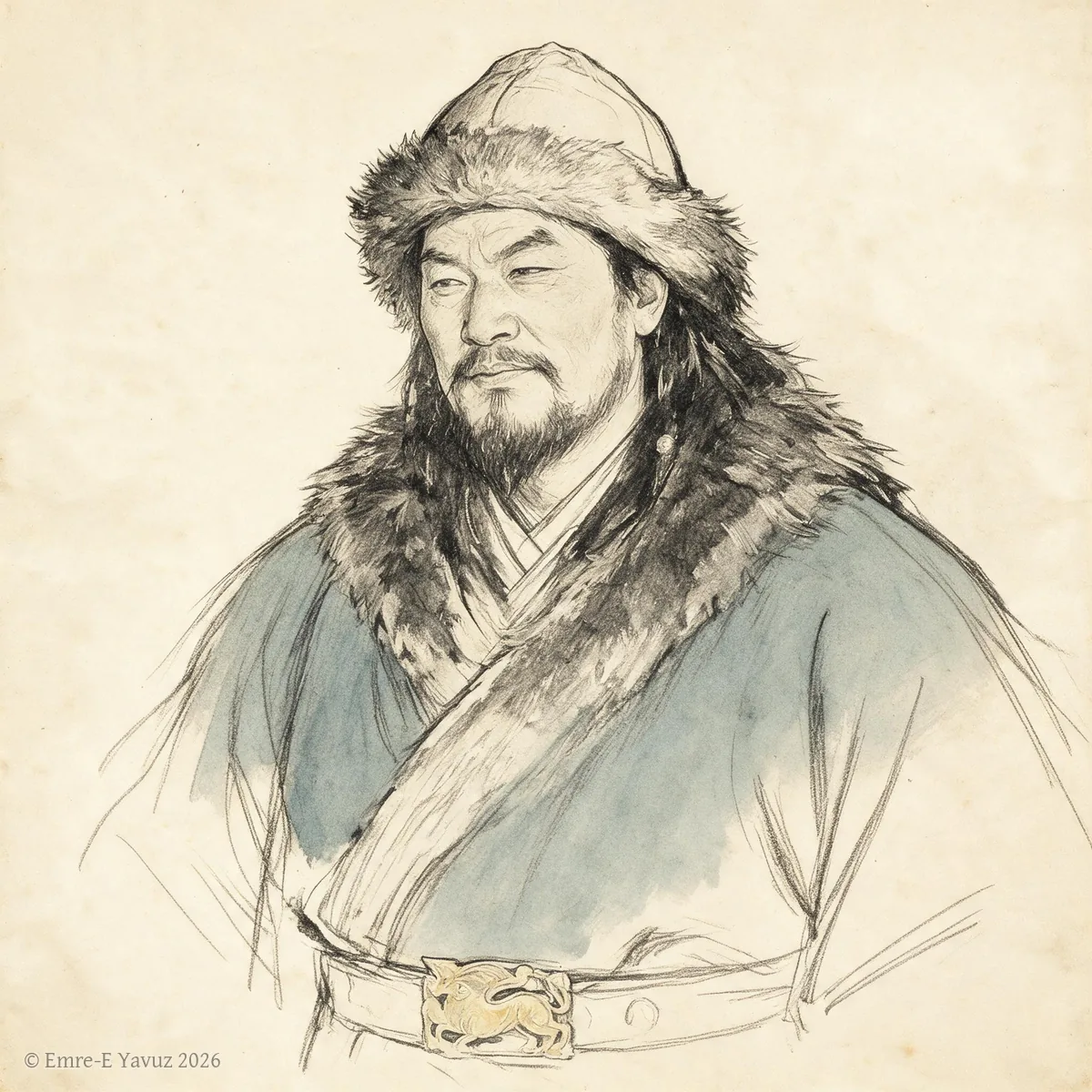
Huhanye lost the civil war and kept the throne. Between 57 and 54 BC as many as six men held the title of chanyu at once. The Han Shu calls that stretch the time of the five chanyus. Huhanye was beaten twice in this period, the second time by his own brother. The throne came back to him because he was the one who went to Chang’an and bowed.[1] His line held the Xiongnu throne for the next two centuries. When the Southern Xiongnu of the first century AD repeated what he had done, they took his title for their own.[2]
The war of the five chanyus
Huhanye had held the court for a few months and had sent his troops home. Then the men around the Right Worthy King set up the Tuqi Chanyu against him. They came east with tens of thousands. Huhanye was defeated and fled.[1] The Tuqi Chanyu then killed the Right Worthy King and his son on a slander. He learned afterwards that the charge was false and killed the accuser too. The king of the Hujie took fright at this and declared himself Hujie Chanyu. The Right Aojian King declared himself Cheli Chanyu. The Wuji commandant declared himself Wuji Chanyu. That made five.[1] They fought each other, and the smaller titles were surrendered. In the end the Tuqi Chanyu marched against Huhanye with sixty thousand horse. He met about forty thousand of Huhanye’s horse, lost and killed himself.[1]
The war did not end there. Huhanye’s elder brother Hutuwusi, whom Huhanye had himself raised to Left Guli King, declared himself Zhizhi Chanyu in the east. A cousin of the dead Tuqi Chanyu declared himself Runzhen Chanyu in the west. Zhizhi destroyed Runzhen and took his troops. He then marched on Huhanye, defeated him and took the chanyu’s court.[1]
The debate at the court
What Huhanye did next is preserved as an argument. It is the only surviving Xiongnu council debate. The Left Yizhizi King advised him to declare himself a subject, go to court and ask the Han for help. Only that, he said, would settle the Xiongnu. The great ministers answered that it could not be done. In their view, the custom of the Xiongnu put strength first and service last. The state had been made on horseback and in battle, and from that it had its name among the hundred peoples. To die fighting was what a man was for. Brothers were quarrelling over the state, but whether the elder or the younger won, the name would stand, and the descendants would always rule the other peoples. The Han were strong but could not swallow the Xiongnu. To serve them would shame the former chanyus and make the Xiongnu a laughing-stock among the peoples they had ruled.[1][3] Some scholars take this reply of the Xiongnu nobles as a document of the whole of Turkic history.[4]
The Left Yizhizi King answered that strength and weakness have their seasons. The Han were now at their height, he said, and the walled states and the Wusun were all their servants. Since the time of the Qiedihou Chanyu the Xiongnu had been shrinking year by year and could not recover. Stubbornness had not bought a single peaceful day. If they served the Han, they would survive; if they refused, they would be destroyed. No plan was better than that.[1] The great men argued for a long time. Huhanye took the second view. He brought his people south near the frontier and sent his son to serve at the Han court.[1] The year is given: the first year of Ganlu, 53 BC.[1][5] Some scholars note that the imperial annals of 54 and 53 BC call him simply Huhanye Chanyu, while Zhizhi is the Xiongnu Chanyu. In that case the Han court took the northern ruler for the true chanyu.[5]
Chang’an, 51 BC
He came to the Wuyuan frontier and asked to attend the New Year audience. The Han sent an escort and lined the road with two thousand horse from each of seven commanderies. He made his audience in the first month at the Sweet Springs palace. He was received with a distinction the Han did not give its own vassals. His place was above the vassal kings. At the announcement he was called a subject but not called by name.[1][6][7] On a modern account, the Han of the Former Han treated the chanyu as the ruler of a state of equal rank, and the Han of the Later Han treated him as a vassal.[8] He was given a cap and sash and robes, a gold seal with the green cord, a jade-hilted sword, a belt knife, a bow and four sets of arrows, ten halberds, a carriage, a saddle and bridle, fifteen horses, twenty catties of gold, two hundred thousand cash, seventy-seven suits of clothing, eight thousand bolts of brocade and figured silk and six thousand catties of floss.[1][9] On the Wei bridge the crowd called out the imperial acclamation as he passed.[1]
He asked to stay below the Guanglu line, with the Han receiving-city to fall back on in an emergency. The Han sent sixteen thousand horse with him out past the Jilu pass and left them there as his guard. They also shipped thirty-four thousand hu of grain north to feed his people.[1] His brother Zhizhi sent tribute in the same year. He was received well, but less well than Huhanye.[1][10] The gifts grew with each visit. In 49 BC the court added to the first gifts and gave 110 suits, 9,000 bolts and 8,000 catties of floss. In 33 BC it gave twice as much as in 49 BC. In 25 BC it gave 20,000 bolts and 20,000 catties, and in 1 BC 370 suits, 30,000 bolts and 30,000 catties.[1][11] According to some scholars the Han also cut the Southern Xiongnu off from the goods of the Tarim oases and so made them wholly dependent on Han supply.[12]
The oath on Mount Nuoshui
In about 43 BC two Han officers came north with Huhanye’s hostage son. They found the chanyu’s people grown numerous and the game below the frontier exhausted. They found the chanyu strong enough to guard himself and no longer afraid of Zhizhi. They heard that his great men were urging a return north, and they feared that he would then be beyond reach. The two officers therefore made a treaty with him on the spot. The treaty read: from this day the Han and the Xiongnu are one house, and neither shall deceive or attack the other for all generations. A thief shall be reported and punished and his theft made good. If raiders come, each shall send troops to the other. Whichever first breaks this oath shall receive the ill favour of Heaven.[1] They climbed the eastern hill above the river Nuoshui with the chanyu and his great men. They killed a white horse. The chanyu stirred wine with a sword and a spoon in the cup that had been made from the skull of the Yuezhi king whom Laoshang had killed. Then they drank the blood oath.[1]
The Han council was scandalised. It held that the two officers had bound the descendants of the Han for all generations in a curse with barbarians. It also held that they had given the chanyu the means to accuse the emperor before Heaven. The council wanted an envoy sent to sacrifice and undo the oath, and it wanted the officers tried for a capital offence. The emperor made light of it. He had the officers redeem the fault with a payment and left the oath standing.[1] Huhanye went back to the north. According to the same chapter, the people came back to him little by little and the realm settled.[1]
The succession
The same chapter tells how the throne passed at his death.[1] Huhanye wished to set up Qiemoche, the favoured son of his senior consort, the Zhuanqu Yanzhi.[1][13] The two consorts were sisters, the daughters of the Huyan king, who was the elder brother of the Left Yizhizi King.[1][14] She advised against it. The realm had only just been made safe with Han help, the people were weary of fighting, and Qiemoche was young.[1] She proposed Diaotaomogao, the eldest son of her sister, the Great Yanzhi.[1] Huhanye followed her advice and set up Diaotaomogao. He bound him to pass the realm to his younger brother.[1] Some scholars take that instruction as the source of the succession from brother to brother that followed among his sons down to the chanyu Yu. The same scholars hold that the instruction bound their generation and no later one.[15] The quarrel over the next generation ended in the split of 48.[16]
From Huhanye’s time on, the chanyus took the epithet ruodi. The Han Shu says that the Xiongnu called filial piety (xiao) by this word. After Huhanye the Xiongnu stood close to the Han, and when they saw the Han emperors given the posthumous epithet xiao, they admired it. All of them therefore took ruodi.[1][17] Some scholars set the epithet beside the Turkic custom of not speaking the name of a dead great man and giving him another name, called kong.[18]
Assessment
The Han treated the submission as a surrender and staged it as one. Others take the whole episode as the tributary system working from the other end. If so, Huhanye offered symbolic submission in return for grain, silk, an escort and a free hand in the steppe. He used the arrangement cleverly, and it led to the rebuilding of a Xiongnu state.[19] Both interpretations rest on the same chapter. The outcome is not in doubt. Zhizhi, who refused, went west and was killed at the end of a Han spear on the Talas. Huhanye, who bowed, died in his own court in 31 BC with the steppe behind him.[1]
References
- ^ a b c d e f g h i j k l m n o p q r s t u v w x y z aa Han Shu, juan 94
- ^ Hou Han Shu, juan 89
- ^ Ögel 2015, p. 144
- ^ Ögel 2015, p. 143
- ^ a b Ögel 2015, p. 145
- ^ Ögel 2015, p. 145–146
- ^ Jagchid 1989, p. 66
- ^ Jagchid 1989, p. 66–67
- ^ Jagchid 1989, p. 118, 169
- ^ Ögel 2015, p. 146
- ^ Jagchid 1989, p. 118
- ^ Jagchid 1989, p. 65, 119
- ^ Ögel 2015, p. 182–183
- ^ Ögel 2015, p. 182
- ^ 内田吟風 1933, p. 105,107
- ^ 内田吟風 1933, p. 107
- ^ Ögel 2015, p. 219
- ^ Ögel 2015, p. 184, 209, 219
- ^ Golden 1992, p. 62
Sources
- Han Shu, juan 94 (after Shiji)
- Hou Han Shu, juan 89
Literature
- Peter B. Golden, An Introduction to the History of the Turkic Peoples (1992)
- Emre-E. Yavuz, The Gokturk Empire: 2nd Edition (2025)
- Uchida Ginpū 内田吟風, 後漢光武帝の對南匈奴策に就て 下篇:匈奴の分裂と光武帝の南匈奴統御 (1933)
- Bahaeddin Ögel, Büyük Hun İmparatorluğu Tarihi II (2015)
- Sechin Jagchid; Van Jay Symons, Peace, War, and Trade Along the Great Wall. Nomadic-Chinese Interaction through Two Millennia (1989)
What links here30
- Persons
- Bi Chanyu · Fuzhulei Chanyu · Li Ling · Qiedihou Chanyu · Su Wu · Wang Zhaojun · Woyanqudi Chanyu · Xulüquanqu Chanyu · Zhizhi Chanyu
- States
- Southern Xiongnu · Xiongnu · Xiongnu Han
- Conflicts
- The Xiongnu–Han Wars
- Battles & Events
- Death of Princess Dayi · The Han–Xiongnu heqin treaties · Xiongnu split of 48 · Yangdi's Visit to Yami Khan (607)
- Peoples
- Dingling
- Lineages
- Luandi
- Institutions and Titles
- Chanyu · Chinese Bans on the Export of Iron · Diplomacy of the Steppe Empires · Gold of the Xiongnu Court · Han Bestowals on the Chanyu · Skull Cup · The Economy of the Steppe Empires · Women among the Turkic Peoples · Worthy Kings of the Left and Right
- Foods
- Millet
- Customs & Pastimes
- The Three Xiongnu Assemblies
Cite this article
Yavuz, Emre-E. “Huhanye Chanyu.” Turkic Atlas, revised 8 November 2026. https://turkicatlas.org/persons/huhanye-chanyu/
Last revised: 8 November 2026

