
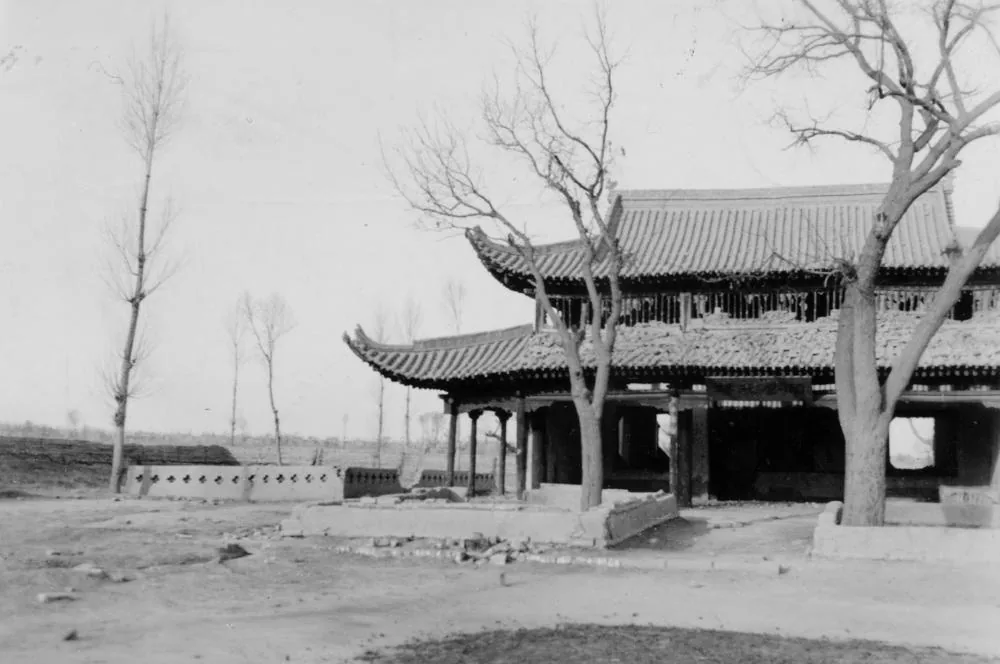
Jiuquan, 酒泉, was a commandery and town in the west of China.[1] In 545 the Western Wei first opened relations with the Göktürks through an envoy from Jiuquan, An Nuopantuo.[2] In 578 Taspar Khan besieged it. A Sui edict names it among the targets of Tardush.[3]
The Han commandery
The Shiji says that the Han set up the Jiuquan commandery in the west to cut the road by which the Hu reached the Qiang.[4] In the account of the Han Shu, the Han general of swift cavalry broke the Xiongnu in their western lands. The Xiongnu kings Hunye and Xiutu surrendered, and their land was left empty.[5] There the Han first set up Jiuquan. Later they moved settlers in and divided off Wuwei, Zhangye and Dunhuang, four commanderies in all.[5] The annals of Wudi in the Han Shu give another order. They place Wuwei and Jiuquan in 121 BC, made together from the land of the Hunye and Xiutu kings after the campaigns of Huo Qubing. They place Zhangye and Dunhuang in 111 BC, cut from the land of the first two.[6] Two further datings are reported. The geographical treatise of the Han Shu is said to give 104 BC for Zhangye and Jiuquan, 101 for Wuwei and 88 for Dunhuang.[7] The Zizhi tongjian sets up Jiuquan alone in 115 BC. It detaches Wuwei from it later and adds Zhangye and Dunhuang in 111.[7] After the expedition against Loulan, the Han Shu has the Han line forts and beacons as far as the Jade Gate.[5] The line has been dated to 108 BC and made to run from Jiuquan.[8] The Shiji adds that after the chanyu Er took the throne, the right wing of the Xiongnu faced Jiuquan and Dunhuang.[4]
Sogdians and the Northern Liang
Ancient Letter II was written by the Sogdian merchant Nanai-vandak. It reports Armat-sāch in Jiuquan safe and well.[9] The letter has been dated to 313.[10] In that case the Sogdian merchants came from Dunhuang and passed through Jiuquan, Guzang and Lanzhou on their way into central China.[10]
The Wei Shu records that the Northern Wei took Guzang, the capital of the Juqu house of the Northern Liang, in 439. At that time Juqu Wuhui, a brother of the Liang ruler, was prefect of Jiuquan.[11] A Wei army reached Jiuquan. Wuhui fled to Jinchang. The Wei left the duke of Yiyang to hold the town.[11] In 440 Wuhui came back and took Jiuquan.[12] In 441 a Wei army under Xi Juan took it again after a siege. According to the Zizhi tongjian, more than ten thousand people starved in that siege.[12] The Sui Shu ties the flight of the Ashina to the Rouran to the same destruction of the Juqu by the Wei.[13]
The envoy of 545
The Zhou Shu says that Bumin’s people grew stronger. They first came to the frontier to buy silk and floss, wishing for relations with China.[14] In 545 Yuwen Tai, the chancellor of the Western Wei, sent An Nuopantuo, a hu of Jiuquan, to them as his envoy.[2] The Göktürks congratulated one another. They said that the envoy of a great state had come and their own state would rise.[14] The envoy came from the town in which the Ancient Letter had placed a Sogdian resident more than two centuries earlier.[15]
The Göktürk attacks
In the winter of 578, in the wars over northern China, Taspar raided the frontier of the Northern Zhou again. He besieged Jiuquan, plundered widely and withdrew.[14] The Zhou annals and the Zizhi tongjian set the siege in the eleventh month. They add that the Göktürks killed and carried off officials and people.[16]
The Zizhi tongjian dates an edict of the Sui emperor Wen to 583. The edict names the town again.[17] It says that Tardush had earlier attacked Jiuquan. Afterwards Khotan, Persia and the Hephthalites rose against the Göktürks at once.[13] The edict does not say whether it means the siege of 578 or a later attack.[13]
Location
In one translation, the old town lies north of the modern Jiuquan in Gansu.[18] The same translation gives the later prefecture of Suzhou as the modern Jiuquan.[19] A different placement puts the seat of the commandery governor at the place that is now called Suzhou, the present Jiuquan.[20][21]
References
- ^ Shiji, juan 110; Zhou Shu (Book of Zhou), juan 50
- ^ a b Zhou Shu (Book of Zhou), juan 50; Zizhi tongjian (Comprehensive Mirror in Aid of Governance), juan 159
- ^ Zhou Shu (Book of Zhou), juan 50; Sui Shu (Book of Sui), juan 84
- ^ a b Shiji, juan 110
- ^ a b c Han Shu, juan 96
- ^ Han Shu, juan 6
- ^ a b Chavannes 1913, v–vi
- ^ Chavannes 1913, vi
- ^ Sogdian Ancient Letters; de la Vaissière 2005a, p. 43
- ^ a b de la Vaissière 2005a, p. 46
- ^ a b Wei Shu, juan 4
- ^ a b Wei Shu, juan 4; Zizhi tongjian (Comprehensive Mirror in Aid of Governance), juan 123
- ^ a b c Sui Shu (Book of Sui), juan 84
- ^ a b c Zhou Shu (Book of Zhou), juan 50
- ^ de la Vaissière 2005a, p. 205
- ^ Zhou Shu (Book of Zhou), juan 7; Zizhi tongjian (Comprehensive Mirror in Aid of Governance), juan 173
- ^ Sui Shu (Book of Sui), juan 84; Zizhi tongjian (Comprehensive Mirror in Aid of Governance), juan 175
- ^ Mau-tsai 1958, Turkish edition, p. 17
- ^ Mau-tsai 1958, Turkish edition, p. 370
- ^ Chavannes 1913, v
- ^ Herrmann 1910, p. 118
Sources
- Shiji, juan 110
- Han Shu, juan 6, 96 (after Shiji)
- Sogdian Ancient Letters
- Wei Shu, juan 4, 4
- Zizhi tongjian (Comprehensive Mirror in Aid of Governance), juan 123, 159, 173, 175 (after Wei Shu, Zhou Shu, Sui Shu and Bei Shi)
- Sui Shu (Book of Sui), juan 84
- Zhou Shu (Book of Zhou), juan 7, 50
Literature
- Étienne de la Vaissière, Sogdian Traders: A History (2005)
- Liu Mau-tsai, Çin Kaynaklarına Göre Doğu Türkleri (1958, Turkish edition)
- Édouard Chavannes, Les documents chinois découverts par Aurel Stein dans les sables du Turkestan oriental (1913)
- Albert Herrmann, Die alten Seidenstrassen zwischen China und Syrien. Beiträge zur alten Geographie Asiens, Bd. 1 (1910)
What links here27
- Persons
- An Nuopantuo · Emperor Wu of Han · Er Chanyu · Hunye King · Huo Qubing · Li Guangli · Lijicha · Nanai-vandak · Wuwei Chanyu · Xulihu Chanyu · Yizhixie Chanyu · Yuwen Tai
- States
- Western Wei
- Conflicts
- Hegemony Wars in Northern China
- Battles & Events
- Edict of Emperor Wen against the Göktürks (583) · The Flight of the Ashina (439) · The Göktürk–Wei alliance · The Siege of Jiuquan (578)
- Institutions and Titles
- Border Markets · The Economy of the Steppe Empires
- Languages
- The Sogdian language
- Sources
- Sogdian Ancient Letters
- Controversies
- Turkic-Sogdian Synthesis
Cite this article
Yavuz, Emre-E. “Jiuquan.” Turkic Atlas, revised 8 November 2026. https://turkicatlas.org/places/jiuquan/
Last revised: 8 November 2026

