
- 400
- 500
- 600
- 700
- 800
- 900
- Rouran 400–554
- First Göktürk 552–630
- Tang rule 630–682
- Second Göktürk 682–744
- Uyghur 744–840
- Kirghiz 840–924
- Huns 370–469
- Western Göktürk 552–659
- Türgesh 699–766
- Karluk 766–800
- Khazar 650–969
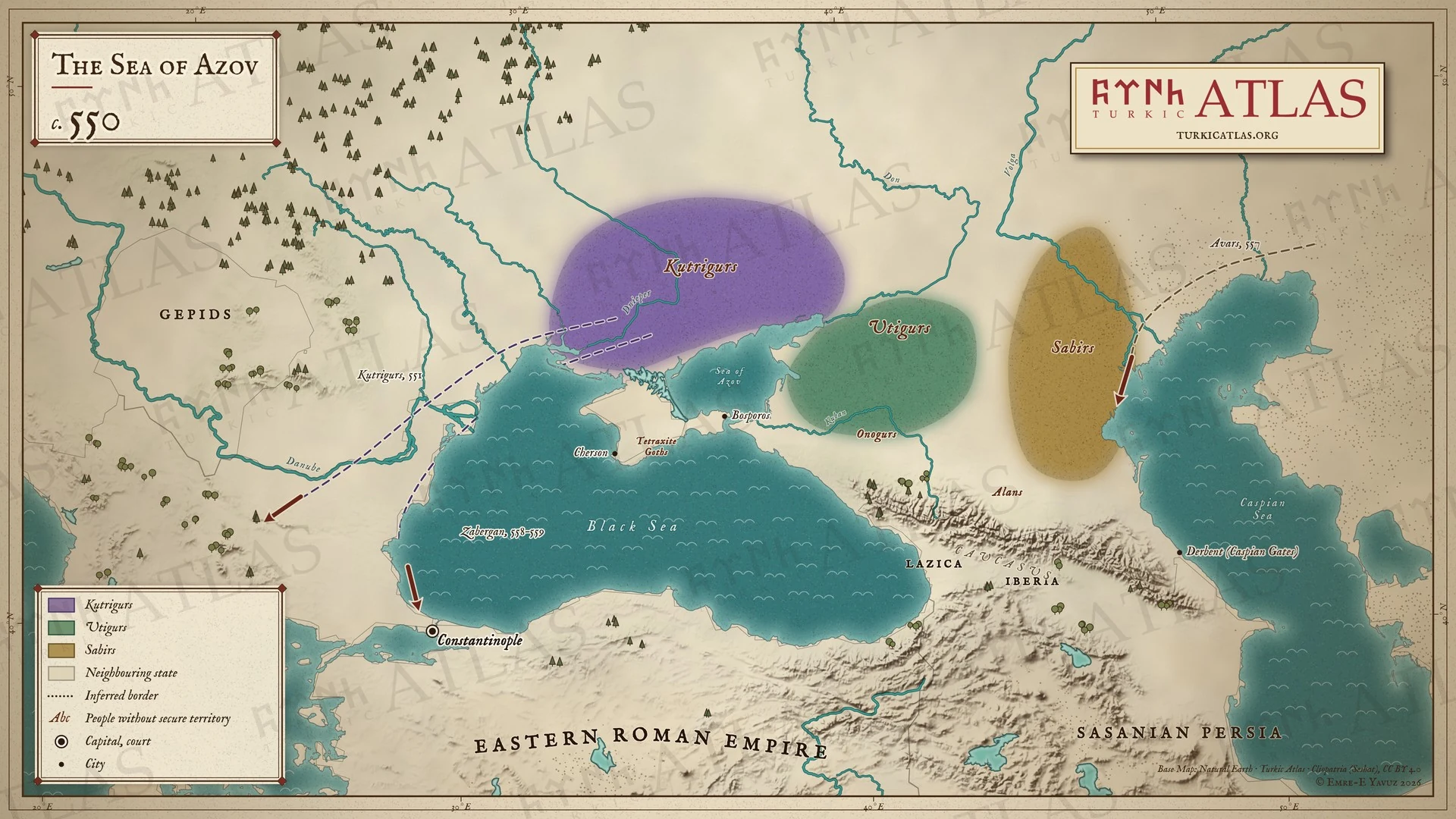
The Kutrigurs were a Hunnic people of the steppe west of the Sea of Azov. They were of common origin with the Utigurs to their east.[1] They raided the Roman Balkans in the 550s and fell under the Avars. When the Avars fled west before the Göktürks, they took Kutrigur elements with them.[2]
Name
- ΚοτρίγουροιGreekMenander Protector
- ΚουτρίγουροιGreekMenander Protector
- kwrtrgrSyriac
- ΚοτζαγηροίGreekTheophylact Simocatta
- AltziagiriLatinJordanes
Agathias, Procopius and Menander write the name Κοτρίγουροι or Κουτρίγουροι. The Syriac list of peoples has kwrtrgr.[1] The name has been derived from an Oguric word for nine, “the Nine Ogurs”. Another derivation explains it as “the enraged”.[1] Menander calls them once “the so-called Kutrigur Huns”.[3] Procopius counts them and the Utigurs as two unions of the Huns.[1]
Raids on the empire
In 551 the Kutrigurs under Chinialon, allied with the Gepids, invaded the empire.[2] In 558 they came again under Zabergan.[2] Justinian expected them to return to Thrace. He pressed Sandilkhos, the leader of the Utigurs, with embassy after embassy to make war on them.[3] He promised that if Sandilkhos destroyed the Kutrigurs, their yearly payments would go to him.[3] Sandilkhos refused to wipe out kinsmen who shared his people’s language, tents, dress and way of life.[3] He offered to take their horses instead.[3] In the fighting that followed, the two peoples decimated one another.[4]
Under the Avars
Menander tells of an unnamed Kutrigur, “the one friendly to the Avars”. This man advised the Avar khagan to kill Mezameros, the envoy of the Antes.[3] The Avars killed the envoy.[3] In 568 the khagan Baian sent ten thousand of the so-called Kutrigur Huns across the Save to ravage Dalmatia.[3] In the same year his envoys claimed from Justin II the payments Justinian had made to the Kutrigurs and the Utigurs, since Baian had subdued both peoples.[3] Justin refused. He said that the Kutrigurs and Utigurs had partly fled from the Romans and partly been destroyed by them.[3]
Flight before the Göktürks
When the Avars moved into Pannonia to escape the advancing Göktürks, Kutrigur elements went with them.[4] In a letter that Theophylact preserves, a Göktürk khagan wrote to the emperor Maurice in 598 that the Tarniakh and the Kotzageroi had fled from the Göktürks. They also descended from the Var and the Chunni.[5] They came to Europe and joined the subjects of the Avar khagan. The reinforcement was reckoned at ten thousand men.[5] The Kotzageroi may be the Kutrigurs.[6] A second marks the equation with a query and counts the Kotzageroi among the peoples of War-Hun origin.[7]
Later history
The Kutrigurs may be the Altziagiri, whom Jordanes places near Cherson, where merchants brought the goods of Asia.[8] Jordanes names the Altziagiri as one of the two branches of the Huns in that country.[9] Or they belonged among the ten tribes of an Onogur federation.[10] An older view took them and the Utigurs for Bulgars.[1] Their old country has also been set west of the Don in the later Black Bulgaria.[11] Later Byzantine writers join the name of the Bulgars to that of the Onogurs, as Onogundur-Bulgars.[12]
The Kutrigur raids on the empire run through the first two thirds of the sixth century. The name disappears with the century.[13] The Kutrigurs left the Pontic steppe ahead of the Göktürks. The Utigurs stayed there and served them.
References
- ^ a b c d e Golden 1992, p. 99
- ^ a b c Golden 1992, p. 99-100
- ^ a b c d e f g h i j Menander Protector
- ^ a b Golden 1992, p. 100
- ^ a b Theophylact Simocatta; Chavannes 1903, p. 248
- ^ Marquart 1903, p. 504
- ^ Golden 1992, p. 99,111
- ^ Marquart 1903, xxvi
- ^ Jordanes; Mierow 1915, § 37, p. 60
- ^ Yavuz 2025, p. 137
- ^ Marquart 1903, p. 503
- ^ Golden 1992, p. 102
- ^ Marquart 1903, p. 505-506
Sources
- Menander Protector
- Procopius
- Theophylact Simocatta
- Jordanes (after Priscus and Ammianus Marcellinus)
Literature
- Peter B. Golden, An Introduction to the History of the Turkic Peoples (1992)
- Josef Marquart, Osteuropäische und ostasiatische Streifzüge (1903)
- Édouard Chavannes, Documents sur les Tou-Kiue (Turcs) occidentaux (1903)
- Emre-E. Yavuz, The Gokturk Empire: 2nd Edition (2025)
- Ludwig Dindorf (ed.), Historici Graeci minores, Bd. II: Menander Protector et Agathias (1871)
- Charles Christopher Mierow, The Gothic History of Jordanes in English Version, with an Introduction and a Commentary (1915)
- Agathias, Ἱστορίαι / Histories (ca. 570s)
- anonymous, Chronicle of Pseudo-Zachariah Rhetor (ca. 568/569)
What links here11
- Persons
- Justin II
- Conflicts
- Göktürk Expansion into Europe
- Battles & Events
- Flight of the Tarniach and Kotzager · Revolt of Turum
- Places
- Cherson
- Peoples
- Huns · Kotzager · Onogurs · Turkic Tribes in Europe · Utigurs
- Languages
- Oghur Turkic
Cite this article
Yavuz, Emre-E. “Kutrigurs.” Turkic Atlas, revised 8 November 2026. https://turkicatlas.org/ethnicities/kutrigurs/
Last revised: 8 November 2026

