
The flight of the Ashina is the earliest event in the history of the Göktürk ruling house to which a year can be attached. According to the Sui Shu, the ancestors of the Göktürks were mixed hu of Pingliang, of the surname Ashina.[1] When Emperor Taiwu of the Northern Wei destroyed the Juqu, the Ashina fled with five hundred families to the Rouran.[1] They lived for generations on the Golden Mountain, the Altai. They were skilled in working iron.[1] The Wei took the Juqu capital in the ninth month of 439. The flight is dated by that conquest.[2]
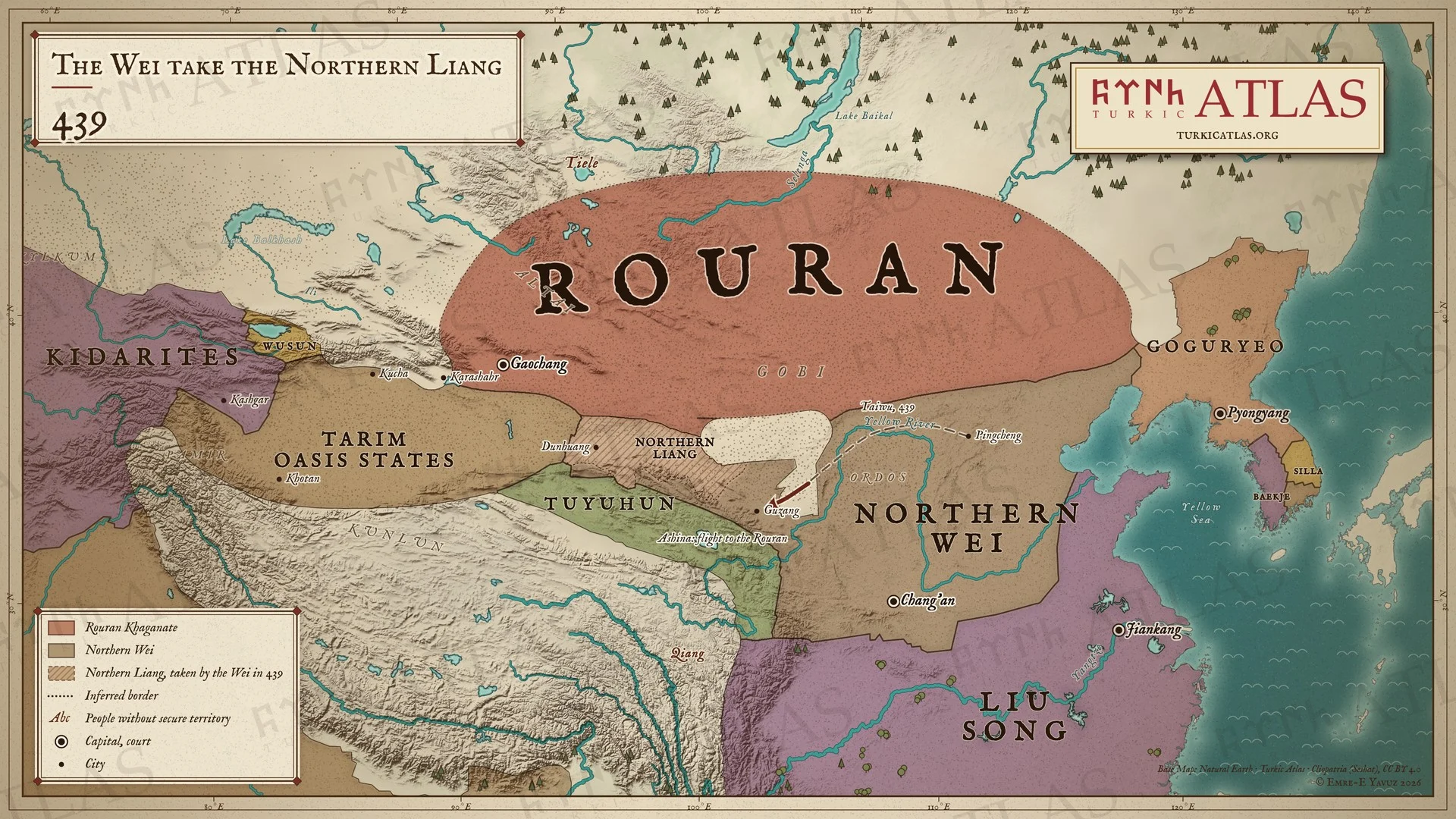
The fall of the Northern Liang
The Juqu were a house counted among the Xiongnu. They had ruled the Northern Liang in Gansu since 397.[3] In the sixth month of 439 Taiwu marched west against their ruler, Juqu Mujian.[2] Against the Rouran he left two generals with twenty thousand men south of the desert.[2] His army reached Guzang, the Liang capital, in the eighth month.[4] In the ninth month Mujian came out to the gate of the Wei camp, bound, with five thousand of his officials and officers.[2] The emperor untied him and received him with the rites due to a vassal.[2] His brothers Yide and Wuhui fled west by way of Jiuquan to Jinchang. A third brother, Anzhou, went south to the Tuyuhun.[2] Two days after the surrender the Rouran broke through the Wei frontier as far as Mount Qijie. The capital was greatly alarmed.[2] In the tenth month the emperor turned east and moved more than thirty thousand households of Liangzhou to his capital.[2]
The Tongdian explains the Sui Shu’s “Juqu” in a note in small type. Juqu Maoqian had his capital at Guzang, his state was called the Northern Liang, and the Wei destroyed it.[5] Maoqian is the Tongdian’s name for the ruler whom the Wei Shu calls Mujian.[6]
The sources
The Sui Shu tells the flight at the opening of its chapter on the Göktürks, before the wolf legend.[1] The Bei Shi gives the same sentence as a second account, introduced with “some say”.[7] It has the Ashina live on the southern slope of the Golden Mountain as ironworkers of the Rouran.[7] The Tongdian takes the sentence over. It joins it to the clause on the Xiongnu that the Zhou Shu and the Bei Shi give: the ancestors of the Tujue were mixed hu of Pingliang, “in fact a separate branch of the Xiongnu”, of the surname Ashina.[8] No earlier text has the two claims in one sentence. Both later works depend on the Sui Shu for the flight. The three texts are therefore a single attestation of it.
The Zhou Shu knows no flight.[9] Its wolf legend ends with the descendants of the she-wolf’s ten sons leaving their cave after several generations. They submitted to the Rouran and worked iron for them on the southern slope of the Golden Mountain.[9]
In the same passage the Sui Shu explains the name. The Golden Mountain was shaped like a helmet. In their common speech a helmet was called 突厥, and so they took the word as their name.[1] The Zhou Shu gives the same etymology in almost the same words, at the end of the wolf legend.[9]
Route and interpretations
The Sui Shu gives no year and no route. It does not say how mixed hu of Pingliang came to be caught up in the fall of the Juqu.[1] One reconstruction places the ancestors of the Ashina within the Northern Liang state. From there they fled to Gaochang about 439 and on to the southern Altai about 460.[10] Others link the flight to the wolf legend. The Wei campaign against the Liang reached a village of Turkic semi-nomads in Pingliang and laid it waste. The legend tells that catastrophe.[11] The Sui Shu itself sets the wolf’s cave on a mountain north-west of Gaochang.[1]
Under the Rouran
The five hundred families became subjects and smiths of the Rouran khaganate.[7] A century later the relation was unchanged in Rouran eyes. When Bumin asked Anagui, the Rouran khan, for a marriage in 546, Anagui answered that Bumin was his blacksmith slave.[12] In 552 Bumin broke the Rouran north of Huaihuang. Anagui killed himself.[9] A hundred and thirteen years had passed since the flight.
References
- ^ a b c d e f g Sui Shu (Book of Sui), juan 84
- ^ a b c d e f g h Wei Shu, juan 4
- ^ Golden 1992, p. 120
- ^ Wei Shu, juan 4; Tongdian, juan 197
- ^ Tongdian, juan 197
- ^ Tongdian, juan 197; Wei Shu, juan 4
- ^ a b c Bei Shi (History of the Northern Dynasties), juan 99
- ^ Tongdian, juan 197; Zhou Shu (Book of Zhou), juan 50; Bei Shi (History of the Northern Dynasties), juan 99
- ^ a b c d Zhou Shu (Book of Zhou), juan 50
- ^ Golden 1992, p. 121
- ^ Yavuz 2025, p. 125
- ^ Zhou Shu (Book of Zhou), juan 50; Tongdian, juan 197
Sources
- Sui Shu (Book of Sui), juan 84
- Bei Shi (History of the Northern Dynasties), juan 99 (after Wei Shu, Zhou Shu and Sui Shu)
- Tongdian, juan 197 (after Sui Shu and Zhou Shu)
- Zhou Shu (Book of Zhou), juan 50
- Wei Shu, juan 4
Literature
- Peter B. Golden, An Introduction to the History of the Turkic Peoples (1992)
- Emre-E. Yavuz, The Gokturk Empire: 2nd Edition (2025)
What links here7
- States
- Northern Wei
- Battles & Events
- The Rouran Marriage Refusal (546)
- Lineages
- Ashina
- Controversies
- The Göktürks and the Xiongnu
Cite this article
Yavuz, Emre-E. “The Flight of the Ashina (439).” Turkic Atlas, revised 8 November 2026. https://turkicatlas.org/events/flight-of-the-ashina-439/
Last revised: 8 November 2026

