
- 400
- 500
- 600
- 700
- 800
- 900
- Rouran 400–554
- First Göktürk 552–630
- Tang rule 630–682
- Second Göktürk 682–744
- Uyghur 744–840
- Kirghiz 840–924
- Huns 370–469
- Western Göktürk 552–659
- Türgesh 699–766
- Karluk 766–800
- Khazar 650–969
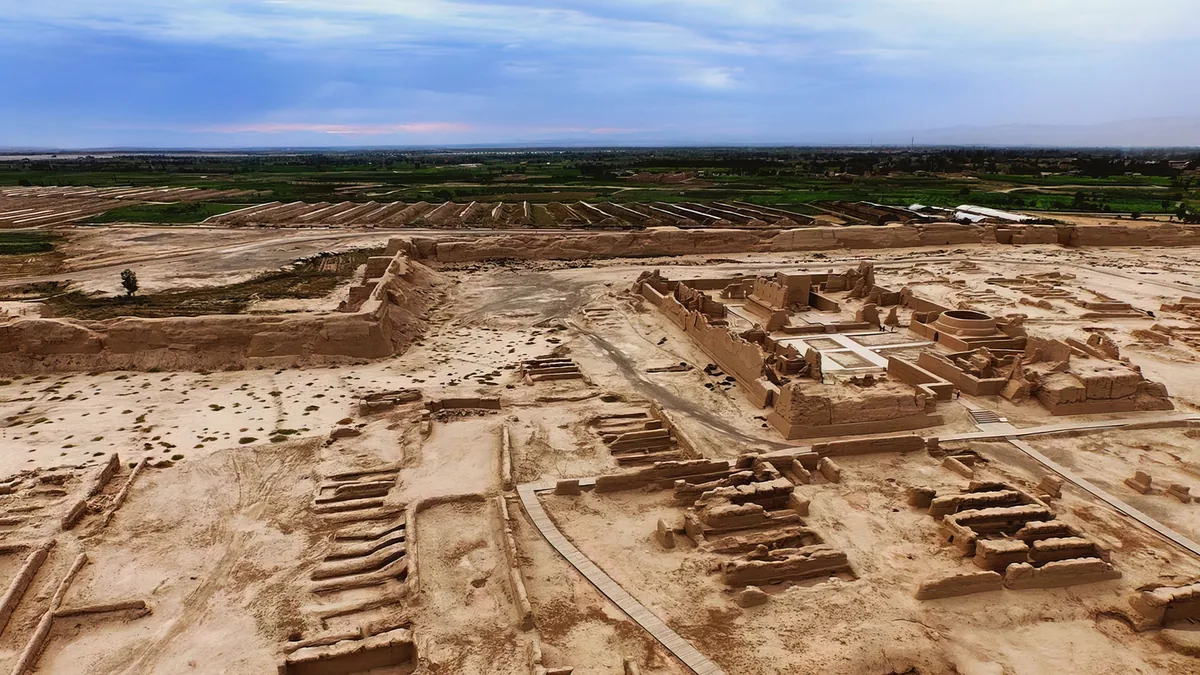
Gaochang is the Chinese name of the kingdom of the Turfan depression. The depression is one of the deepest basins on earth. It lies on the northern rim of the Tarim, where the road from Hami turns west toward Karashahr and Kucha. Gaochang stands at the beginning of Göktürk history, in the origin legend, and at its western turning, as the ally of the western khans. The Tang took it in 640. The Uyghurs made it Qocho.
The city
The oasis was a settlement that flourished from the first century BC as a junction of the east–west trade. The Han and the Xiongnu contested it for decades and at last divided the depression between them. Later it was the seat of the independent kingdom of Gaochang, whose name is still equated with Turfan. Its wealth rested not only on trade but on farming. The karez, the underground irrigation channels later extended by the Uyghurs, made farming possible in the desert. Wine was among its products. The Sui Shu and the Jiu Tang Shu both name grape wine among its goods.[1][2] The Tang compilation reports that after the destruction of Gaochang in 640 the court received the “mare-nipple” grapes grown in the orchards of the oasis. It received with them the method of making wine. The emperor Taizong then gave the wine to his officials to taste.[3][4] Its culture was a mixture of Buddhism, Manichaeism, Nestorian Christianity and later Islam. The caves of Bezeklik and the Astana graves preserve it.[5][6] The archive is large. The local Chinese custom of dressing the dead in paper garments preserved fragments of some sixteen hundred texts in the cemeteries of Astana and Karakhoja. Five per cent are from before 502, thirty per cent from the kingdom of Gaochang between 502 and 640, and sixty-five per cent from the Tang between 640 and 778.[7] The Berlin Turfan collection holds some eight thousand fragments in Syriac, Tibetan, Brahmi and the Old Turkic runic script of the Göktürks.[5] Among the finds are Manichaean fragments written in the runiform script. From Toyoq near Qocho come a leaf with a longer text in it and a fragment of the alphabet, with the names or values of the signs written in Manichaean script.[8] Manuscripts in Sogdian script from the oasis are Buddhist and Manichaean in content. They include fragments in Turkic, and in places they render Chinese in Sogdian letters.[6] The ruined city is also called Idiqut Shahri, the city of the idiqut. The legend of the Seven Sleepers is tied to the nearby shrine of Toyoq. Because of this, the city is sometimes named Apsus, after Ephesus, or Daqianus, after the emperor Decius.[6] A Chinese temple inscription found in the large Maitreya temple of the ruins dates the building of that temple to the fifth century.[9]
Han garrison and Jushi
In the Han period the depression belonged to the Former Jushi. Their king resided at Jiaohe, “the joining of rivers”. The name came from the river, which divided and flowed around the city.[10] Jiaohe is identified with the ruins of Yarkhoto, six or seven kilometres west of modern Turfan.[11] The Jushi kingdom was a large state until 62 BC. Afterwards it broke up into small ones.[11] The Hou Han Shu gives the road from Yiwu to the Gaochang rampart in the land of the Former Jushi as twelve hundred li. It says that the Wu and Ji colonels held the rampart by turns. It says that the Han fought constantly with the Xiongnu for Jushi and Yiwu in order to command the Western Regions.[12] The garrison of the two colonels goes back to the reign of the emperor Yuan (48 to 33 BC). It was manned again in AD 89 with five hundred soldiers.[13] The garrison town is identified with the ruins south-east of Karakhoja, on the evidence of the Chinese sources and the survey of the ruins.[14] A ration list from the Loulan site names three “native soldiers of Gaochang”. It stands among documents of the Jin period and is itself undated.[15]
The origin legend
The Sui Shu tells that the ancestors of the Göktürks were the mixed Hu of Pingliang, surnamed Ashina. They fled with five hundred families to the Rouran when the Northern Wei destroyed the Juqu. They lived for generations in the Golden Mountain working iron. The Sui Shu tells the other story too. A boy’s people had been wiped out by a neighbouring state. His feet and arms were cut off, and a she-wolf fed him. When the neighbour’s men came to kill him, the wolf, as if a spirit had possessed her, fled east of the sea and stopped on a mountain “north-west of Gaochang”. Under the mountain was a cave. Within the cave lay a plain of two hundred li with rich grass, where she bore ten sons. One of them took the surname Ashina and became their chief.[16] The Bei Shi repeats the story. It is not a second witness.[17] The two stories belong together. The sources also record that after the Wei attack some five hundred Ashina families migrated from Gansu to Gaochang, the present Karakhoja. Some scholars think that the clan, driven from Gansu, settled first at Gaochang and then in the Altai.[5] They reckon the five hundred families at three to three and a half thousand people.[5] They suggest that the she-wolf may stand for the inhabitants of Gaochang who gave the clan room to settle and helped it in its need. Gaochang, on that view, is a central anchor of the first Göktürk state.[5] The article on the debate contains the legend as a whole.
Under the Rouran (460)
In 460 the Rouran overthrew Juqu Anzhou, the last of the Northern Liang house at Gaochang. They made Kan Bozhou king in his place. He was the first ruler of the city to be called king of Gaochang.[18] The city stayed within reach of the steppe powers from then on. The Göktürks inherited that position from the Rouran.
The kingdom under the Qu
The Qu family ruled Gaochang as a Chinese kingdom whose institutions copied those of the Wei. Its documents carry the office of the sabao, the head of the Sogdian community. The office appears first in a series of directives of 549 and 550 for the ceremonies of the lunar new year, in which the sabao figures as one cult official among Chinese functionaries. It appears again in decisions about the allocation of grain in 619.[7] The most telling document is a Sogdian contract of 639 for the sale of a slave girl born in Turkestan, made before the people in the bazaar of Gaochang. It is dated “the year sixteen of the divine and great Ilteber-king Yanchyu, the ruler of Gaochang”. The Chinese king of Turfan thus bore a Turkic title, the ilteber that the western khans gave the rulers they subjected. The price was a hundred and twenty very pure drachms minted in Sasanian Persia. In the kingdom of Gaochang during the first half of the seventh century the Göktürks had functionaries responsible for the supervision and taxation of commerce.[7]
Between the Göktürks and China
The kingdom lived between the western Göktürks and the Sui and Tang, and the sources show it on both sides. In 605, when the Tiele rose against Heshana, Yiwu, Gaochang and Karashahr all went over to the Tiele khan.[19] Shegui fell on Heshana about 611. The beaten khan fled east with several thousand riders. He was robbed on the way and hid east of Gaochang on the Shiluoman mountain.[19] The king of Gaochang, Qu Boya, reported him to the Sui court. After that Pei Ju brought the khan’s mother to the Jade Gate and talked him in.[19] According to the Tang annals, the Yabgu Khan of the western Göktürks and the king of Gaochang sent joint embassies to Chang’an in 619 and 620. The second embassy brought the great birds of Tiaozhi.[20] Xuanzang set out west in 629 or 630. At Turfan he found that the king of Gaochang was the western khan’s ally and almost his vassal. The king gave him letters of recommendation to his great neighbour.[20] At Suyab, in the scene the Tong Yabgu article carries, envoys from China and from Gaochang were admitted to the khan’s tent and their letters read. At Kunduz the pilgrim visited the khan’s eldest son, the Tardu Shad. Tardu Shad ruled Tokharistan and was married to the sister of the king of Turfan.[21] One translation makes his wife the king’s daughter.[20] Turfan was the outpost and the link between the eastern and the western parts of the Göktürk realm. It was also the fixed anchor against the Chinese states to the south-east.[5] The Ashina were in close contact with its people before the khaganate existed. The reason was the wealth of the oasis and its culture.[5]
Xizhou and Qocho
The Tang took the kingdom in 640 and made it the prefecture of Xizhou.[22] The Xin Tang Shu measures Helu’s yabgu seat on the Duoluosi river as fifteen hundred li due north of Xizhou. It has him plot in 649 to seize Xizhou and Tingzhou, the two Tang prefectures on either side of the Tian Shan.[22] The Ashina of the interregnum, after 630, lurked in a region between Turfan and Gansu.[5] In the ninth century the Uyghurs of the Turfan region (Xizhou, Gaochang, Qara Xoja, Qocho) made it the winter residence of a kingdom. The summer seat of that kingdom was Beshbalik.[23][24] The Uyghur rulers of Gaochang kept good relations with the Liao, the Jurchen and the Song for centuries.[23]
The Manichaean quarter
The Berlin excavators called one group of buildings in the ruined city ruin K. They found the Manichaean remains of Qocho in it.[25] In a vaulted room a bundle of Manichaean manuscripts lay near the stair. The manuscripts were partly in Sogdian and mostly in Turkic. They were written for the most part in Sogdian and Uyghur script and in a few cases in Manichaean script.[26] The floor of the domed hall beside it was covered by a layer of rotted books, whole ones and many of them richly illuminated. The layer crumbled to dust when it dried.[27] The wall of the central hall had carried the painting of a Manichaean high priest among rows of men in white, with names in late Sogdian script. Peasants digging for treasure tore it down as the expedition arrived. The excavators bought it from them.[28] In the rubble east of that wall lay a leaf with a damaged miniature on one side. On the other side was a list, in Manichaean script and Middle Persian, that its finders described as the court of the Uyghur khagan.[27] A copper coin of Chinese form with a legend in Sogdian script was found in the same hall. Its finder took it for a coin of a khagan of the Türgesh from the first decades of the eighth century.[27]
In the library room of the ruin the excavators took from the wall a row of marching warriors with banner lances and name tablets in Old Uyghur.[29] The first tablet is read inancu orongu targan. Of the second only the ending -gu sangun is preserved.[29] On the outer face of a north wall of the same ruin a bold outline drawing of armoured horsemen was torn off by local people and broke on its way to the expedition. No picture of it survives.[30]
Assessment
Gaochang is the city the Göktürks never conquered and never left. The legend puts the wolf’s cave above it. The Sui histories put the fleeing khan beside it. The Sogdian contract puts a Turkic title on its Chinese king. A Chinese kingdom on the Tarim’s rim that paid the Göktürks their share and sent its envoys to sit in the khan’s tent was exactly the kind of subject the western Göktürks wanted.
References
- ^ Sui Shu (Book of Sui), juan 83
- ^ Jiu Tangshu (Old Book of Tang), juan 198
- ^ Tang Huiyao (Institutional History of the Tang)
- ^ Laufer 1919, p. 232
- ^ a b c d e f g h Yavuz 2025
- ^ a b c von Le Coq 1913, p. 4
- ^ a b c de la Vaissière 2005a
- ^ von Le Coq 1913, p. 5, 18
- ^ von Le Coq 1913, p. 4, pl. 67a
- ^ Han Shu, juan 96
- ^ a b Herrmann 1910, p. 82
- ^ Hou Han Shu, juan 88
- ^ Herrmann 1910, p. 123, 126
- ^ Herrmann 1910, p. 81–82
- ^ Chavannes 1913, p. 194
- ^ Sui Shu (Book of Sui), juan 84; Golden 1992
- ^ Bei Shi (History of the Northern Dynasties), juan 99
- ^ 内田吟風 1944, p. 301
- ^ a b c Sui Shu (Book of Sui), juan 84
- ^ a b c Chavannes 1903
- ^ Life of Xuanzang, juan 2
- ^ a b Xin Tangshu (New Book of Tang), juan 215
- ^ a b Golden 1992
- ^ Özertural 2013, p. 93
- ^ von Le Coq 1913, p. 8–9
- ^ von Le Coq 1913, p. 8
- ^ a b c von Le Coq 1913, p. 9
- ^ von Le Coq 1913, p. 9, pl. 1
- ^ a b von Le Coq 1913, pl. 2c
- ^ Grünwedel 1920, i 78
Sources
- Sui Shu (Book of Sui), juan 83, 84
- Xin Tangshu (New Book of Tang), juan 215 (after Jiu Tangshu)
- Bei Shi (History of the Northern Dynasties), juan 99 (after Wei Shu, Zhou Shu and Sui Shu)
- Life of Xuanzang, juan 2
- Jiu Tangshu (Old Book of Tang), juan 198
- Han Shu, juan 96 (after Shiji)
- Hou Han Shu, juan 88
- Tang Huiyao (Institutional History of the Tang)
Literature
- Emre-E. Yavuz, The Gokturk Empire: 2nd Edition (2025)
- Étienne de la Vaissière, Sogdian Traders: A History (2005)
- Peter B. Golden, An Introduction to the History of the Turkic Peoples (1992)
- Édouard Chavannes, Documents sur les Tou-Kiue (Turcs) occidentaux (1903)
- Uchida Ginpū 内田吟風, 後魏柔然表 (上): 中古蒙古史の編年史的整理の意圖をかねて (1944)
- Zekine Özertural, Mitteliranische Einflüsse auf die manichäisch-türkische Wortbildung (2013)
- Albert von Le Coq, Chotscho. Facsimile-Wiedergaben der wichtigeren Funde der ersten Königlich Preussischen Expedition nach Turfan in Ost-Turkistan (1913)
- Albert Grünwedel, Alt-Kutscha. Archäologische und religionsgeschichtliche Forschungen an Tempera-Gemälden aus buddhistischen Höhlen der ersten acht Jahrhunderte nach Christi Geburt (1920)
- Albert Herrmann, Die alten Seidenstrassen zwischen China und Syrien. Beiträge zur alten Geographie Asiens, Bd. 1 (1910)
- Édouard Chavannes, Les documents chinois découverts par Aurel Stein dans les sables du Turkestan oriental (1913)
- Berthold Laufer, Sino-Iranica. Chinese Contributions to the History of Civilization in Ancient Iran (1919)
What links here57
- Persons
- Ashina Helu · Bumin Khan · Futu Khan · Heshana Khan · Lady Xiang · Pei Ju · Shegui Khan · Tardu Shad · Tong Yabgu · Yiwu Tudun Shad · Yukuk Shad
- Conflicts
- Rouran Domination of the Turkic Peoples · The Tang conquest of the western Khaganate, 640–659
- Battles & Events
- Assembly at Mount Yanzhi (609) · Embassy of Cui Junsu (608) · Fall of Heshana Khan (611) · Music of Empress Ashina (568) · Ransom of the Chinese from the Göktürks (631) · Revolt of the Tiele (627) · Submission of Yiwu (630) · The Flight of the Ashina (439) · Tiele Revolt (605) · Xuanzang's visit to Tong Yabgu
- Places
- Anxi Protectorate · Cave of the ancestors · Huo · Jade Gate · Jiaohe · Karashahr · Pingliang · Suyab · Tanhan Mountain · Tarim Basin · Xihai · Yinshan · Yiwu
- Lineages
- Ashina
- Institutions and Titles
- Baidie Cotton · Farming and Taxes in Gaochang · Ilteber · Sabao · The Economy of the Steppe Empires · Trade Routes of the Steppe
- Controversies
- The Göktürks and the Xiongnu
Cite this article
Yavuz, Emre-E. “Gaochang.” Turkic Atlas, revised 8 November 2026. https://turkicatlas.org/places/gaochang/
Last revised: 8 November 2026

