
Tong Yabgu, the khan of the western Göktürks, was killed by his paternal uncle. The uncle made himself khan as Moheduo Hou Quli Sibi Khan.[1] Tong Yabgu died in 630. The Zizhi tongjian enters the murder at the end of 628.[2] The western tribes would not accept the usurper.[3] They raised Tong Yabgu’s son as a rival khan, and the two fought until Baghatur was killed at the end of 630.[4] In those years the peoples who had served the western khaganate fell away from it.[3]
The khan
Tong Yabgu was brave and a good strategist.[1] He brought the Tiele under his rule in the north, held off Persia in the west and reached Jibin in the south.[1] He had several hundred thousand bowmen and ruled the Western Regions. He moved his court to the Thousand Springs north of Chach.[1] He gave the kings of the Western Regions the title ilteber and set a tudun over each to collect the taxes.[5] The Jiu Tang Shu says that the western peoples had never been so powerful.[3]
Marriage negotiations with the Tang
In 620 Tong Yabgu sent tribute to the Tang, who sought him as an ally against the eastern Göktürks. He promised to attack in the winter of 622.[1] Ilig Khan, the eastern khan, took fright and made peace with him. Each promised not to attack the other.[3] Then Tong Yabgu asked for a Tang princess.[3] The emperor Gaozu was advised to grant the marriage in order to overawe Ilig: befriend the distant and attack the near.[6] The Jiu Tang Shu, the Tongdian and the Xin Tang Shu name Feng Deyi as the adviser. The Zizhi tongjian names Pei Ju.[7] Gaozu sent Li Daoli, the prince of Gaoping, to Tong Yabgu, who was delighted.[3]
In 627 Tong Yabgu sent the Zhenzhu tong irkin back with Li Daoli. The envoy brought a gold belt set with ten thousand studs and five thousand horses to fetch the bride.[8] Ilig did not want the marriage.[3] He raided China again and again. He also sent word to Tong Yabgu that a Tang princess would have to pass through his country.[8] Tong Yabgu was troubled, and the marriage was never made.[3]
The murder
The Jiu Tang Shu gives the reason for his fall.[3] Tong Yabgu relied on his strength and showed his people no kindness. They all resented him, and many of the Karluks rebelled.[1] His uncle killed him and made himself khan.[1] The Jiu Tang Shu, the Tongdian and the Zizhi tongjian call the killer his father’s elder brother. The Xin Tang Shu calls him a paternal uncle.[9] Baghatur had earlier ruled part of the Göktürk tribes as a lesser khan.[3] When he called himself great khan, the people would not follow him.[5]
One modern account names the uncle as a man of the Nushibi tribes.[10] The same account also reports the view that the murderer was Tong Yabgu’s own son.[10] It dates his reign from 618 to 628.[11]
The year is given in three ways.[12] The first is 628. The Zizhi tongjian enters the murder at the end of that year. The Tiele chapter of the Jiu Tang Shu says that the Yabgu Khan died in the second year of Zhenguan, 628, and that his state fell into great disorder.[13] The second is 627. The Cefu yuangui tells the murder and Taizong’s mourning under the first year of Zhenguan.[14] A third reckoning dates Xuanzang’s visit to the khan’s court to 630 and finds a successor already reigning in that year. It puts the murder soon after the pilgrim had passed.[15] A second account of the same kind sets Tong Yabgu at the height of his power in 630. In that account the tribes, led by the Karluks, rise against him and kill him afterwards.[16]
The war of the two khans
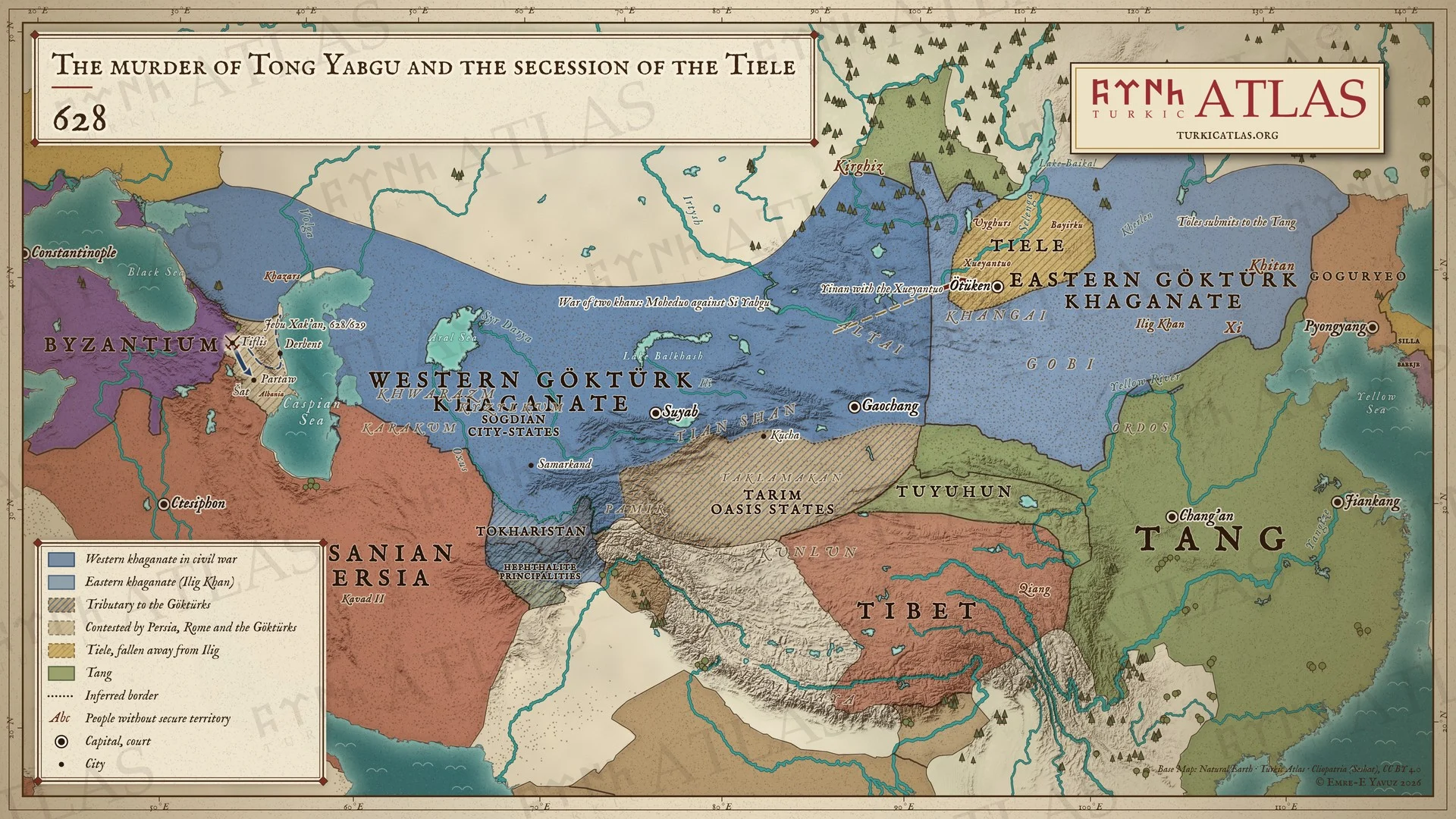
The Nushibi tribes put forward Nishu Bagha Shad as khan, and he refused.[1] Tong Yabgu’s son, the tegin Dieli, had fled from Baghatur to Kangju.[4] Nishu fetched him and raised him as Yipi Boluo Si Yabgu Khan.[4] The Xin Tang Shu says that the two khans divided the realm between them.[17] They fought each other without pause.[4]
Both khans sent envoys to Chang’an and asked for a Tang princess.[4] The emperor Taizong refused them.[3] He answered that their country was in turmoil and ruler and subjects were unsettled. It was no time to speak of marriage, and each was to keep to his own territory.[4] The Xin Tang Shu dates Baghatur’s request to 630.[17] The states of the Western Regions and the Tiele who had served the western Göktürks all fell away. The country was drained.[4]
Si Yabgu was the son of the old ruler, and he won the people over. Many of Baghatur’s chiefs came to him.[4] He attacked Baghatur and beat him badly.[3] Baghatur fled to Jinshan, the Golden Mountain, and Nishu killed him there.[4] The tribes then raised Si Yabgu as great khan.[4] The Zizhi tongjian enters his victory at the end of 630.[2] The Golden Mountain is the Altai.[18]
The news abroad
When Taizong heard of Tong Yabgu’s death, he mourned him.[19] He sent jade and silk to be burned as an offering at the place where Tong Yabgu had died. The envoys turned back because the country was in turmoil.[5]
In the west the news reached the Romans.[20] One modern account says that Heraclius had promised Tong Yabgu the hand of his daughter Eudoxia Epiphania.[21] The patriarch Nikephoros writes that Heraclius sent his daughter Eudokia on her way to the lord of the Turks, to whom he had betrothed her.[20] When it became known that the Turk had been slain, he ordered her to return.[20]
The Armenian history of the Caucasian Albanians has the news reach the army of the north in the Caucasus, which it calls the Khazars. The army had just destroyed a Persian force by Lake Sevan.[22] Jebu Xak’an sent word to the Šat’, who led his army there. Brigands had fallen upon him, he said, and the Šat’ would never see his face again.[23] He told the Šat’ not to stay to destroy the people around him but to escape from them before they heard what had happened.[23] It is disputed whether Jebu Xak’an and the lord of the Turks in Nikephoros were Tong Yabgu. One modern account says that the Göktürks withdrew from the Caucasus to the steppe because Tong Yabgu had been murdered.[10]
Consequences
The same account sees the end of the united west in the murder.[24] After Tong Yabgu there were still men with the title of yabgu or khan. The real power, however, passed to the ten tribes, the On Ok, the Ten Arrows.[24] From the murder onwards the western Göktürks no longer acted as one.[24]
References
- ^ a b c d e f g h Jiu Tangshu (Old Book of Tang), juan 194; Tongdian, juan 199
- ^ a b Zizhi tongjian (Comprehensive Mirror in Aid of Governance), juan 193
- ^ a b c d e f g h i j k l Jiu Tangshu (Old Book of Tang), juan 194
- ^ a b c d e f g h i j Jiu Tangshu (Old Book of Tang), juan 194; Zizhi tongjian (Comprehensive Mirror in Aid of Governance), juan 193
- ^ a b c Jiu Tangshu (Old Book of Tang), juan 194; Xin Tangshu (New Book of Tang), juan 215
- ^ Jiu Tangshu (Old Book of Tang), juan 194; Zizhi tongjian (Comprehensive Mirror in Aid of Governance), juan 191
- ^ Jiu Tangshu (Old Book of Tang), juan 194; Tongdian, juan 199; Xin Tangshu (New Book of Tang), juan 215; Zizhi tongjian (Comprehensive Mirror in Aid of Governance), juan 191
- ^ a b Jiu Tangshu (Old Book of Tang), juan 194; Zizhi tongjian (Comprehensive Mirror in Aid of Governance), juan 192
- ^ Jiu Tangshu (Old Book of Tang), juan 194; Tongdian, juan 199; Zizhi tongjian (Comprehensive Mirror in Aid of Governance), juan 193; Xin Tangshu (New Book of Tang), juan 215
- ^ a b c Yavuz 2025, p. 371
- ^ Yavuz 2025, p. 359
- ^ Zizhi tongjian (Comprehensive Mirror in Aid of Governance), juan 193; Cefu yuangui, juan 974
- ^ Zizhi tongjian (Comprehensive Mirror in Aid of Governance), juan 193; Mau-tsai 1958, Turkish edition, p. 473
- ^ Cefu yuangui, juan 974
- ^ Chavannes 1903, p. 195
- ^ Sinor 1990, p. 309
- ^ a b Xin Tangshu (New Book of Tang), juan 215
- ^ Mau-tsai 1958, Turkish edition, p. 473
- ^ Jiu Tangshu (Old Book of Tang), juan 194; Cefu yuangui, juan 974
- ^ a b c Nikephoros
- ^ Yavuz 2025, p. 370
- ^ Movsēs Dasxurancʿi, book II
- ^ a b Movsēs Dasxurancʿi, book II
- ^ a b c Yavuz 2025, p. 372
Sources
- Jiu Tangshu (Old Book of Tang), juan 194
- Tongdian, juan 199 (after Sui Shu and Zhou Shu)
- Xin Tangshu (New Book of Tang), juan 215 (after Jiu Tangshu)
- Zizhi tongjian (Comprehensive Mirror in Aid of Governance), juan 191, 192, 193 (after Wei Shu, Zhou Shu, Sui Shu and Bei Shi)
- Cefu yuangui, juan 974 (after Tongdian and Jiu Tangshu)
- Nikephoros
- Movsēs Dasxurancʿi, book II
Literature
- Emre-E. Yavuz, The Gokturk Empire: 2nd Edition (2025)
- Liu Mau-tsai, Çin Kaynaklarına Göre Doğu Türkleri (1958, Turkish edition)
- Édouard Chavannes, Documents sur les Tou-Kiue (Turcs) occidentaux (1903)
- Denis Sinor (ed.), The Cambridge History of Early Inner Asia (1990)
What links here5
- Persons
- Baghatur Khan · Nishu Bagha Shad · Si Yabgu Khan · Zhenzhu Tong Irkin
- Institutions and Titles
- Great Khan
Cite this article
Yavuz, Emre-E. “Murder of Tong Yabgu (630).” Turkic Atlas, revised 8 November 2026. https://turkicatlas.org/events/murder-of-tong-yabgu-628/
Last revised: 8 November 2026

