
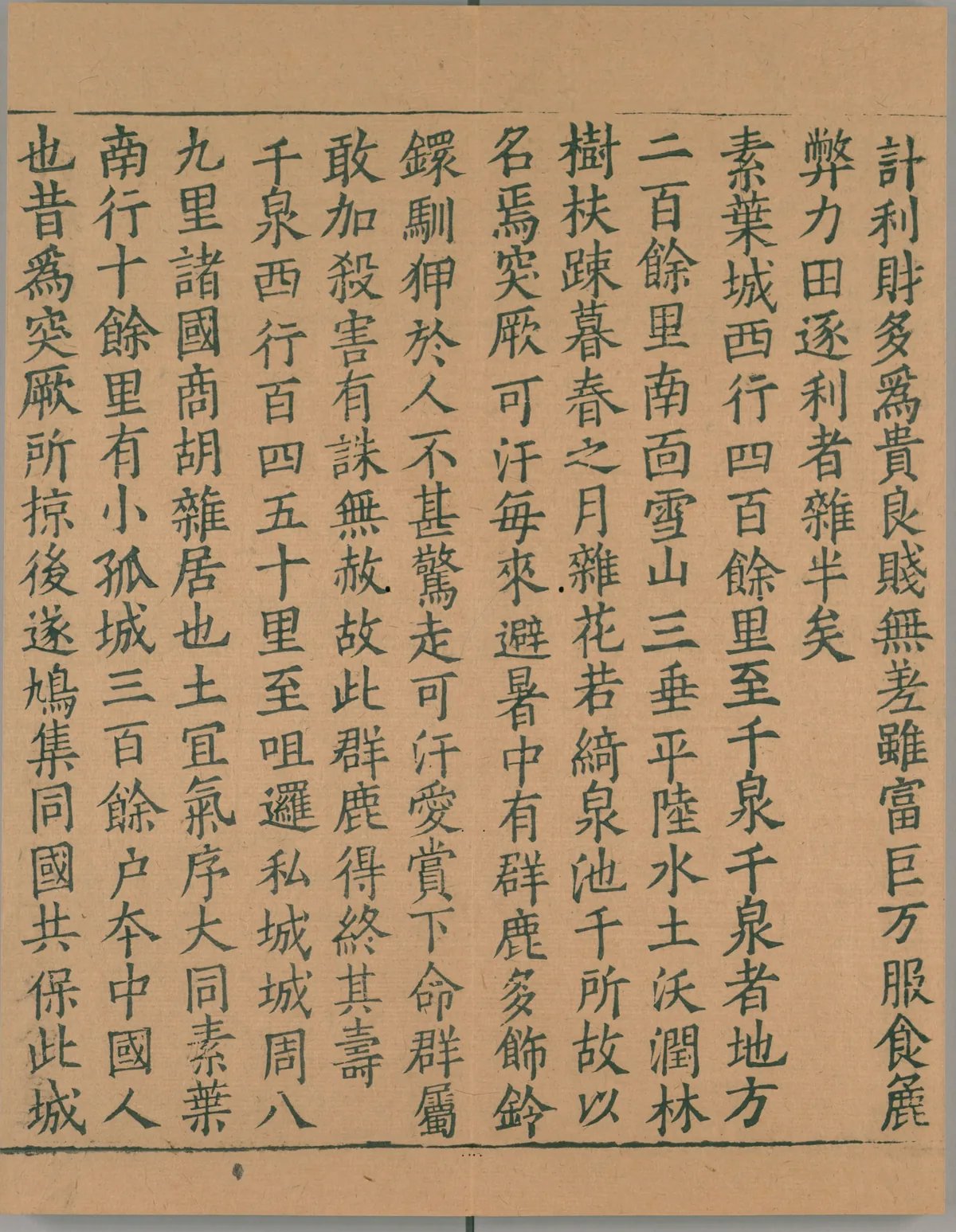
The Thousand Springs, 千泉, was a plain west of Suyab, where the khans of the western Göktürks spent the summer.[1] Tong Yabgu moved his court there, to the Thousand Springs north of Chach.[2]
The place in Xuanzang’s record
The Record of the Western Regions is the account of the pilgrim Xuanzang’s journey. It sets the Thousand Springs some four hundred li west of the town on the Suye river.[1] The country measured more than two hundred li across. Snow mountains rose to the south, and level land lay on the other three sides.[1] Its soil was moist and fertile, and its trees grew tall. The Record compares the flowers of late spring to figured silk.[1] There were a thousand springs and pools, and the place took its name from them.[1]
The Göktürk khan came there every year to escape the summer heat.[1] Herds of deer lived among the springs. Many of them were hung with bells and rings, and they were tame and unafraid of people.[1] The khan was fond of them. He ordered that whoever killed one would die without pardon. As a result, the deer lived out their lives.[1] A hundred and forty or fifty li to the west lay the town of Talas.[1]
The Life of Xuanzang gives the place a second name, Pingyu, 屏聿. It explains that the name means the Thousand Springs.[3] It describes a country several hundred li across, full of pools and fine trees, cool and moist. This was the place where the khan escaped the summer heat.[4] The Xin Tang Shu repeats the Record’s description almost word for word in its chapter on the Western Regions.[5] The two passages are therefore one testimony.
The court of Tong Yabgu
Tong Yabgu succeeded his elder brother Shegui, who had held court on Sanmi Mountain north of Kucha.[6] The Jiu Tang Shu says that Tong Yabgu annexed the Tiele in the north, held off Persia in the west and reached Jibin in the south.[6] He held the old land of the Wusun. He moved his court to the Thousand Springs north of Chach.[6] The kings of the western states received from him the title of ilteber. He sent a tudun to supervise them and oversee the taxes.[7]
Some scholars call the Thousand Springs his capital and place it east of the Talas.[8] Others have him range over the old Wusun land, the valleys of the Kunges, the Tekes and the Ili. He stayed at the Thousand Springs by preference.[9] Under Heshana, the Sui Shu sets one of two lesser khans north of Chach, to control the Hu states.[10] That lesser khan’s residence has been put at the Thousand Springs.[11]
After Tong Yabgu
According to the Jiu Tang Shu, Ashina Helu went west with his son in 651. He took the lands of the Üç Tuğlu Khan and set up his court at Shuanghe and at the Thousand Springs.[6] There he called himself Shaboluo Khan.[7] In 657, after Helu’s defeat, the Tang deputy protector Xiao Siye came to the Thousand Springs, where Helu’s lower camp had stood.[6]
Location
Xuanzang’s two accounts fix the place by distance: some four hundred li west of Suyab and about a hundred and fifty li east of Talas.[12] Some scholars put it at the northern foot of the mountains, about two thirds of the way from Tokmak to Talas.[11] They take Bin-gheul for the Turkic name of the place, with the same meaning as the Chinese.[13] The Arabic geographers place a district of a thousand springs between Isfijab and Talas. It lay west of Talas and is a different place.[14]
References
- ^ a b c d e f g h i Record of the Western Regions, juan 1
- ^ Jiu Tangshu (Old Book of Tang), juan 194; Xin Tangshu (New Book of Tang), juan 215; Tongdian, juan 199
- ^ Life of Xuanzang, juan 2; Beal 1911, p. 44
- ^ Life of Xuanzang, juan 2; Beal 1911, p. 44–45
- ^ Xin Tangshu (New Book of Tang), juan 221; Record of the Western Regions, juan 1
- ^ a b c d e Jiu Tangshu (Old Book of Tang), juan 194
- ^ a b Jiu Tangshu (Old Book of Tang), juan 194; Xin Tangshu (New Book of Tang), juan 215
- ^ Golden 1992, p. 135
- ^ Chavannes 1903, p. 263
- ^ Sui Shu (Book of Sui), juan 84
- ^ a b Chavannes 1903, p. 14
- ^ Record of the Western Regions, juan 1; Life of Xuanzang, juan 2
- ^ Chavannes 1903, p. 195
- ^ Chavannes 1903, p. 120
Sources
- Record of the Western Regions, juan 1
- Life of Xuanzang, juan 2
- Jiu Tangshu (Old Book of Tang), juan 194
- Xin Tangshu (New Book of Tang), juan 215, 221 (after Jiu Tangshu)
- Tongdian, juan 199 (after Sui Shu and Zhou Shu)
- Sui Shu (Book of Sui), juan 84
Literature
- Édouard Chavannes, Documents sur les Tou-Kiue (Turcs) occidentaux (1903)
- Peter B. Golden, An Introduction to the History of the Turkic Peoples (1992)
- Samuel Beal (trans.), The Life of Hiuen-Tsiang by the Shaman Hwui Li (1911)
What links here11
- Persons
- Ashina Helu · Irbis Shegui Khan
- Battles & Events
- Murder of Tong Yabgu (630) · Xuanzang's visit to Tong Yabgu
- Places
- Sanmi Mountain · Suyab
- Institutions and Titles
- Trade Routes of the Steppe · Tudun
Cite this article
Yavuz, Emre-E. “Thousand Springs.” Turkic Atlas, revised 8 November 2026. https://turkicatlas.org/places/thousand-springs/
Last revised: 8 November 2026

