
- 400
- 500
- 600
- 700
- 800
- 900
- Rouran 400–554
- First Göktürk 552–630
- Tang rule 630–682
- Second Göktürk 682–744
- Uyghur 744–840
- Kirghiz 840–924
- Huns 370–469
- Western Göktürk 552–659
- Türgesh 699–766
- Karluk 766–800
- Khazar 650–969
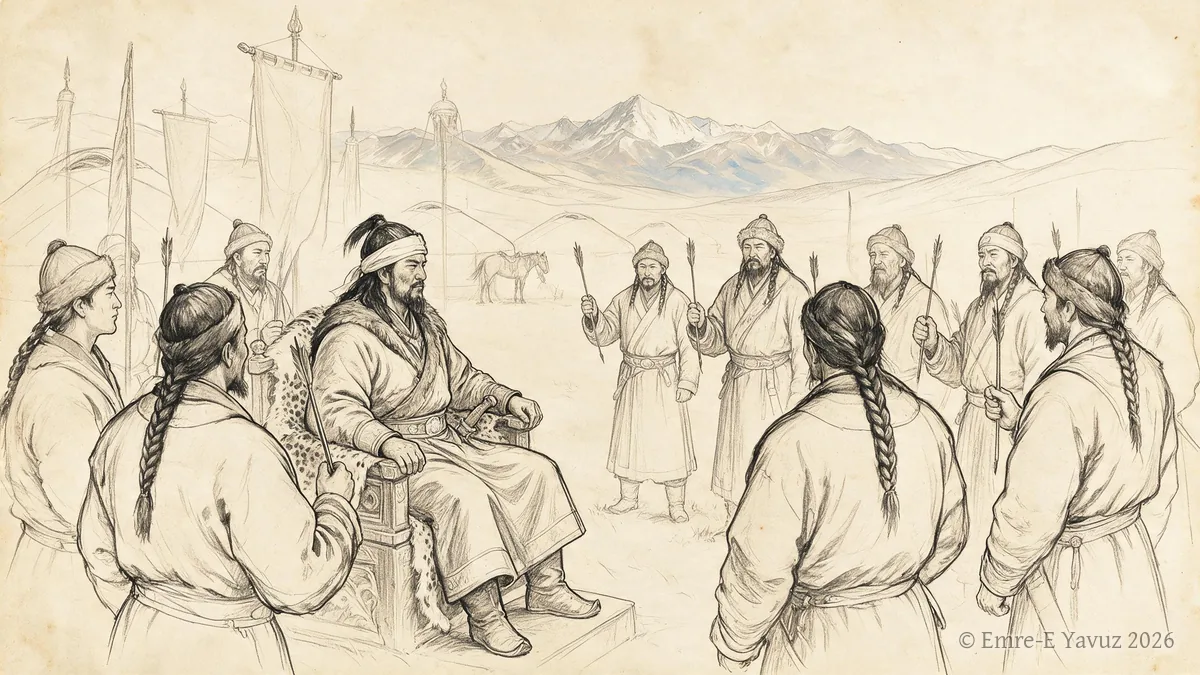
The murder of Tong Yabgu touched off a civil war. The western Göktürks disintegrated into the On Oq.[1] The confederation fully manifested itself in the reign of Ishbara Tolis, the Shaboluo Dielishi of the Chinese, from 634 to 639.[1] It consisted of two tribal unions of five tribes each, each with its own khan. The Üç Tuğlu lay east of Suyab, and the Nushibi lay west of it. The Tang histories call the Üç Tuğlu the Duolu, “those with the three tuğ”.[1] The chiefs at first bore the title shad and later čor in the Üç Tuğlu and irkin in the Nushibi. Each had been given an arrow as the symbol of his authority, and this is the origin of the name.[1] The Tang histories name the five Üç Tuğlu tribes as the Chumukun, the Huluwu, the Sheshetidun, the Tuqishi Heluoshi and the Shunishi. The Tuqishi Heluoshi are the Türgesh. The Tang histories name the five Nushibi tribes as the Axijie, the Geshu, the Basaigan, the Axijie of Nishu irkin and the Geshu of Chupan irkin.[2] The ten tribes now held the power. The men who still took the title of yabgu or khan after Tong Yabgu were subordinate to them. Both Tang histories already describe the people of the western Göktürks as a mixture of six groups: the Duolu and the Nushibi, the Karluk, the Chuyue, the Chumi and the Yiwu.[3] This count may date to the time of Chuluo Khan, about 611. The six would then be the hordes of the western realm before the Ten Arrows took their form.[4]
The Ten Surnames
The Chinese chapters have a second name for the confederation, and both names stand in one sentence. The Xin Tang Shu says that the khan divided his state into ten tribes. He set one man over each and gave each man an arrow. They were called the Ten Shads, also the Ten Arrows. They were made into a left and a right: the five Duolu tribes under five great chur east of Suyab, the five Nushibi tribes under five great irkin west of it. Below them one arrow was called one tribe. The whole was named the Ten Surnames tribes, 十姓部落.[2]
The equation is in the source and is not a modern inference. Ten Arrows and Ten Surnames are one body under two names. The first comes from the token each chief held, the second from the Chinese habit of counting a people by its clans.[2] An older proposal reads the Turkic name behind the ten tribes as On Oguz, “the ten Oguz”. It regards this as the name of the whole western realm from about 635.[5] Another proposal reads the On Oq as probably the Tardush group of the Tölis, also called western Turks.[6] The Turkic texts write the name on ok.[7]
That sentence writes “right” twice, once for each wing. The parallel notices settle the matter the other way. The Jiu Tang Shu has the left wing’s five Duolu chur and the right wing’s five Nushibi irkin come over to the Tang in 715. The Xin Tang Shu’s own eastern chapter has the left five Duolu and the right five Nushibi ask to submit in the same years.[3] The doubled character is a slip in transmission. The left wing is the Duolu.
The chapter singles out two of the ten chiefs. The Huluwu Que was Ashina Helu’s son-in-law. The Axijie Que Irkin was the strongest of them, with fighting men reckoned in the hundreds of thousands.[2]
The title in Tang use
After the capture of Helu in 657 the name became an office. The Tang gave it to men of the Ashina who held Chinese rank. One man took the title without being given it. In the Yifeng period Ashina Duzhi styled himself Khan of the Ten Surnames. The Tang had made him a grand general and governor of Fuyan in 671 to settle his people. He made common cause with Tibet and raided Anxi.[2] Pei Xingjian asked for no army. He took Duzhi by a ruse and travelled west under commission to escort the Persian prince home. Duzhi suspected nothing. He came with his sons and brothers to pay his respects and was seized in the first year of Tiaolu.[2] “From this the western surnames grew weaker still, and afterwards the men of the two divisions scattered by the day.”[2]
The office was held twice more in the generation that followed. In the Chang’an period Ashina Xian carried the commission for the pacification of the Ten Surnames together with the grand protectorate of Beiting. In the fourth year Ashina Huaidao was made Khan of the Ten Surnames and protector of Mengchi. Huaidao bore the Tang patent to the Türgesh Suoge in the Shenlong period.[2]
The east used the name as well. Kapgan Khan set his son Fuju over the west as Little Khan, above the two shads. The Jiu Tang Shu says that Kapgan gave Fuju the Chumukun and the rest of the Ten Surnames, more than forty thousand men, under the title Khan of the expanded west.[8] In 715 the ten tribes moved the other way.[8] The left wing’s five Duolu chur and the right wing’s five Nushibi irkin came over to the Tang. With them came the khan’s son-in-law Gao Wenjian, a Goguryeo, and other chiefs, each leading his own people.[8] More than ten thousand tents came over in all. An edict settled them in their old lands south of the river.[8]
The last Khan of the Ten Surnames was Huaidao’s son Xin, sent west with an escort after the Türgesh Tuhuoxian was beaten. He reached Julan city west of Suyab and was killed there by the Türgesh Mohe Dagan. The Jiaohe princess and her son got away to China.[2] With that, the Xin Tang Shu says, the western Göktürks came to an end.[2]
Khans and the end of independence
Power shifted back and forth between the Üç Tuğlu and Nushibi khans, with China an occasional player. In 657 Ashina Helu was captured and the west was divided into ten prefectures. The khans of the years between Tong Yabgu and Helu have their own articles: Ishbara Tolis, Yukuk Shad, Irbis Ishbara Yabgu and Irbis Shegui. Some of the On Oq came under Tibetan overlordship in the late 660s. The Tang regained their pre-eminence by the 680s. The revived eastern khaganate attacked and pillaged the On Oq lands repeatedly between 685 and 688. The Üç Tuğlu khan Hushile emigrated to China in 690. In 699 Kapgan Khan of the east set his younger brother and a nephew over the two branches. Within the confederation the Türgesh were by then gaining supremacy. The Kül Tegin inscription, from the eastern side, says of the Türgesh khan that he was of the Göktürks’ own stock. Because of his errors, it says, he and his commanders died and the On Oq people suffered.[7] By 766 the Karluks were complete masters of the western Göktürk lands. The Tang history has the On Oq brought under Karluk authority.[1] Throughout the On Oq stage the western Göktürk polity kept the khaganal dignity, titles and officials but lacked internal cohesion. It had reverted to a tribal union and only intermittently functioned as a state.[1]
References
- ^ a b c d e f Golden 1992
- ^ a b c d e f g h i j Xin Tangshu (New Book of Tang), juan 215
- ^ a b Jiu Tangshu (Old Book of Tang), juan 194; Xin Tangshu (New Book of Tang), juan 215
- ^ Markwart 1938, p. 150
- ^ Markwart 1938, p. 149
- ^ Kayra 1996, p. 150
- ^ a b Kül Tegin inscription
- ^ a b c d Jiu Tangshu (Old Book of Tang), juan 194
Sources
- Xin Tangshu (New Book of Tang), juan 215 (after Jiu Tangshu)
- Jiu Tangshu (Old Book of Tang), juan 194
- Kül Tegin inscription
- Tonyukuk inscription
Literature
- Emre-E. Yavuz, The Gokturk Empire: 2nd Edition (2025)
- Peter B. Golden, An Introduction to the History of the Turkic Peoples (1992)
- Josef Markwart, Wehrot und Arang. Untersuchungen zur mythischen und geschichtlichen Landeskunde von Ostiran (1938)
- Osman Kemal Kayra, Orhun Anıtlarında Sıfatlar, Sıfat Tamlamaları ve Bunlara İlişkin Bazı Açıklamalar (1996)
What links here34
- Persons
- Ashina Helu · Bayanchur Khan · Inel Khan · Ishbara Tolis Khan · Istemi · Su Dingfang · Tong Yabgu
- Battles & Events
- Battle of Bolchu · Murder of Tong Yabgu (630)
- Peoples
- Chumukun · History of the Turkic peoples · Karluk · Nushibi · Türgesh
- Institutions and Titles
- Army of the Steppe Empires · Baghatur · Chur · Post and Communication · Tally Sticks and the Golden Arrow · Tudun
Cite this article
Yavuz, Emre-E. “On Oq.” Turkic Atlas, revised 8 November 2026. https://turkicatlas.org/ethnicities/on-oq/
Last revised: 8 November 2026

