
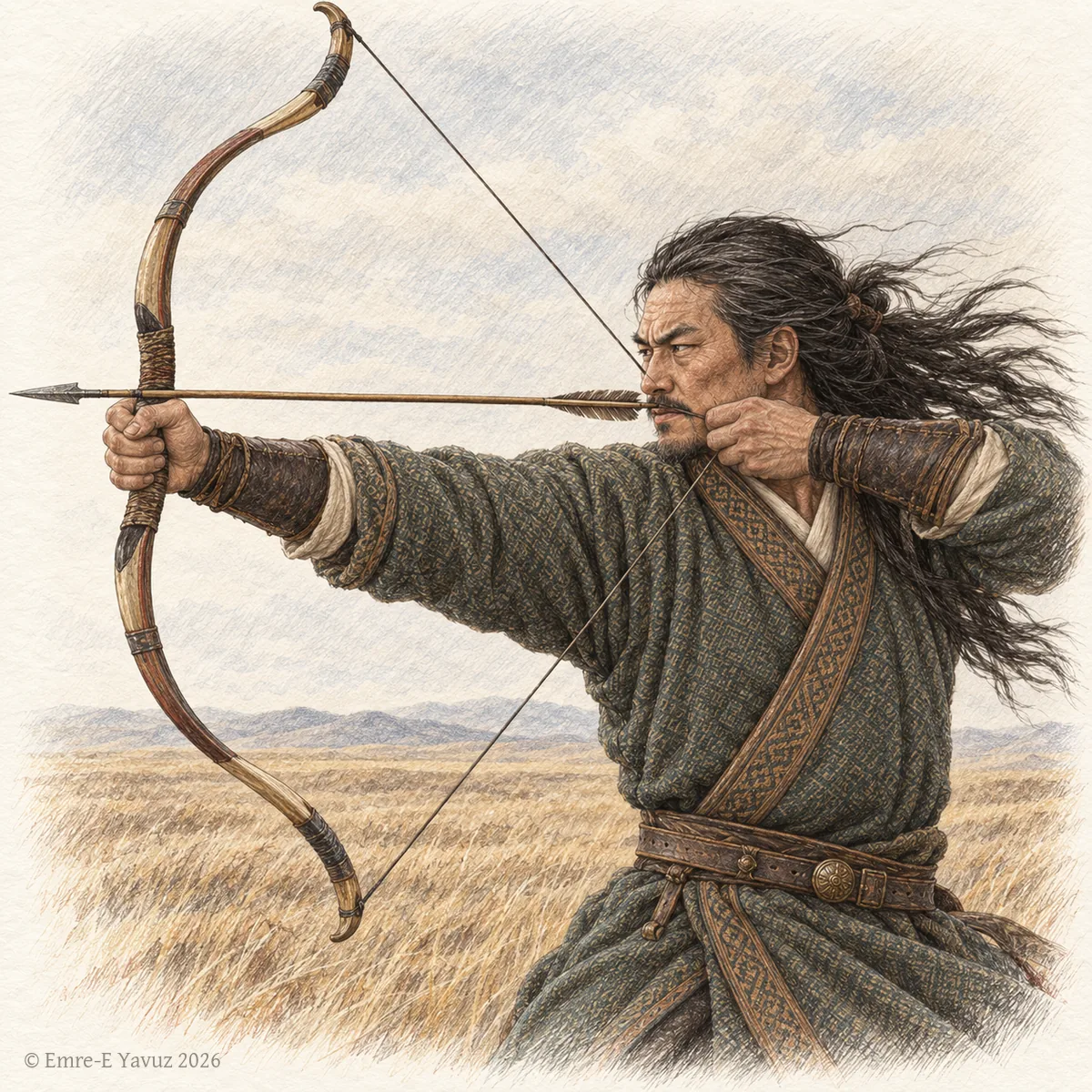
Ishbara was a Göktürk title that marked a man out for his courage.[1] The Tongdian, the Tang encyclopaedia of government, says that the Göktürks called the brave and strong shiboluo, 始波羅, and also yinghefu.[1] It gives the word in a passage on the early ranks of the khaganate. The names of these ranks, it says, were taken from the body, from age, from colour and hair, from wine and meat, or from animals.[1]
In the titles of Ishbara Khan
The word is best known from the khan the Chinese call Shabolüe. The Göktürks agreed among themselves to raise him to the throne. The Sui Shu says that he was then styled Yili Julu She Mohe Shiboluo Khan, and also Shabolüe, 沙鉢略.[2] Under that second name the Sui Shu tells the whole reign of Ishbara Khan.[2] It says of him that he was brave and that the peoples of the north followed him.[2]
He used the title in his own letters. One of them is dated the tenth day of the ninth month of the dragon year.[2] In it he calls himself born of Heaven, of the Great Göktürks, the wise and holy Son of Heaven of all under Heaven, Yili Julu She Mohe Shiboluo Khan.[2] The dragon year was 584.[3] The Sui emperor answered with the same string of titles. Where the khan’s letter has shiboluo, the reply has shabolüe.[2]
The khan was hard pressed by Tardush and feared the Khitan in the east. He later asked leave to bring his people south of the desert.[2] After a treaty that made the desert the frontier, he sent the Sui a memorial of submission.[2] It opens with the words “Great Göktürk Yili Julu She Shiboluo Mohe Khan, your subject Shetu, says”.[2] The title now stands before mohe, and the khan closes the string with his own name.[2]
The word
One translation of the Tongdian renders shiboluo as the Turkic ïšbara.[4] The word stands on the Kül Tegin inscription, before a man’s name.[5] In the battle against the Chinese general Čača Seŋün, the second horse that Kül Tegin rode and lost was the grey of Išbara Yamtar.[6]
One derivation takes ïšbara from the Sanskrit īśvara, “prince, lord”. On this derivation the word reached the Göktürks through Tokharian.[7] The Tongdian’s gloss and this derivation give the word two different meanings, the brave in the one and the lord in the other.
Later holders
Among the western Göktürks the Tang histories write the word 沙缽羅, shaboluo, in the titles of Ishbara Tolis Khan and Irbis Ishbara Yabgu Khan.[8] The Tongdian uses the same spelling for both in its chapter on the west, while its gloss on the brave writes 始波羅.[9] In 647 Chebi Khan, an Ashina who had made himself khan north of the Altai, sent his son Shaboluo Tegin to the Tang court with gifts.[10]
References
- ^ a b c Tongdian, juan 197
- ^ a b c d e f g h i j Sui Shu (Book of Sui), juan 84
- ^ Golden 1992, p. 147
- ^ Mau-tsai 1958, Turkish edition, p. 21
- ^ Kül Tegin inscription
- ^ Kül Tegin inscription; Tekin 1968, p. 396
- ^ Golden 1992, p. 148
- ^ Xin Tangshu (New Book of Tang), juan 215; Jiu Tangshu (Old Book of Tang), juan 194
- ^ Tongdian, juan 199; Tongdian, juan 197
- ^ Xin Tangshu (New Book of Tang), juan 215
Sources
- Tongdian, juan 197, 199 (after Sui Shu and Zhou Shu)
- Sui Shu (Book of Sui), juan 84
- Kül Tegin inscription
- Xin Tangshu (New Book of Tang), juan 215 (after Jiu Tangshu)
- Jiu Tangshu (Old Book of Tang), juan 194
Literature
- Liu Mau-tsai, Çin Kaynaklarına Göre Doğu Türkleri (1958, Turkish edition)
- Peter B. Golden, An Introduction to the History of the Turkic Peoples (1992)
- Wilhelm Radloff, Die alttürkischen Inschriften der Mongolei (1894–1895, parts 1–3)
- Talât Tekin, A Grammar of Orkhon Turkic (1968)
What links here5
- Institutions and Titles
- Baga · Kül Tegin's Horses · The Twenty-Eight Ranks · Yinghefu
- Languages
- Chinese transcriptions of Turkic
Cite this article
Yavuz, Emre-E. “Ishbara (Title).” Turkic Atlas, revised 8 November 2026. https://turkicatlas.org/institutions/ishbara-title/
Last revised: 8 November 2026

