
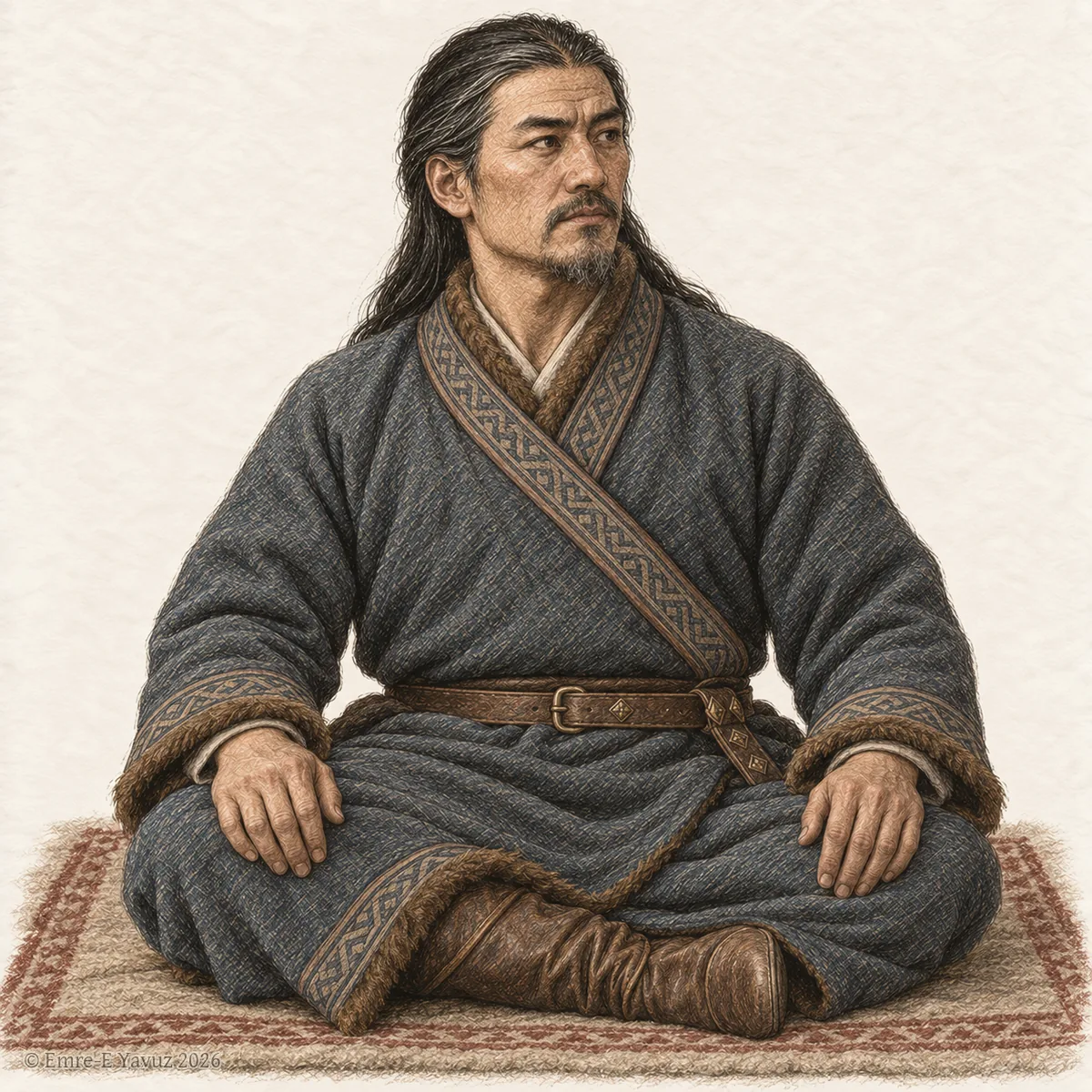
Baga was a title of the Göktürk court.[1] The Chinese histories write it 莫何 or 莫賀, mohe. It appears inside the long titles of khans.[2] The word is borrowed from Iranian baga, “god, divine”.[3] A second account sets the Old Turkic word baγa, “small, lower in rank”, beside this derivation.[4]
In the titles of the khans
When Ishbara was raised to the throne, the Sui Shu records his title as 伊利俱盧設莫何始波羅可汗, Yili Julu She Mohe Shiboluo Khan.[1] Some scholars divide the string, element by element, as ilig külü šad baga išbara qagan, with 莫何 as baga.[5] On this division, the first element is the Illig of Bumin’s title. The third is the shad.[5] The fifth element, 始波羅, is the word that the Tongdian explains as “the brave”, the Ishbara.[6]
Ishbara used the full title in his letters. In a letter to the Sui emperor, dated in a year of the dragon, he called himself the son of Heaven born of Heaven. He gave his title with 莫何 before 始波羅.[1] In the memorial in which he later accepted the Sui as overlord, the order is reversed: 伊利俱盧設始波羅莫何可汗.[1] The Tongdian gives the memorial in the same form.[6]
Ishbara’s brother Bagha, whom the Chinese call Chuluohou, took the throne in 587. At that point the Zizhi Tongjian calls him 莫何可汗, Mohe Khan.[7] The Sui Shu calls him 葉護可汗, Yabgu Khan, instead.[1] He is known in the literature as Bagha Khan after the first of these titles.[8]
Beyond the house of Ashina
The title was not reserved to the Ashina.[1] In 605 the Tiele rose against the western khan. They raised Qibi Geleng, of the Qibi, as Yiwuzhen Mohe Khan.[1] The Sui Shu then calls him simply Mohe, matchless in courage, who won the hearts of his people.[1]
The Tang histories write the word with 莫賀.[9] After the murder of Tong Yabgu, the Nushibi tribes chose Nishu Mohe Shad as khan. He refused.[9] Some scholars render the name Nishu Baga Shad.[10] The same characters begin the title Baghatur, 莫賀咄.[9]
In the Second Khaganate the word is attested in Turkic.[11] Tonyukuk names himself on his monument Bilge Tonyukuk Boyla Baga Tarkan. The stone spells the word 𐰉𐰍𐰀.[12] The Türgesh leader whom the western tribes chose about 699 bore the title Baga Tarkan as well.[3] In both cases the word stands before tarkan. The two together formed a title of its own.[13]
One edition of the Ongin inscription reads baga teŋriken in the line about the speaker’s father. It takes baga with his name or title.[14] The editor does not give his reasons for this choice.[14]
References
- ^ a b c d e f g h Sui Shu (Book of Sui), juan 84
- ^ Sui Shu (Book of Sui), juan 84; Xin Tangshu (New Book of Tang), juan 215
- ^ a b Golden 1992, p. 139
- ^ Tekin 1968, p. 307
- ^ a b Golden 1992, p. 122
- ^ a b Tongdian, juan 197
- ^ Zizhi tongjian (Comprehensive Mirror in Aid of Governance), juan 176
- ^ Yavuz 2025, p. 323
- ^ a b c Xin Tangshu (New Book of Tang), juan 215
- ^ Chavannes 1903, p. 54
- ^ Tonyukuk inscription; Tekin 1968, p. 307
- ^ Tonyukuk inscription; Tekin 1968, p. 283, 307
- ^ Tonyukuk inscription
- ^ a b Ölmez 2016, p. 52–53
Sources
- Sui Shu (Book of Sui), juan 84
- Tongdian, juan 197 (after Sui Shu and Zhou Shu)
- Zizhi tongjian (Comprehensive Mirror in Aid of Governance), juan 176 (after Wei Shu, Zhou Shu, Sui Shu and Bei Shi)
- Xin Tangshu (New Book of Tang), juan 215 (after Jiu Tangshu)
- Tonyukuk inscription
Literature
- Peter B. Golden, An Introduction to the History of the Turkic Peoples (1992)
- Édouard Chavannes, Documents sur les Tou-Kiue (Turcs) occidentaux (1903)
- Emre-E. Yavuz, The Gokturk Empire: 2nd Edition (2025)
- Talât Tekin, A Grammar of Orkhon Turkic (1968)
- Mehmet Ölmez, Ongi Yazıtı, Sorunlar ve Çözüm Önerileri (2016)
What links here3
- Persons
- Bagha Shad · Nishu Bagha Shad
- Institutions and Titles
- Baghatur
Cite this article
Yavuz, Emre-E. “Baga.” Turkic Atlas, revised 8 November 2026. https://turkicatlas.org/institutions/baga/
Last revised: 8 November 2026

