
- 400
- 500
- 600
- 700
- 800
- 900
- Rouran 400–554
- First Göktürk 552–630
- Tang rule 630–682
- Second Göktürk 682–744
- Uyghur 744–840
- Kirghiz 840–924
- Huns 370–469
- Western Göktürk 552–659
- Türgesh 699–766
- Karluk 766–800
- Khazar 650–969
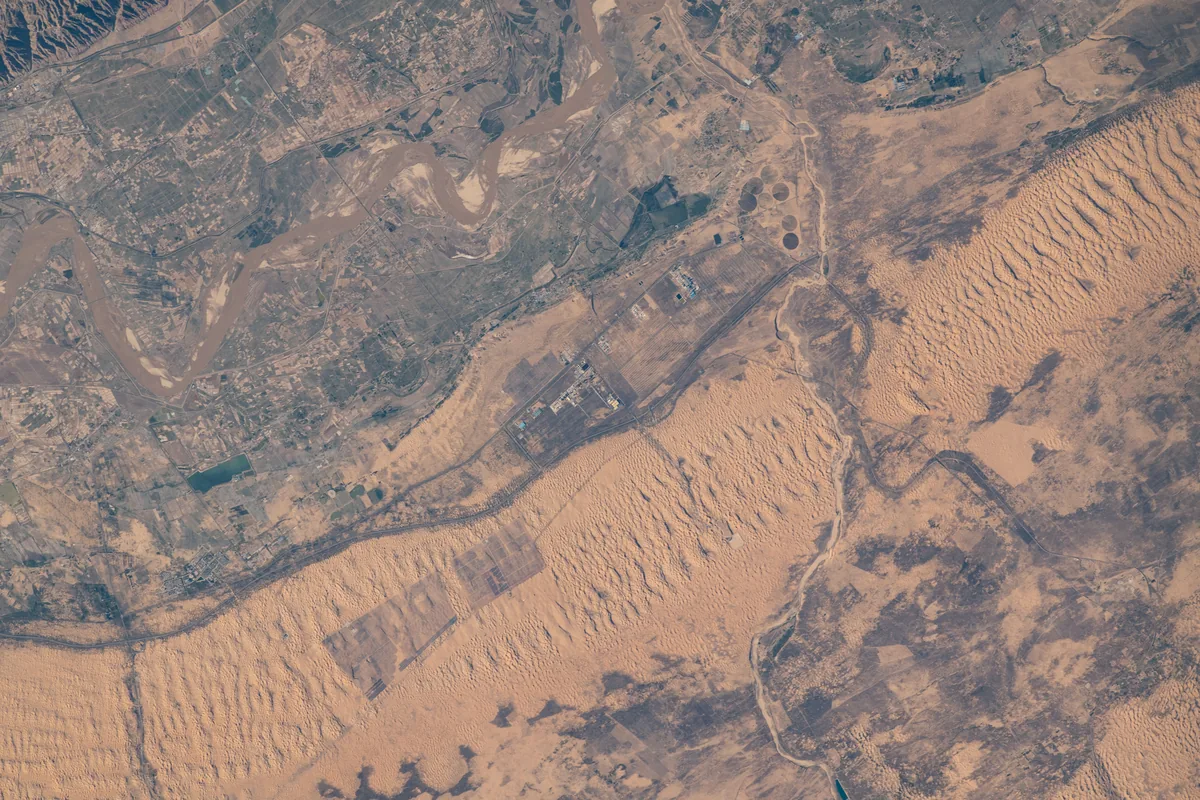
The Ordos is the steppe inside the great northern bend of the Yellow River. It is a plateau of grass and sand that the river encloses on three sides. The Chinese called it simply Henan, “south of the river”. It is the one piece of the steppe that lies inside the line a Chinese wall can be built on. For that reason every steppe power and every northern Chinese state fought over it in the history of the steppe empires. It was a natural frontier between the Chinese culture to the south and east and the nomadic, Mongolic and Turkic culture to the north and west.[1]
Xiongnu and Han
The Shiji records the first contest for the loop. When the Qin had destroyed the six states, the First Emperor sent Meng Tian north with a hundred thousand men against the Hu. Meng Tian took all the land south of the river and made the river the frontier. He built forty-four walled towns along it and moved convicts there to fill them.[2] After Bagatur had beaten the Yuezhi, the Loufan and the king of Baiyang south of the river, he recovered all the Xiongnu land that Meng Tian had taken. He reached the old Han frontier south of the river.[2] In the third year of the emperor Wen, 177 BC, the Xiongnu Right Wise King came to live in the land south of the river. He raided Shangjun, until the emperor sent eighty-five thousand chariots and horse against him.[2] The Xiongnu had camps in the Orkhon and Ordos regions with permanent structures for religious, political and storage purposes.[3] The archaeology of the Ordos has found no secure trace of the Xiongnu cultural complex for the period of their power. The southern Xiongnu are supposed to have lived there. Turkic Atlas reports this under the Xiongnu.[3]
Rouran and Wei
Under the Northern Wei the loop was the frontier itself. The Ordos was the focus of Datan’s wars with the emperor Taiwu in the 420s.[4] The Wei Shu has Taiwu drill his army and set out from Wuyuan on the loop’s northern edge against the Rouran in 438. The Six Garrisons, of which Huaihuang was one, ran along the Hetao plain that begins at the Ordos.[4] Anagui’s raid of 523 and his intervention of 525 were fought on the same ground.[5]
Göktürks and the Rouran remnant (553)
The Zhou Shu places the end of the Rouran here. In 553 Issik Khan broke Dengshuzi’s army at Mount Mulai, north of Woye. Woye was the westernmost of the Six Garrisons on the loop’s northern edge.[6] Some scholars have Issik overtake the Rouran army in the spring of 553 and destroy it on the Ordos. From that steppe every Chinese wall could be turned.[1] The Zhou Shu’s mountain and the plateau are the same ground seen from two sides.[1] In 564 the Zhou general Yang Zhong marched out by Woye with Mukan against the Qi.[6]
Tang and the eastern Göktürks
Before his accession Ilig was the Moheduo Shad with his camp north of Wuyuan. The Sui governor of Wuyuan had attached the town to the Göktürks. This lasted until the Tang bribed the shad to give it back in 618.[7] Liang Shidu, the warlord whom Shibi made a khan, held Xiazhou on the loop’s southern edge. He joined Shibi there in 619. With his help the Göktürks occupied the Ordos.[8] Ilig and Töles invaded by way of Yuanzhou in 624. Li Shimin rode out with a hundred horsemen to meet them on the loop’s edge.[7]
When Ilig fell in 630 the Tang debated where to put the hundred thousand Göktürks who had surrendered.[7] Wen Yanbo argued for the precedent of the Han. The Han had settled the surrendered Xiongnu inside the Wuyuan frontier, keeping their tribes whole as a shield and not uprooting them from their customs.[7] Wei Zheng made three points. Beasts in human form should be sent back north of the river. A hundred thousand would be a million in a few years. The Jin had let the Xiongnu live in the inner commanderies and had lost Luoyang to them.[7] The emperor followed Wen Yanbo. He set up the protectorates of Shun, You, Hua and Chang from Youzhou to Lingzhou. He divided Ilig’s land into six prefectures under Dingxiang and Yunzhong. Several thousand Göktürk families went to live at Chang’an.[7] After the revolt of Töles’s brother in 639 the court thought better of it. It moved Ashina Simo and his people north of the river.[7] The Xueyantuo threatened them there. In 643 Simo’s people, a hundred thousand with forty thousand fighting men, rebelled against him. They asked to return south of the river between Sheng and Xia, which was granted.[7] For fifty years the eastern Göktürks lived on the loop under Chinese protectorates. The Second Khaganate rose from among them in 682.
Six hu prefectures
The Sogdians settled the loop as well. The six hu prefectures of the Ordos were Sogdian settlements under Tang administration, from 630 to 679 and again from 721 to 727. The horse trade of the Tang and the Shi graves of Guyuan belong to the same milieu.[9] In 698 Kapgan demanded the surrendered households of the six prefectures with seed and farming tools. The Jiu Tang Shu names the handover as the source of his strength.[7] The three Shouxiang towns the Tang then built along the northern bend were the bar against him.[7] Turkic Atlas treats the rest under the Sogdians and under An Lushan, who came out of that frontier world.
Assessment
No steppe power held the Ordos for long, and none could leave it alone. It fed horses. It opened every road into Guanzhong. Whoever camped on it could reach Chang’an in a season, as Ilig did in 626. That is why the Tang put their surrendered Göktürks there, and why they regretted it.
References
Sources
- Shiji, juan 110
- Wei Shu, juan 103
- Zhou Shu (Book of Zhou), juan 50
- Jiu Tangshu (Old Book of Tang), juan 194
Literature
- Emre-E. Yavuz, The Gokturk Empire: 2nd Edition (2025)
- Peter B. Golden, An Introduction to the History of the Turkic Peoples (1992)
- Étienne de la Vaissière, Sogdian Traders: A History (2005)
What links here22
- Persons
- An Lushan · Aoshe Shad · Dengzhu · Duman (Touman) · Emperor Wu of Han · Ilig Khan · Kang Sumi · Meng Tian · Shibi Khan · Wei Qing · Yizhixie Chanyu · Yushe Shad
- States
- Northern Zhou · Western Wei
- Conflicts
- The Xiongnu–Han Wars
- Peoples
- Sogdians
- Institutions and Titles
- Six Garrisons
- Controversies
- Turkic-Sogdian Synthesis
Cite this article
Yavuz, Emre-E. “Ordos.” Turkic Atlas, revised 8 November 2026. https://turkicatlas.org/places/ordos/
Last revised: 8 November 2026

