
Dingxiang, 定襄, was a town and commandery on the northern frontier of China.[1] The Sui built the town for a Göktürk khan in 600.[2] From 620 it was the seat of a Sui court in exile under Göktürk protection.[3] In 630 the Tang opened their last campaign against the eastern khaganate with a night attack on it.[4]
The Sui frontier
In 600 the Sui emperor sent Zhao Zhongqing to build two towns, Jinhe and Dingxiang, for Yami Khan. The Sui called Yami Qimin Khan.[2] The Sui Shu’s life of Pei Ju names the Dingxiang road in a campaign against Tardush.[5] Shi Wansui marched out by it with Pei Ju as his chief of staff. He broke Tardush beyond the frontier.[5] The Sui Shu’s chapter on the Göktürks has Shi Wansui march out from Shuozhou instead.[6]
In 607, according to the Zizhi tongjian, the emperor Yangdi was at Yulin. The governor of the Dingxiang commandery, Zhou Fashang, came to his travelling palace.[7] On the emperor’s return Yami escorted him into the frontier as far as Dingxiang.[6] There an edict sent the khan back to his own land.[6]
The Sui court in exile
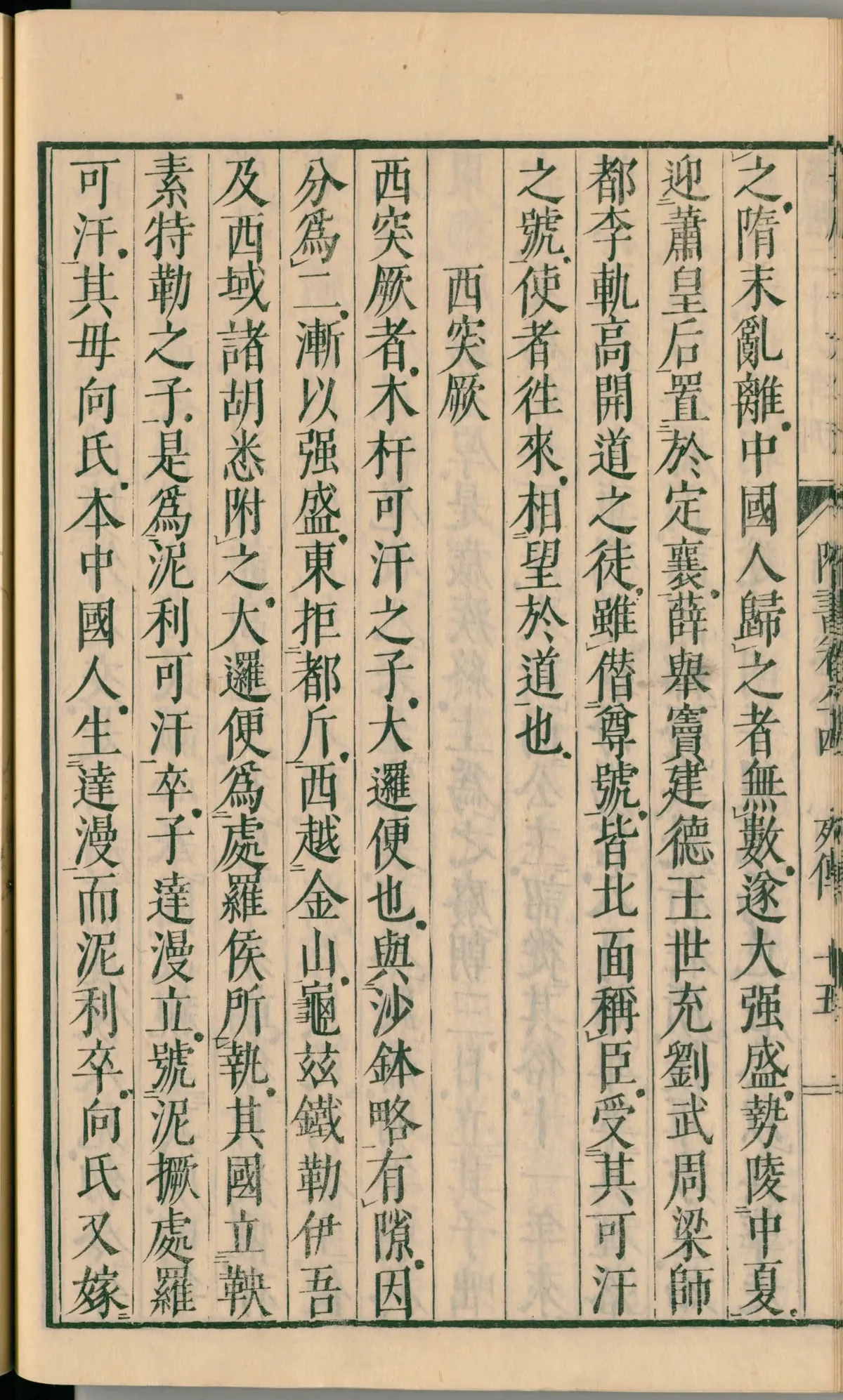
In the disorder at the end of the Sui, the Sui Shu says, countless Chinese went over to the Göktürks. The Göktürks grew strong enough to overshadow China.[6] They brought the empress Xiao, the consort of the emperor Yangdi, and installed her at Dingxiang.[6] The Jiu Tang Shu dates this to the second month of 620.[3] The empress and Yang Zhengdao, a grandson of Yangdi, had fallen into the hands of the rebel Dou Jiande.[8] Chula Khan fetched them to his camp and made Zhengdao Prince of Sui.[3]
The Chinese who lived among the Göktürks were placed under Zhengdao.[3] They kept the Sui calendar and had their own officials. Ten thousand of them lived in the town of Dingxiang.[3] The Tongdian gives the same account and counts more than ten thousand.[9]
The night attack of 630
In 629 the Tang sent Li Jing against Ilig Khan by the Dingxiang road. This was the war that ended the eastern khaganate.[3] The Xin Tang Shu counts six columns in all, more than a hundred thousand men, every one of them under Li Jing’s command.[10] In the first month of 630 Li Jing came from Mayi with three thousand picked horsemen. He camped on the Eyang ridge and fell on Dingxiang by night.[4]
Ilig had not expected him. Ilig said that Li Jing would not have dared to come so far with a lone army unless the Tang had come with all their strength.[4] He moved his camp to Qikou.[3] The hu chief Kang Sumi went over to the Tang and brought the empress Xiao and Yang Zhengdao with him.[3] In the second month Li Jing destroyed Ilig’s state. The Tang took back the lands of Dingxiang and Heng’an and pushed the frontier out to the great desert.[9]
After the conquest
When Ilig’s former lands were divided, the Tang set up an area command of Dingxiang for the left and one of Yunzhong for the right. They were to govern his people.[3] These commands are counted among the loose-rein prefectures. In 641, according to the Xin Tang Shu, Ashina Simo crossed the Yellow River. He set up his court in the old town of Dingxiang.[10]
Location
Some scholars place Dingxiang north-west of Pinglu in Shanxi.[11] A commentary cited in the same translation puts the old town of Dingxiang three hundred li north of Mayi.[12] The histories do not say whether the town built in 600, the seat of the court in exile and the old town of 641 stood on one site.[13]
References
- ^ Sui Shu (Book of Sui), juan 84; Zizhi tongjian (Comprehensive Mirror in Aid of Governance), juan 180
- ^ a b Zizhi tongjian (Comprehensive Mirror in Aid of Governance), juan 179
- ^ a b c d e f g h i Jiu Tangshu (Old Book of Tang), juan 194
- ^ a b c Zizhi tongjian (Comprehensive Mirror in Aid of Governance), juan 193
- ^ a b Sui Shu (Book of Sui), juan 67
- ^ a b c d e Sui Shu (Book of Sui), juan 84
- ^ Zizhi tongjian (Comprehensive Mirror in Aid of Governance), juan 180
- ^ Jiu Tangshu (Old Book of Tang), juan 194; Zizhi tongjian (Comprehensive Mirror in Aid of Governance), juan 193
- ^ a b Tongdian, juan 197
- ^ a b Xin Tangshu (New Book of Tang), juan 215
- ^ Mau-tsai 1958, Turkish edition, p. 95
- ^ Mau-tsai 1958, Turkish edition, p. 284
- ^ Zizhi tongjian (Comprehensive Mirror in Aid of Governance), juan 179; Jiu Tangshu (Old Book of Tang), juan 194; Xin Tangshu (New Book of Tang), juan 215
Sources
- Sui Shu (Book of Sui), juan 67, 84
- Tongdian, juan 197 (after Sui Shu and Zhou Shu)
- Jiu Tangshu (Old Book of Tang), juan 194
- Xin Tangshu (New Book of Tang), juan 215 (after Jiu Tangshu)
- Zizhi tongjian (Comprehensive Mirror in Aid of Governance), juan 179, 180, 193 (after Wei Shu, Zhou Shu, Sui Shu and Bei Shi)
Literature
- Liu Mau-tsai, Çin Kaynaklarına Göre Doğu Türkleri (1958, Turkish edition)
What links here31
- Persons
- Ashina Simo · Chula Khan · Ilig Khan · Nishufu Khan · Pei Ju · Shibi Khan · Yami Khan
- States
- Sui · The Göktürk interregnum, 630–682
- Battles & Events
- Battle of Mount Dajin (600) · Battle of the Iron Mountain (630) · Night Attack on Dingxiang (630) · Ransom of the Chinese from the Göktürks (631) · The Court Debate of 630 · The Sui Court in Exile at Dingxiang (620) · Yangdi's Visit to Yami Khan (607)
- Places
- Baidao Plain · Eyang Ridge · Heng'an · Iron Mountain · Jin River · Mayi · Mount Dajin · Ordos · Qikou · Shanyu Protectorate · Yinshan · Yunzhong
- Institutions and Titles
- Loose-rein prefectures · Seasonal Pastures
Cite this article
Yavuz, Emre-E. “Dingxiang.” Turkic Atlas, revised 8 November 2026. https://turkicatlas.org/places/dingxiang/
Last revised: 8 November 2026

