
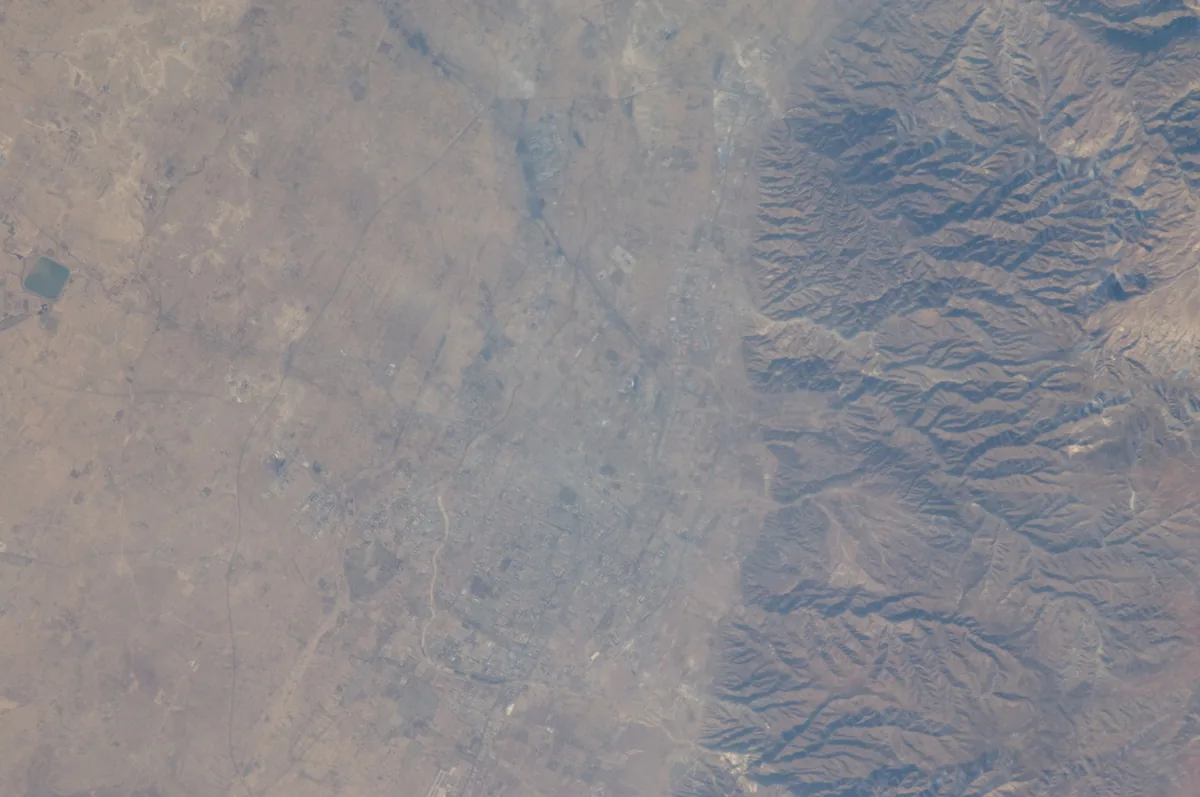
Baidao, 白道川, is a place on the northern frontier of China. The histories name it in the Göktürk wars from 583 to 630.[1] The Sui Shu has Ishbara Khan cross the desert southward to reach it.[2] The Tongdian makes it the northern edge of a land that began at the Yellow River.[3] It lay, then, between the desert and the river.
The last character of the name, 川, is rendered in two ways. The French translation of 1864 calls the place the valley of Baidao.[4] A modern translation calls it the Baidao river and places it at Baidao, north of Guihuacheng in Suiyuan. The river, it adds, was also called the Heihe or the Mangganshui.[5] The same translation gives the name Baidao chuan as an older name of the Jin river.[6]
The defeat of 583
The first Göktürk battle at Baidao was fought in June 583. It belongs to the wars with the Sui.[7] The Zizhi tongjian enters it under the fourth month of that year.[8] The Sui prince of Wei led four commanders out by the Shuozhou road and met Ishbara at Baidao.[8] His commander Li Chong argued that the Göktürks, used to quick victories, would despise the Sui and keep no guard.[8] Li Chong and Li Che took five thousand picked horsemen and fell on them. The Göktürks broke.[8] Ishbara threw away his golden armour and escaped hidden in the grass.[8] His army had no food. It ground bones to eat and was struck by disease.[8]
Ishbara’s refuge
Two years later Ishbara came back to Baidao as a refugee. This was in the civil war.[9] Tardush pressed him hard. He also feared the Khitan in the east.[2] He asked the Sui emperor to let him bring his tribes across the desert and lodge them within the Baidao plain. The emperor agreed.[2] The Zizhi tongjian enters the request under 585.[10] Guang, the prince of Jin, was sent with troops to support him and to give him clothing and food.[2]
From Baidao Ishbara struck west against Apa.[2] While he was away, the Aba tribes carried off his wives and children. Sui troops beat the Aba and gave everything they took to Ishbara.[2] He then made a treaty that took the desert as the frontier.[2] In the memorial that followed he wrote to the emperor as his subject.[2] The Bei Shi repeats the account.[11]
Under the Sui
In 599 a Sui army under the chancellor Gao Jiong pursued a beaten Göktürk army across Baidao and over the Qin mountains, more than seven hundred li.[12] In the same war Gao Jiong went out by Baidao and planned to push into the desert.[12] When he asked for more troops, men at court said he meant to rebel.[12]
After the Sui victory at Mount Dajin, Yami Khan sent the emperor a memorial of thanks. The Sui called him Qimin Khan.[2] He wrote that the tribes coming over to him had either entered the Long Wall or settled at Baidao. Their people, sheep and horses filled the hills and valleys.[2]
The Tang conquest
In the first month of 630 the Tang general Li Shiji came out from Yunzhong and crushed the Göktürks at Baidao.[13] Li Jing joined him there after his night attack on Dingxiang.[13] At Baidao the two generals planned the march that broke the camp of Ilig Khan in the Tang conquest.[13]
Ashina Simo
The Tang set Ashina Simo over Ilig’s former tribes. The land given to him ran from the Yellow River in the south to the Baidao plain in the north, where it met the Xueyantuo.[3] The Jiu Tang Shu says that Simo’s people feared the Xueyantuo and at first would not move north of Baidao.[14] The Xin Tang Shu dates his crossing of the river to 641.[15] It calls the land between the river and Baidao wide pasture and the best ground of the northern wastes. The Göktürks had fought for it.[15] When Simo died, his grave mound at Zhaoling was raised in the shape of the Baidao mountain.[14]
References
- ^ Zizhi tongjian (Comprehensive Mirror in Aid of Governance), juan 175; Zizhi tongjian (Comprehensive Mirror in Aid of Governance), juan 193
- ^ a b c d e f g h i j Sui Shu (Book of Sui), juan 84
- ^ a b Tongdian, juan 197
- ^ Julien 1864, p. 499
- ^ Mau-tsai 1958, Turkish edition, p. 76
- ^ Mau-tsai 1958, Turkish edition, p. 93
- ^ Yavuz 2025, p. 318
- ^ a b c d e f Zizhi tongjian (Comprehensive Mirror in Aid of Governance), juan 175
- ^ Sui Shu (Book of Sui), juan 84; Zizhi tongjian (Comprehensive Mirror in Aid of Governance), juan 176
- ^ Zizhi tongjian (Comprehensive Mirror in Aid of Governance), juan 176
- ^ Bei Shi (History of the Northern Dynasties), juan 99
- ^ a b c Zizhi tongjian (Comprehensive Mirror in Aid of Governance), juan 178
- ^ a b c Zizhi tongjian (Comprehensive Mirror in Aid of Governance), juan 193
- ^ a b Jiu Tangshu (Old Book of Tang), juan 194
- ^ a b Xin Tangshu (New Book of Tang), juan 215
Sources
- Sui Shu (Book of Sui), juan 84
- Bei Shi (History of the Northern Dynasties), juan 99 (after Wei Shu, Zhou Shu and Sui Shu)
- Tongdian, juan 197 (after Sui Shu and Zhou Shu)
- Jiu Tangshu (Old Book of Tang), juan 194
- Xin Tangshu (New Book of Tang), juan 215 (after Jiu Tangshu)
- Zizhi tongjian (Comprehensive Mirror in Aid of Governance), juan 175, 176, 178, 193 (after Wei Shu, Zhou Shu, Sui Shu and Bei Shi)
Literature
- Emre-E. Yavuz, The Gokturk Empire: 2nd Edition (2025)
- Liu Mau-tsai, Çin Kaynaklarına Göre Doğu Türkleri (1958, Turkish edition)
- Stanislas Julien, Documents historiques sur les Tou-kioue (Turcs) (1864)
What links here23
- Persons
- Ashina Simo · Bagha Khan · Ishbara Khan · Poliuhan Baling · Töremen Apa · Yami Khan
- States
- First Göktürk Khaganate · Sui
- Battles & Events
- Battle of Baidao (583) · Battle of the Iron Mountain (630) · Ishbara's Hunt (587) · Night Attack on Dingxiang (630) · Submission of Ishbara (585) · The Sui Campaign of 599
- Places
- Iron Mountain · Jin River · Shuozhou · Yinshan · Yunzhong
- Institutions and Titles
- Drums and Banners for the Khans · Seasonal Pastures
Cite this article
Yavuz, Emre-E. “Baidao Plain.” Turkic Atlas, revised 8 November 2026. https://turkicatlas.org/places/baidao-plain/
Last revised: 8 November 2026

