
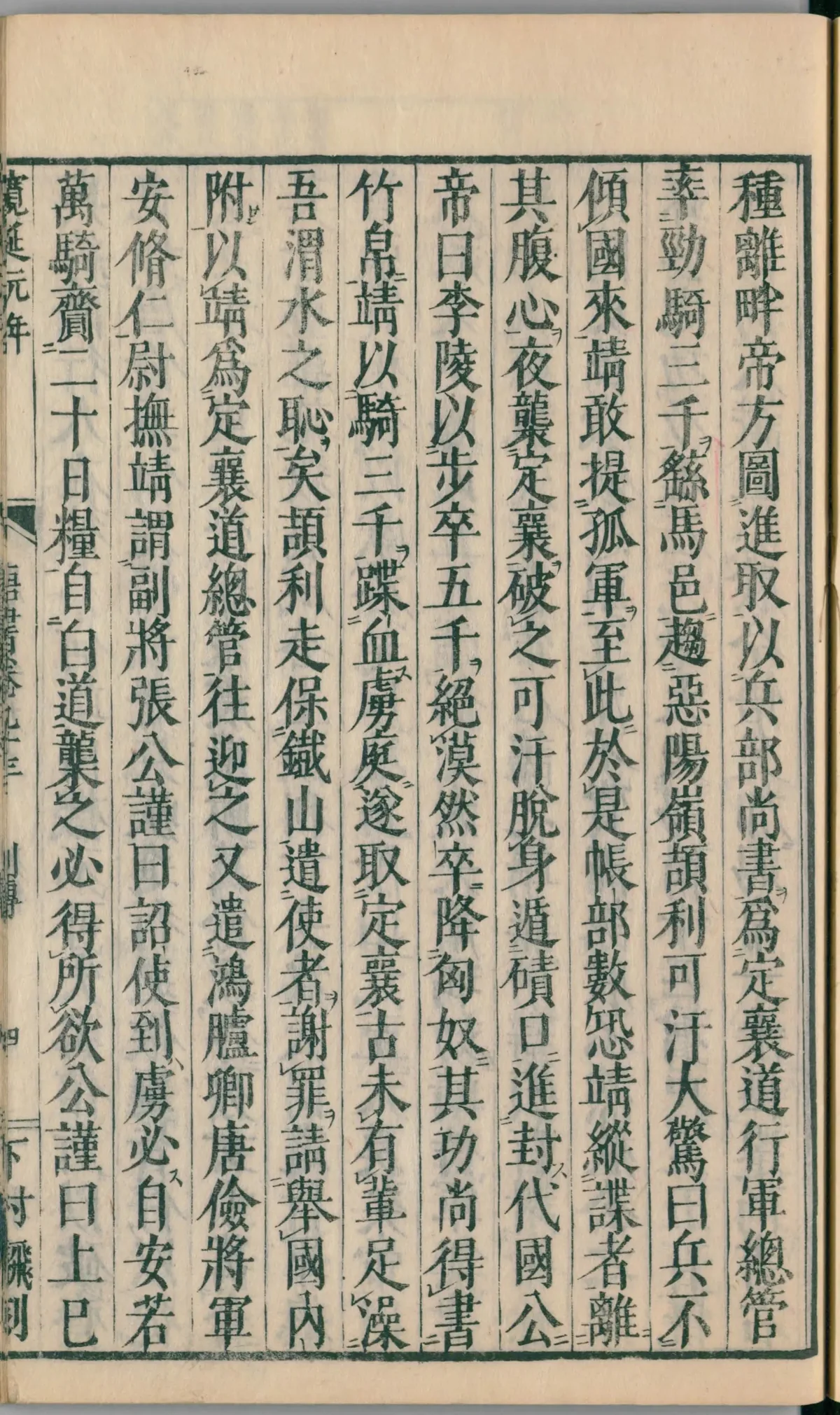
The Iron Mountain, 鐵山, Tieshan, was the mountain where the army of Ilig Khan, the last khan of the eastern Göktürks, was destroyed in 630.[1] In the second month of that year Ilig was driven from Dingxiang and Qikou. He fled to the Iron Mountain with several tens of thousands of men still under arms.[2] He sent Zhishi Sili to the Tang court to confess his fault. He offered the whole state in submission.[1] The emperor sent Tang Jian and An Xiuren to receive the surrender. Ilig grew easier.[1] Li Jing struck while the envoys were in the camp. He broke Ilig utterly and destroyed his state.[1] Ilig escaped alone on a thousand-li horse to the camp of his kinsman Shaboluo. There a Tang force took him alive in the third month.[1] The Xin Tang Shu has Ilig flee to the mountain to make a stand there. It has Li Jing attack because he knew the envoys’ presence would lull the Göktürks.[3]
The Zizhi tongjian tells the attack more fully. It dates the victory to the day jiachen of the second month.[4] Ilig, it says, was outwardly humble and inwardly undecided. He meant to wait until the grass was green and the horses fat, and then escape north of the desert.[4] Li Jing and Li Shiji met at Baidao. They chose ten thousand horse with twenty days’ grain and marched by night.[4] At the Yinshan they came upon more than a thousand Göktürk tents. They took the tents along.[4] Su Dingfang led two hundred riders ahead in the fog. He was seven li from the khan’s tent before the Göktürks saw him.[4] Ilig fled first. His people broke.[4] The Tang cut off more than ten thousand heads. They took more than a hundred thousand men and women.[4] They killed the Sui princess Yicheng and captured her son.[4]
The Zizhi tongjian enters the victory as Li Jing’s defeat of Ilig at the Yinshan.[4] A note in the Cefu yuangui says the same.[5] Therefore the end of the eastern khaganate came at a mountain that the histories place in or beside the Yinshan.
The site is not settled. Some scholars follow the commentary on the Zizhi tongjian. They put the Iron Mountain north of the Yin mountains.[6] Others put it in the Maoming’an banner. Their reason is that the eighth post station north-west of Guihua bore a name that means iron.[6] Still others ask whether the Iron Mountain was the Altai, where Ilig may also have had a base.[7]
References
- ^ a b c d e Jiu Tangshu (Old Book of Tang), juan 194
- ^ Jiu Tangshu (Old Book of Tang), juan 194; Tongdian, juan 197
- ^ Xin Tangshu (New Book of Tang), juan 215
- ^ a b c d e f g h i Zizhi tongjian (Comprehensive Mirror in Aid of Governance), juan 193
- ^ Cefu yuangui, juan 1000
- ^ a b Mau-tsai 1958, Turkish edition, p. 193
- ^ Yavuz 2025, p. 378
Sources
- Jiu Tangshu (Old Book of Tang), juan 194
- Tongdian, juan 197 (after Sui Shu and Zhou Shu)
- Xin Tangshu (New Book of Tang), juan 215 (after Jiu Tangshu)
- Zizhi tongjian (Comprehensive Mirror in Aid of Governance), juan 193 (after Wei Shu, Zhou Shu, Sui Shu and Bei Shi)
- Cefu yuangui, juan 1000 (after Tongdian and Jiu Tangshu)
Literature
- Liu Mau-tsai, Çin Kaynaklarına Göre Doğu Türkleri (1958, Turkish edition)
- Emre-E. Yavuz, The Gokturk Empire: 2nd Edition (2025)
What links here8
- Persons
- Ilig Khan · Zhishi Sili
- Battles & Events
- Battle of the Iron Mountain (630) · Night Attack on Dingxiang (630)
- Religions
- Sacred Mountains
Cite this article
Yavuz, Emre-E. “Iron Mountain.” Turkic Atlas, revised 8 November 2026. https://turkicatlas.org/places/iron-mountain/
Last revised: 8 November 2026

