
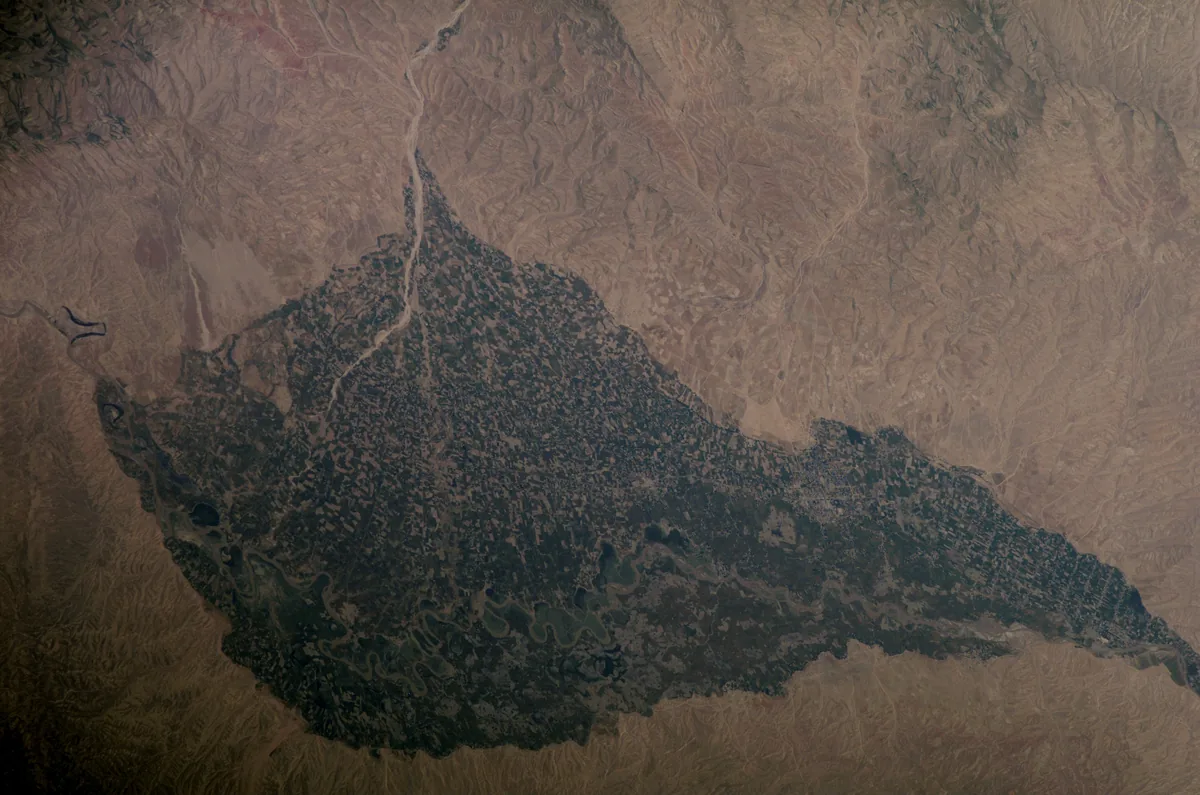
Huo, 活國, was a country of Tokharistan beside the Oxus. The eldest son of the Yabgu Khan of the western Göktürks had his seat there.[1] The Chinese pilgrim Xuanzang came there on his way to India and again on his way home.[1][2] In his time its king was a Göktürk. He ruled all the small states south of the Iron Gate.[3]
The country
The Record of the Western Regions, Xuanzang’s account of the lands he crossed, counts Huo among the old lands of Tokharistan.[3] It describes the country in its last book, among the stages of the return journey.[3] Its first book names Huo only as a point on the road, with Fuqielang to the south-west and Khost and Andarab to the south-east. It refers the reader to the account of the return.[4]
The country measured about three thousand li around. Its capital measured about twenty.[3] The land was level. Sowing and harvest came in their seasons. Plants, flowers and fruit grew in great abundance.[3] The climate was mild and the customs were simple. The people dressed in wool.[3] Many of them believed in the Three Jewels of Buddhism. Few worshipped spirits.[3] About ten monasteries held several hundred monks, who studied both the Great and the Small Vehicle.[3] The Congling mountains, the Record adds, reached west as far as Huo.[5]
The Göktürk king
The Record says that Huo had no prince of its own and was subject to the Göktürks.[3] Its king was a Göktürk.[3] He ruled all the small states south of the Iron Gate.[3] He did not keep to one town. The Record says that he changed his residence as inconstantly as the birds.[3]
Tardu Shad
After his visit to the Yabgu Khan, Xuanzang passed the Iron Gate, crossed the Oxus and came to Huo.[1] It was the residence of Tardu Shad, the khan’s eldest son. Tardu Shad had married a sister of the king of Gaochang.[1] The Yabgu Khan of the biography is identified with Tong Yabgu.[6] On one dating the pilgrim reached Huo in 630.[7][8] Tardu Shad died of poison during his stay. His son by an earlier wife, a tegin, seized his rank of shad.[9] The new shad counted Balkh among his lands and sent the pilgrim on there.[10]
The return
On his way home Xuanzang came back to Huo from Andarab and Khost.[11] In one account, the return falls in 643 or 644.[7][12] The Life sets the country beside the Oxus and calls it the eastern boundary of Tokharistan.[2] Its capital stood on the southern bank of the river in one translation and on the eastern bank in the other.[2][13]
Tokharistan was now ruled by a kinsman of the Yabgu Khan, who called himself yabgu.[2] The translations make him the khan’s nephew.[2][13] He may be the tegin who had seized the rank of shad, a grandson of Tong Yabgu.[7] Xuanzang stayed a month at his camp.[2] The yabgu then gave him an escort of soldiers. The pilgrim went east with a party of merchants.[2]
Location
Huo has been identified with Kunduz.[14][8] This puts the capital on the site of the present town, on the southern bank of the river.[7] The same identification finds Huo again in A-hoan and O-hoan of the Tang histories, and in War-wālīz of the Arabic geographers, the capital of Tokharistan.[15][16][8] If so, the Tang made the town of the yabgu of Tokharistan the seat of their government of the Yuezhi in 661. This government covered Tokharistan.[17][16]
Another proposal puts Huo at Ghori, at the northern foot of the great mountains on the direct road from Kunduz to Kabul.[18] It identifies Fuqielang, the next stage towards Balkh, with Baghlan, between Ghori and Kunduz.[19] Both proposals keep Huo in Tokharistan south of the Oxus, on the road between the Iron Gate and Andarab.
The Hephthalite capital
A third explanation is that Huo was the capital of the Hephthalite kings, the Badiyan of the Chinese reports. The Göktürk shad of 630 then sat in the place of the Hephthalite king. His son and successor took the title of yabgu, the highest after the khan, in 643 or 644.[20] In that case Huo, 活, is the town named for the people, whom the Chinese write Hua, 滑. The ten or so monasteries that Xuanzang counts in the country answer to the temples that the Chinese histories give the Hephthalite capital.[21] The Hephthalites article sets out the other proposals about the king’s seat.
References
- ^ a b c d Life of Xuanzang, juan 2; Beal 1911, p. 47
- ^ a b c d e f g Life of Xuanzang; Beal 1911, p. 196
- ^ a b c d e f g h i j k l Record of the Western Regions; Julien 1857–1858, vol. 2, p. 193
- ^ Record of the Western Regions, juan 1
- ^ Record of the Western Regions; Julien 1857–1858, vol. 2, p. 194
- ^ Chavannes 1903, p. 194
- ^ a b c d Chavannes 1903, p. 196
- ^ a b c Markwart 1938, p. 44
- ^ Life of Xuanzang, juan 2; Beal 1911, p. 47–48
- ^ Life of Xuanzang, juan 2; Beal 1911, p. 48
- ^ Life of Xuanzang; Beal 1911, p. 195–196
- ^ Markwart 1938, p. 45
- ^ a b Life of Xuanzang; Julien 1853, p. 268
- ^ Beal 1911, p. 47
- ^ Chavannes 1903, p. 155
- ^ a b Chavannes 1903, p. 275
- ^ Chavannes 1903, p. 68
- ^ Julien 1857–1858, vol. 2, p. 287–288
- ^ Julien 1857–1858, vol. 2, p. 288
- ^ Markwart 1938, p. 44–45
- ^ Markwart 1938, p. 45–46
Sources
- Life of Xuanzang, juan 2
- Record of the Western Regions, juan 1
Literature
- Samuel Beal (trans.), The Life of Hiuen-Tsiang by the Shaman Hwui Li (1911)
- Stanislas Julien (trans.), Histoire de la vie de Hiouen-Thsang et de ses voyages dans l'Inde (1853)
- Stanislas Julien, Mémoires sur les contrées occidentales (1857–1858)
- Édouard Chavannes, Documents sur les Tou-Kiue (Turcs) occidentaux (1903)
- Josef Markwart, Wehrot und Arang. Untersuchungen zur mythischen und geschichtlichen Landeskunde von Ostiran (1938)
What links here14
- Persons
- Tardu Shad
- States
- Yabgus of Tokharistan
- Conflicts
- The Göktürk–Hephthalite war, 555–563
- Battles & Events
- Xuanzang's visit to Tong Yabgu
- Peoples
- Hephthalites
- Institutions and Titles
- Levirate · Loose-rein prefectures · Shad · Tegin
- Sources
- Life of Xuanzang
Cite this article
Yavuz, Emre-E. “Huo.” Turkic Atlas, revised 8 November 2026. https://turkicatlas.org/places/huo/
Last revised: 8 November 2026

