
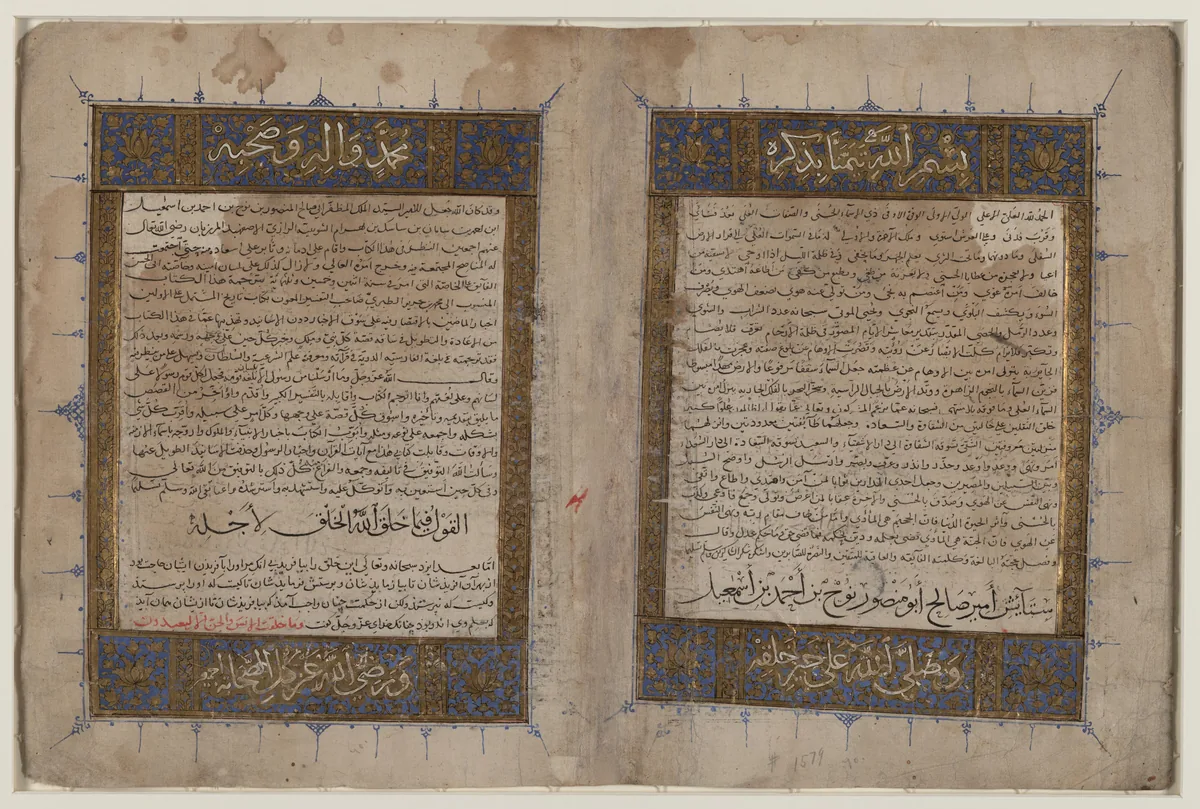
The gate of Sul was a fortification on the northern frontier of Sasanian Persia.[1] According to Tabari, a khagan turned back before it without a battle.[2] Tabari uses the name Sul for a land, for a people and for the gate.[3]
The Sasanian works
King Peroz built a town, Roshan-Peroz, between Gurgan and the gate of Sul.[4] Al-Thaʿalibi has the same town in the same place.[5] In Tabari, Peroz also raised a building of stone in the region of the Sul and the Alans, to protect his land from those peoples.[6] His son Kawad added many more works there.[6]
Khosrow I took captive a people named Sul.[7] He had all but eighty of their best warriors put to death and settled the eighty in Shahram-Peroz to serve him in war.[7] In the region of Sul he built towns and castles, walls and many other works with stone quarried in the region of Gurgan.[6] The inhabitants were to take refuge in them from sudden attack.[6]
The khagan Sinjibu
The same chapter of Tabari tells of the khagan Sinjibu, “the boldest and mightiest of all the Turks”. He had killed Warz, king of the Hephthalites, and conquered his land.[8] Sinjibu has been identified with Istemi.[9] Sinjibu won over the Abkhaz, the Bangar and the Balangar, who told him that the kings of Persia had always bought them off with payments.[10]
He set out with a hundred and ten thousand warriors.[10] Near the land of Sul he sent Khosrow a threatening and haughty message.[10] He demanded money for himself and the old payments for the three peoples, or he would invade the country and attack the king himself.[2] Khosrow ignored the threat.[1] He had fortified the region of the gate of Sul and secured the roads and passes by which Sinjibu had to march.[1] He also knew the Armenian frontier to be held by five thousand foot and horse.[1] When Sinjibu heard how strong the fortifications at Sul were, he went home with his people, his purpose unachieved.[1] Tabari gives no year for the march.[11]
The gate in al-Thaʿalibi
Al-Thaʿalibi names the gate among the works of Khosrow’s reign. He has the king build stone fortresses in Gurgan, the gate of Sul, five parasangs long and of marble. He also has him build the wall at Bab al-Abwab as a barrier between Iran and the Khazars.[12] In his account the gate of Sul and the wall at Bab al-Abwab are two different works.
Location
Tabari sets the Sul beside the Alans.[6] The Abkhaz and the Balangar, two of the peoples who joined Sinjibu, lived in the Caucasus and north of Derbent.[13] The gate at Derbent was known as Čol, and in Greek as Tzur.[14] Sul has nevertheless been put in Gurgan, at the south-eastern corner of the Caspian.[14] The mention of Gurgan is said to rule out Derbent. Ṣūl is taken for a locality of Gurgan and probably for the name of a people, and a Turkic prince named Ṣūl in that country is cited.[14] Tabari is then said to have mixed the walls of Gurgan with those of the Caucasus, since nobody would quarry stone in Gurgan to build in the Caucasus.[15] Sinjibu’s target was then Khorasan, which the walls of Gurgan protected.[15]
References
- ^ a b c d e Tabari; Nöldeke 1879, p. 160
- ^ a b Tabari; Nöldeke 1879, p. 159–160
- ^ Tabari; Nöldeke 1879, p. 157–160
- ^ Tabari; Nöldeke 1879, p. 123
- ^ aṯ-Ṯaʿālibī; Zotenberg 1900, p. 578
- ^ a b c d e Tabari; Nöldeke 1879, p. 158
- ^ a b Tabari; Nöldeke 1879, p. 157
- ^ Tabari; Nöldeke 1879, p. 158–159
- ^ Chavannes 1903, p. 226–228
- ^ a b c Tabari; Nöldeke 1879, p. 159
- ^ Tabari
- ^ aṯ-Ṯaʿālibī; Zotenberg 1900, p. 611
- ^ Nöldeke 1879, p. 157
- ^ a b c Nöldeke 1879, p. 123
- ^ a b Nöldeke 1879, p. 158
Sources
Literature
- Theodor Nöldeke, Geschichte der Perser und Araber zur Zeit der Sasaniden. Aus der arabischen Chronik des Tabari übersetzt und mit ausführlichen Erläuterungen und Ergänzungen versehn (1879)
- Hermann Zotenberg (ed., trans.), Histoire des rois des Perses par Abou Mansour ʿAbd al-Malik ibn Mohammad ibn Ismaʿil al-Thaʿalibi (1900)
- Édouard Chavannes, Documents sur les Tou-Kiue (Turcs) occidentaux (1903)
What links here8
- Persons
- Khosrow I
- States
- Sasanian Persia
- Peoples
- Alans
- Sources
- aṯ-Ṯaʿālibī · Tabari
Cite this article
Yavuz, Emre-E. “Gate of Sul.” Turkic Atlas, revised 8 November 2026. https://turkicatlas.org/places/sul-gate/
Last revised: 8 November 2026

