
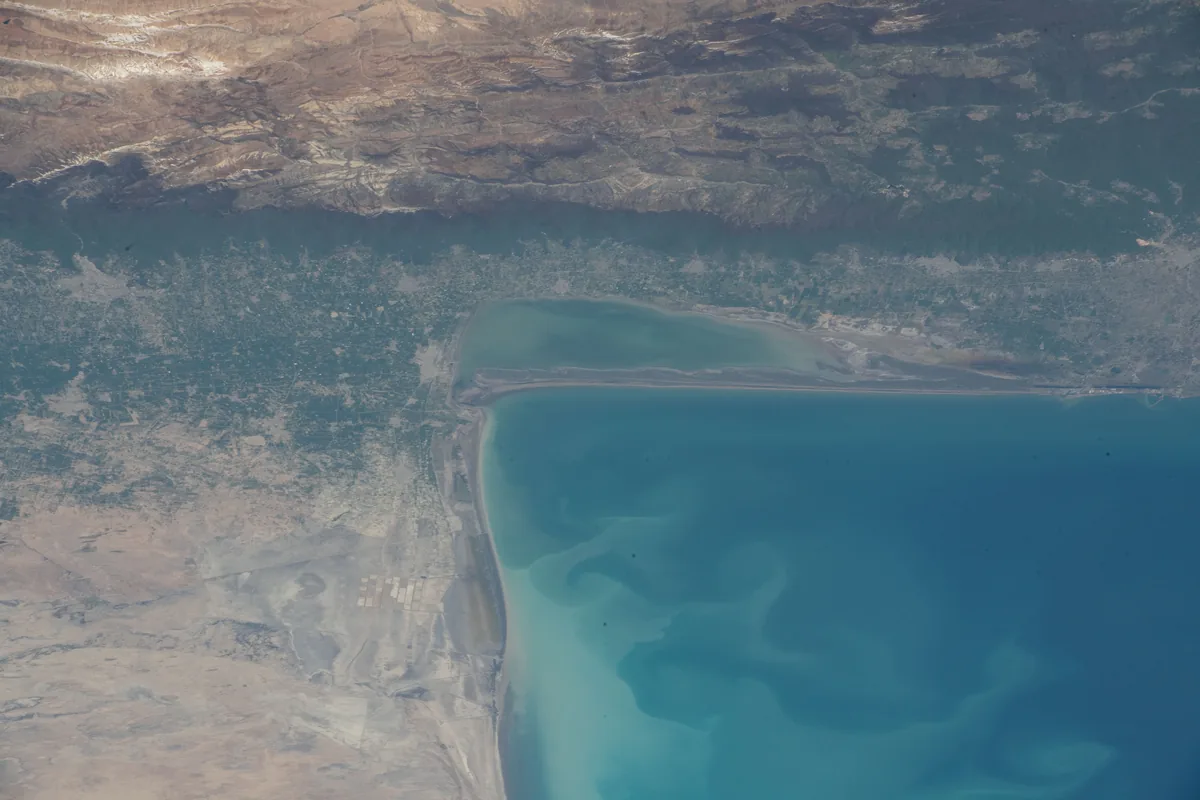
Gurgan is the land at the south-eastern corner of the Caspian Sea, the Hyrcania of the Greeks.[1] It lies between the Elburz and the Kopet mountains.[2] For the Persian kings it was at all times a base against the peoples of the northern steppe.[1] The Sasanian king Khosrow I ringed it with fortresses. The stone for his works at Sul was quarried there.[3][4]
The frontier before the Göktürks
King Peroz built a town, Roshan-Peroz, between Gurgan and the gate of Sul.[5][6] Lazarus names Gurgan as the place from which Peroz set out against the Hephthalites and to which the survivors fled. Priscus and Procopius name it too.[7] The lie of the land may explain the choice. The frontier of western Khorasan was open to raids from the desert. From Gurgan the raids could be met.[7] Several Sasanian kings are also said to have built walls against the nomads there.[7]
Khosrow I’s fortresses
In Tabari’s account, Khosrow I built towns and castles, walls and many other works in the region of Sul. He used stone quarried in the region of Gurgan.[3] The inhabitants were to take refuge in them from sudden attack.[3] The khagan Sinjibu, “the boldest and mightiest of all the Turks”, then came against the region with a great army.[8] He turned back when he heard how strong the fortifications at Sul were.[4] Sinjibu has been identified with Istemi.[9] Tabari adds that after the works were built, the enemies who lived over against Gurgan could no longer raid the land or take it.[4]
Where Sul lay is disputed. Tabari himself sets the Sul beside the Alans, a people of the Caucasus.[3][10] Tabari may have mixed up the works in Gurgan with those at the Caucasus, since nobody would quarry stone in Gurgan to build at the Caucasus.[11] If so, Sinjibu’s target was the part of Khorasan that the fortifications of Gurgan protected.[11]
Al-Thaʿalibi keeps the works apart. In his account Khosrow closed the passes and fortified the frontiers.[12] He built fortresses of stone in Gurgan, the gate of Sul, five parasangs long and of marble, and the wall at Bab al-Abwab as a barrier against the Khazars.[13] He also built more than a hundred citadels between his empire and the Caucasus. They were to protect Iran against its enemies, the Turks, the Khazars and the Rus.[13] In al-Thaʿalibi’s division of the empire into four regions, Gurgan belonged to the second, with Media, Armenia, Adharbaijan and Tabaristan.[14]
Istemi and the army of 588
One modern account has a Göktürk force cross the desert into Persian territory in 560. The force appears at Gurgan on the Caspian.[15] Khosrow marched there with a great army and met Istemi in person. Istemi declared that he wanted no war.[15] In that account the two kings fixed the frontier along the Oxus. They sealed a pact of non-aggression with the marriage of Istemi’s daughter to Khosrow.[16]
The same account brings the Göktürks back in 588.[17] After taking Herat and the cities of Bactria, the Göktürk army of that year marched on west. It reached Hyrcania, into which Istemi had once come.[17]
Smbat Bagratuni in Vrkan
Under Khosrow II the Armenian Smbat Bagratuni became marzpan of Gurgan. The Armenian history attributed to Sebeos calls the province Vrkan.[18] The king gave him Persian and Armenian troops. Smbat brought prosperity back to a land that had been ravaged.[19] In the same province, Sebeos places a community deported from Armenia. It was settled on the edge of the great desert that stretches from T’urk’astan and Delhastan.[19] Some scholars date Smbat’s appointment to 599 or 600 and his retirement, after eight years, to 606 or 607.[2] Others put the appointment in 595.[20]
Khosrow later sent Smbat east against the Kushans. Smbat called up his own Armenian troops from Vrkan, about two thousand horsemen.[21] The kings of the Kushans called in the great khan. The war with the khan’s host followed.[21] In the sources, Gurgan remains the fortified corner of Persia that faced the steppe, from Peroz to Khosrow II.
References
- ^ a b Nöldeke 1879, p. 17
- ^ a b Howard-Johnston 1999, p. 181
- ^ a b c d Tabari; Nöldeke 1879, p. 158
- ^ a b c Tabari; Nöldeke 1879, p. 160
- ^ Tabari; Nöldeke 1879, p. 123
- ^ aṯ-Ṯaʿālibī; Zotenberg 1900, p. 578
- ^ a b c Nöldeke 1879, p. 131
- ^ Tabari; Nöldeke 1879, p. 158–159
- ^ Chavannes 1903, p. 226–227
- ^ Nöldeke 1879, p. 157
- ^ a b Nöldeke 1879, p. 158
- ^ aṯ-Ṯaʿālibī; Zotenberg 1900, p. 610–611
- ^ a b aṯ-Ṯaʿālibī; Zotenberg 1900, p. 611
- ^ aṯ-Ṯaʿālibī; Zotenberg 1900, p. 609
- ^ a b Yavuz 2025, p. 278
- ^ Yavuz 2025, p. 278–279
- ^ a b Yavuz 2025, p. 323–324
- ^ Sebeos; Howard-Johnston 1999, p. 43–44
- ^ a b Sebeos; Howard-Johnston 1999, p. 44
- ^ Howard-Johnston 1999, p. 44
- ^ a b Sebeos, ch. 28; Howard-Johnston 1999, p. 50
Sources
- Tabari
- aṯ-Ṯaʿālibī
- Sebeos, ch. 28
Literature
- Theodor Nöldeke, Geschichte der Perser und Araber zur Zeit der Sasaniden. Aus der arabischen Chronik des Tabari übersetzt und mit ausführlichen Erläuterungen und Ergänzungen versehn (1879)
- Hermann Zotenberg (ed., trans.), Histoire des rois des Perses par Abou Mansour ʿAbd al-Malik ibn Mohammad ibn Ismaʿil al-Thaʿalibi (1900)
- R. W. Thomson (trans.), James Howard-Johnston (commentary), The Armenian History attributed to Sebeos (1999)
- Édouard Chavannes, Documents sur les Tou-Kiue (Turcs) occidentaux (1903)
- Emre-E. Yavuz, The Gokturk Empire: 2nd Edition (2025)
What links here11
- States
- Sasanian Persia
- Battles & Events
- Battle of Bukhara · Smbat Bagratuni's war with the khan
- Places
- Derbent · Gate of Sul · Herat · Khorasan · Samandar
- Sources
- aṯ-Ṯaʿālibī
Cite this article
Yavuz, Emre-E. “Gurgan.” Turkic Atlas, revised 8 November 2026. https://turkicatlas.org/places/gurgan/
Last revised: 8 November 2026

