
Irbis Shegui Khan was the last khan the Nushibi raised before Ashina Helu. He was the first of the western Göktürks chosen with a Chinese envoy in the room.[1] He drove Yukuk Shad out of the west and held it for nine years. He lost it to Helu in 651.[1] After that the histories do not mention him. One modern hypothesis sends him to the Volga.[2]
Name and descent
The Chinese write his title 乙毗射匱可汗, Yipi Shegui Khan. The second element is the name of Shegui Khan, who ruled the west a generation earlier. The two are not the same man. The Xin Tang Shu makes him the son of Yiqulishi Yipi Khan, the son of Ishbara Tolis who reigned for less than a year in 639.[1] The Jiu Tang Shu calls his father Moheduo Yipi Khan. One translation treats him as the same man.[3]
Accession (642)
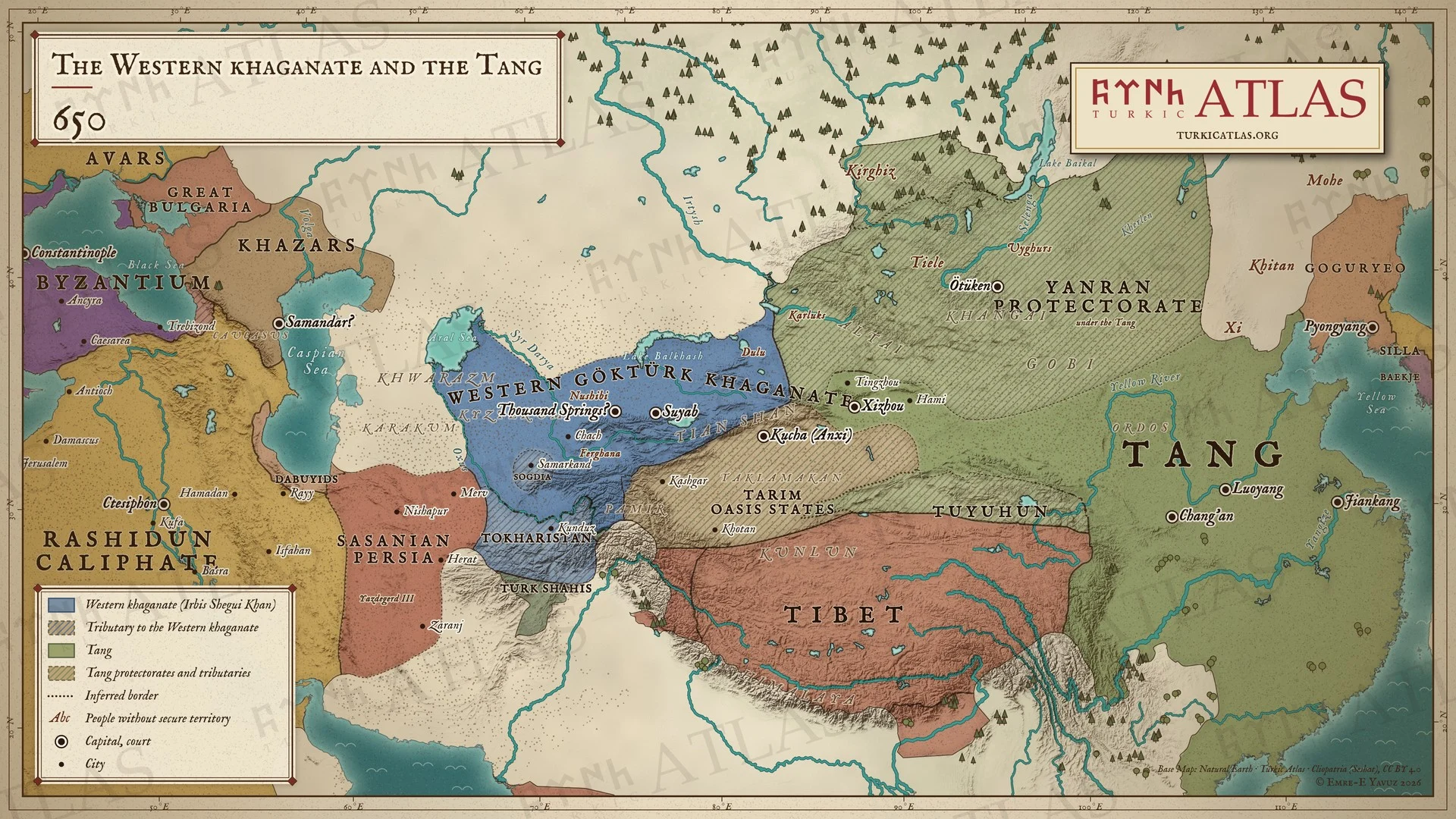
Yukuk Shad had lost his people and held only the Sogdian town of Baishui. The Nushibi would not have him for khan and sent to the Tang to ask for an appointment.[1] Taizong sent Wen Wuyin with a sealed edict. Wen Wuyin was to choose, together with the great ministers of the state, a worthy man among the sons and grandsons of the khans of the Göktürks. The edict was given to the son of Yiqulishi Yipi Khan.[1] The manner of the choice was new. His people had raised Ishbara Tolis, and the five Nushibi chiefs had raised Irbis Ishbara Yabgu. The chiefs chose Irbis Shegui with a Chinese envoy, on a Chinese writ. The Tang histories record it as the emperor giving the power.
His first acts were toward China. He moved the detained Chinese envoys to a better lodging. He sent them all back to Chang’an with every courtesy.[1] Then he sent the Nushibi against Baishui. Yukuk Shad came out and beat them. He called his old tribes to him, but they refused. He fled to Tokharistan. The west was Irbis Shegui’s.[1]
The bride-price (640s)
He sent tribute of the products of his country and asked for a marriage alliance. The emperor ordered him to detach the five states of Kucha, Khotan, Kashgar, Zhujubo and the Pamirs and give them as the bride-price. The marriage did not take place.[1] The demand shows what the Tang took the western khan to hold: the whole of the Tarim south of the Tian Shan. The Tang took Kucha by arms instead, in 648, with Ashina Helu riding ahead as guide.[4]
Helu (648–651)
Helu had been the Duolu khan’s yabgu on the Duoluosi river. When Yukuk Shad fled to Tokharistan, Irbis Shegui sent troops to harry and pursue Helu. Helu lost his fixed seat, and most of his people scattered.[1] Three tribes, the Zhisheti, the Chumukun and the Pobi, went to the khan to plead that Helu was innocent. The khan was angry and wanted to exterminate them. The three took their several thousand tents and went with Helu to the Tang in 648, the twenty-second year of Zhenguan.[1] In 649 an embassy from the western khan reached the court. The annals enter it under the name Si Yabgu Khan, by a slip for Irbis Shegui.[3] Then Taizong died. Helu rebelled and went west. He seized the old lands of Duolu Khan, set up his standard at the Thousand Springs and called himself Shaboluo Khan. The text says that “the hordes of the khan were all taken by him”.[1] That is the last the histories say of Irbis Shegui.[1]
The Khazar hypothesis
Mikhail Artamonov proposed that Irbis Shegui, a defeated khan of the Nushibi, moved to the Khazar lands about 651 and founded the ruling house of that union.[2] Artamonov supported the hypothesis with the notice in the Ḥudūd al-ʿālam that the Khazar king is one of the descendants of Ansā. He read Ansā as a garbling of Ashina.[2] The hypothesis comes with its problems. The reading of Ashina itself is uncertain. Minorsky preferred to see in Ansā a corruption of īšā, the title of a sub-ruler.[2] The Khazar article covers the question of Ashina descent. The sources end the man himself at the Thousand Springs.
Assessment
He was the khan of a decade in which the west was governed by the Tang’s envoys and the Nushibi’s choice. He governed it well enough that the sources record no rebellion against him until Helu. His bride-price is the clearest statement in the Tang histories of what the western Göktürks were still thought to hold in the 640s. Helu’s seizure of his hordes is the beginning of the end.
References
Sources
- Xin Tangshu (New Book of Tang), juan 215 (after Jiu Tangshu)
- Jiu Tangshu (Old Book of Tang), juan 194
Literature
- Édouard Chavannes, Documents sur les Tou-Kiue (Turcs) occidentaux (1903)
- Peter B. Golden, An Introduction to the History of the Turkic Peoples (1992)
- Emre-E. Yavuz, The Gokturk Empire: 2nd Edition (2025)
What links here9
- States
- Khazar Khaganate · Sasanian Persia
- Places
- Tarim Basin
- Peoples
- History of the Turkic peoples · On Oq
Cite this article
Yavuz, Emre-E. “Irbis Shegui Khan.” Turkic Atlas, revised 8 November 2026. https://turkicatlas.org/persons/irbis-shegui-khan/
Last revised: 8 November 2026

