
- 400
- 500
- 600
- 700
- 800
- 900
- Rouran 400–554
- First Göktürk 552–630
- Tang rule 630–682
- Second Göktürk 682–744
- Uyghur 744–840
- Kirghiz 840–924
- Huns 370–469
- Western Göktürk 552–659
- Türgesh 699–766
- Karluk 766–800
- Khazar 650–969
The Akatziri were a nomadic people of the steppe north of the Black Sea in the fifth century. Jordanes calls them “a very brave tribe ignorant of agriculture, who subsist on their flocks and by hunting”.[1] Priscus tells how Attila brought them under his rule.
Under Attila
The Akatziri, Priscus writes, had many rulers, by peoples and clans. The emperor Theodosius II tried to draw them away from their alliance with Attila with gifts, but his envoy did not give them out by rank. Kouridachos, the senior of the kings, received his gift second and felt slighted. He called in Attila against the other kings. Attila sent a large army. It killed some of the kings and forced the rest to submit. Attila then invited Kouridachos to share the fruits of victory. Kouridachos suspected a trap and refused, and he gave his reason: it was hard for a man to come into the sight of a god, for if no one could look at the disc of the sun with steady eyes, how could anyone face the greatest of the gods unharmed? So Kouridachos kept his kingdom, and the rest of the land of the Akatziri passed under Attila’s rule.[2] Kouridachos’s words have been heard as having a Persian ring. On this interpretation the Akatziri looked up to Attila as the Persians did to their king.[3]
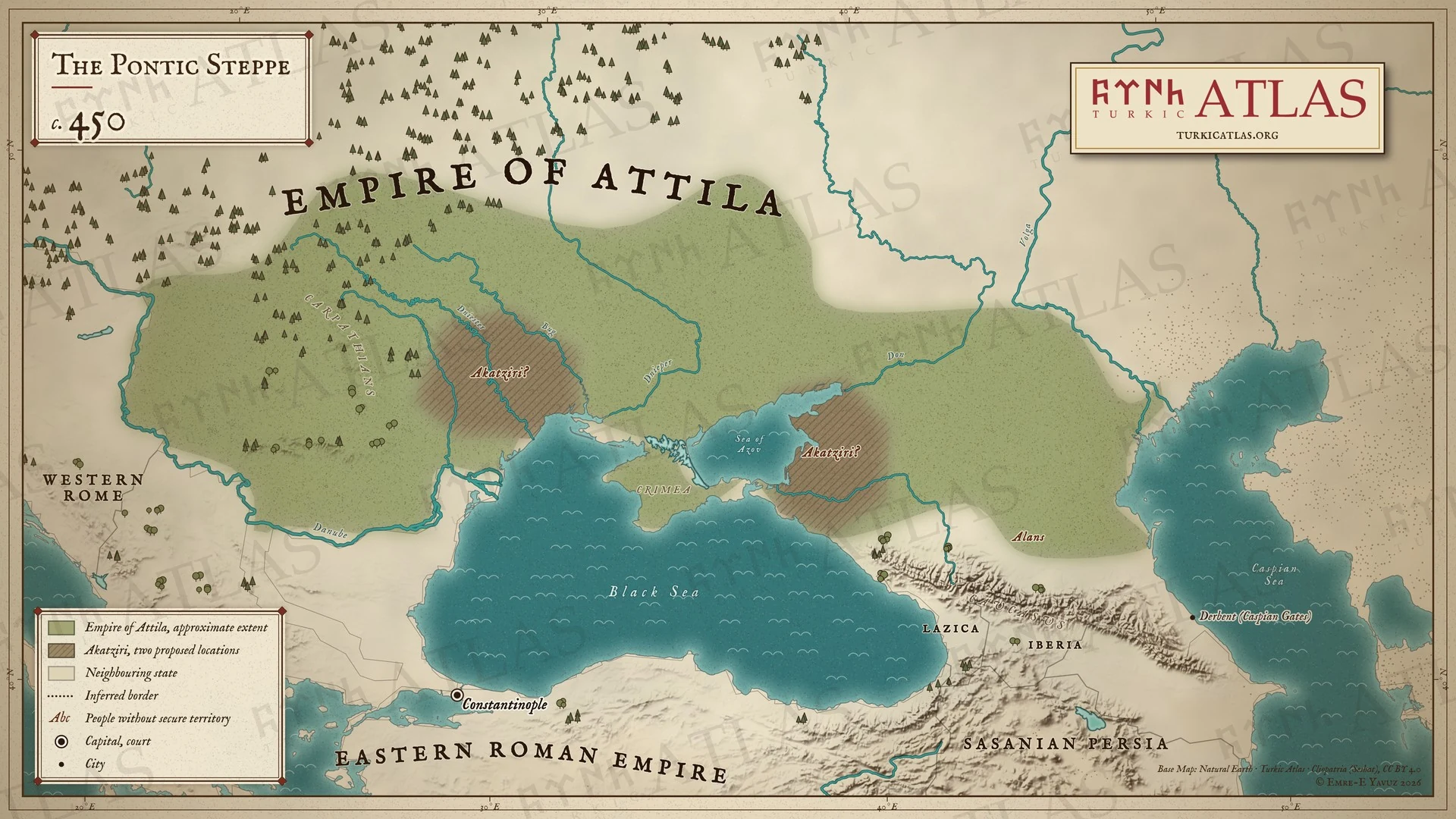
Attila decided to make his eldest son, Ellac, king over them. He sent his minister Onegesius to install him.[4] In 449 Priscus heard that this son ruled “the Akatziri and the other peoples who live in Scythia along the Pontus”.[5] A Greek captive at Attila’s court had won his freedom by fighting for his Hun master against the Romans and against the Akatziri.[6] In the early 440s the confederation was torn between a party for the Huns and a party for the Romans. The chiefs who opposed Attila were defeated about 445.[7][8] Some scholars date the war to 448, because Priscus speaks of it in 449 as recently ended.[9]
After Attila
About 463 the Saragurs, driven from their own lands by the Sabirs, came “to the Akatziri Huns”. They fought many battles, defeated the Akatziri and sent envoys to the Romans for an alliance.[10][7] In the Latin of the edition, the Saragurs then joined with the Akatziri and other peoples and marched against Persia.[11] It has been held that the Akatziri did not march with them, and that the passage has been mistranslated.[12] The Akatziri were in all likelihood absorbed into the new Oguric tribal unions.[7]
Identity and name
Scholars disagree about who the Akatziri were. One answer is that they were Huns, since Priscus calls them so.[13] A second treats them as a people of their own. It finds it unclear whether they were already in the steppes of the Black Sea and the Caspian when the Huns arrived. In 375, it adds, the Akatziri were not yet subject to the Huns.[14] A third answer takes them for a people of the steppe, not forest dwellers, who lived on the lower Bug and the Dniester, perhaps as far west as the Pruth.[15] A fourth places them near the eastern shore of the Black Sea or the Sea of Azov in 448 and rejects Jordanes’s placing of them south of the Aesti.[16]
Priscus probably wrote Akatiroi. The form with tz reflects Jordanes’s spelling habit.[17] The name has been taken for the Turkic ağač-eri, forest people, for the Khazars or the White Khazars, and for “senior army”. These etymologies remain little more than conjectures.[18][19] The old and simple explanation, Turkic ayac eri, “woodman”, may still be the good one. In that case the Akatziri were a people of the forest belt, indomitable and with imperial ambitions of their own. Priscus calls them of Scythian stock in one place and Huns in another, and neither word had a clear content then.[20] Their identification with the Khazars is one of several hypotheses on the origin of the Khazars.[21] The name of Kouridachos has been derived from the Turkic qurt, wolf.[22] This has been found unlikely, since the word has that meaning only in Oghuz Turkic.[7]
References
- ^ Jordanes; Mierow 1915, § 36, p. 60
- ^ Priscus; Müller 1851, fr. 8, p. 82–83
- ^ Maenchen-Helfen 1973, p. 272–274
- ^ Priscus; Müller 1851, fr. 8, p. 83
- ^ Priscus; Müller 1851, fr. 8, p. 89
- ^ Priscus; Müller 1851, fr. 8, p. 86
- ^ a b c d Golden 1992, p. 88
- ^ Maenchen-Helfen 1973, p. 105
- ^ Thompson 1948, p. 95
- ^ Priscus; Müller 1851, fr. 30, p. 105
- ^ Priscus; Müller 1851, fr. 37, p. 107
- ^ Maenchen-Helfen 1973, p. 436–437
- ^ Thompson 1948, p. 11
- ^ Golden 1992, p. 87, 89
- ^ Maenchen-Helfen 1973, p. 433
- ^ Thompson 1948, p. 96
- ^ Maenchen-Helfen 1973, p. 435–436
- ^ Golden 1992, p. 87
- ^ Maenchen-Helfen 1973, p. 437
- ^ Sinor 1990, p. 191
- ^ Golden 1992, p. 234
- ^ Maenchen-Helfen 1973, p. 437–438
Sources
Literature
- Karl Müller (ed.), Fragmenta Historicorum Graecorum, Bd. IV (darin: Menandri Protectoris fragmenta, griechisch mit lateinischer Übersetzung) (1851)
- J. B. Bury, History of the Later Roman Empire from the Death of Theodosius I to the Death of Justinian, vol. I (1923)
- Charles Christopher Mierow, The Gothic History of Jordanes in English Version, with an Introduction and a Commentary (1915)
- Otto J. Maenchen-Helfen, The World of the Huns: Studies in Their History and Culture (1973)
- E. A. Thompson, A History of Attila and the Huns (1948)
- Peter B. Golden, An Introduction to the History of the Turkic Peoples (1992)
- Denis Sinor (ed.), The Cambridge History of Early Inner Asia (1990)
What links here9
- States
- Hunnic Empire
- Battles & Events
- Embassy of Maximinus to Attila
- Places
- Viminacium
- Peoples
- Saragurs
Cite this article
Yavuz, Emre-E. “Akatziri.” Turkic Atlas, revised 8 November 2026. https://turkicatlas.org/ethnicities/akatziri/
Last revised: 8 November 2026

