
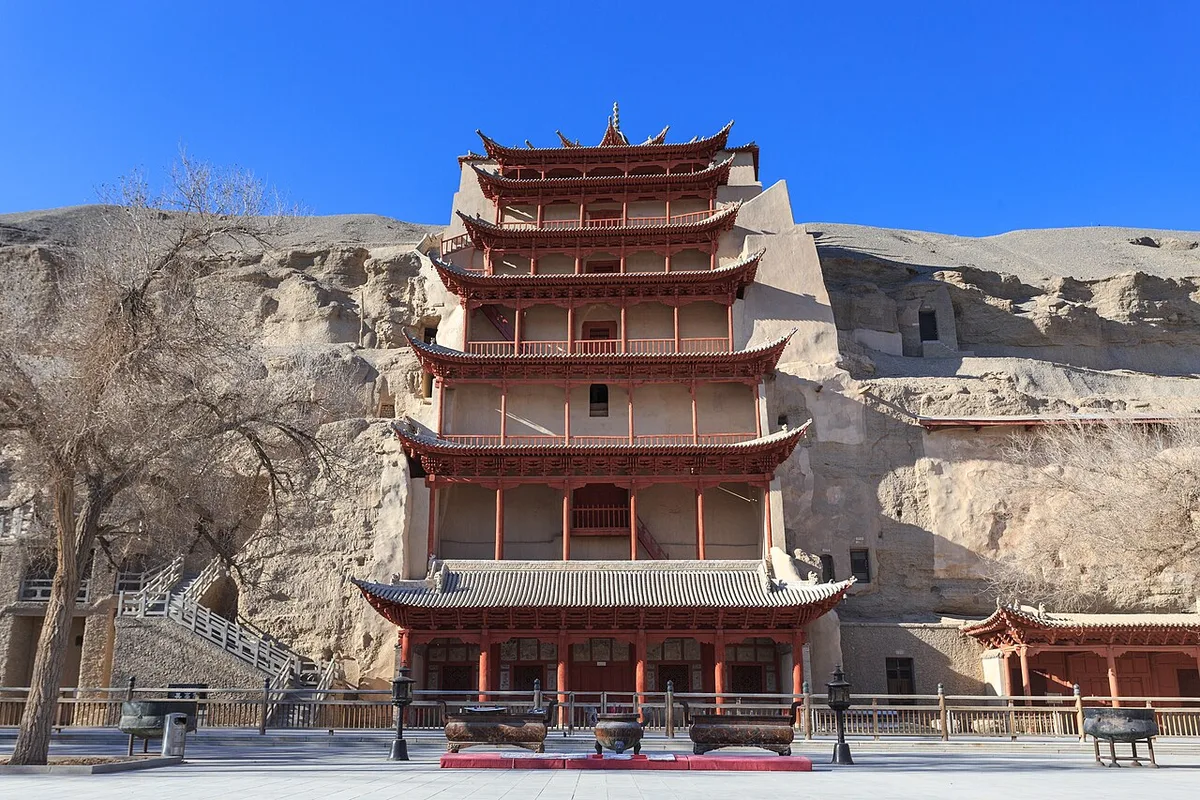
Dunhuang lay at the western end of the Gansu corridor, where the road left China for the Tarim. According to the Shiji, the Yuezhi had once lived between Dunhuang and the Qilian mountains. Then the Xiongnu drove them west.[1] The army of Li Guangli returned to Dunhuang from its failed first campaign against Ferghana with one man in ten or two in ten.[1]
The commandery and the Jade Gate
Dunhuang was one of the four commanderies of the Hexi, and one of the last two of them. The annals of Wudi in the Han Shu have Zhangye and Dunhuang cut from the land of Wuwei and Jiuquan in 111 BC. Settlers were moved in to fill them.[2] The chapter on the Western Regions names Jiuquan alone as the first. It says that Wuwei, Zhangye and Dunhuang were set apart from it later.[3] The geographical treatise of the Han Shu is said to give 88 BC for Dunhuang.[4] The Zizhi tongjian adds Zhangye and Dunhuang in 111 BC. Jiuquan came first, in 115, and Wuwei later.[4]
The Jade Gate stood on this frontier. Li Guangli’s beaten army came back from the first campaign against Dayuan. The emperor sent word to bar the Jade Gate and to behead any soldier who crossed it. Li Guangli stopped at Dunhuang.[1] The Gate may then still have stood east of Dunhuang. After the second campaign against Dayuan, the line of forts was carried west.[5] The Han Shu has forts and beacons run from Dunhuang west to the Salt Marsh once Dayuan was beaten.[3] Another dating puts the wall about 110 BC. In that case the name Jade Gate is attested in 105 BC, and the posts from Dunhuang to the Salt Marsh were raised about 95 BC.[6] Slips found along the frontier north of Dunhuang name a military commandant of the Jade Gate in 94 BC, in 39 BC and in AD 43.[7]
The frontier line
The slips of this frontier are dated from 98 BC to AD 137.[8] The soldiers lived in stations. The troop of a station was a company of about 150 men.[9] Many slips name a soldier’s home. About half of the men came from Shanxi and Henan. The rest were recruited in the west. The men sent out from the interior were probably convicts. A slip that applies the legal term for deportees to eight men suggests this.[10][9] In an alarm a post lit a fire. The next post repeated the signal. The news passed from one small garrison to the next. Slips note the exact hour at which a signal appeared.[11]
The companies had names of their own. Some boasted of triumphing over the barbarians: the company “who oppresses the hu”, the company “who suppresses the hu”, “who crushes the hu”, “who subdues the hu”, “who swallows the hu”.[9] Slips dated between AD 8 and 21 show the line still manned under Wang Mang.[8] The historians have the western countries in revolt from AD 9.[8]
The Sogdian community
The Sogdian Ancient Letters were found in 1907 in a watchtower ninety kilometres west of the town.[12] Letters I and III were written at Dunhuang by a Sogdian woman, Miunai.[13] Chinese papers of the Jin period from the Lop Nor mention the town as well. One fragment says that someone traded at Dunhuang with 20,000 coins. Another is headed as a letter written at Dunhuang. It bears three lines in Kharoshthi on its back.[14] A priest mentioned in Letter I suggests that the Sogdian community of Dunhuang was large enough to keep a place of worship.[15] Around 750 a roll of raw silk was worth 460 bronze coins at Dunhuang.[16]
Tibetan and Uyghur times
Under Tibetan rule, from 787 to 848, Sogdian names appear among the officials and the Buddhist clergy of Dunhuang.[17] In the Uyghur period trade east of the Tarim was barter, in cotton and woollen cloth. The Uyghur business documents from Dunhuang never mention the silver coins of the Samanids.[18] One Uyghur merchant’s letter from Dunhuang, probably of the tenth century, is addressed to a Sogdian of the writer’s own family.[19]
References
- ^ a b c Shiji, juan 123
- ^ Han Shu, juan 6
- ^ a b Han Shu, juan 96
- ^ a b Chavannes 1913, v–vi
- ^ Chavannes 1913, vi–vii
- ^ Herrmann 1910, p. 118
- ^ Chavannes 1913, p. 71,95,107
- ^ a b c Chavannes 1913, vii
- ^ a b c Chavannes 1913, x
- ^ Chavannes 1913, x–xi
- ^ Chavannes 1913, xi
- ^ de la Vaissière 2005a, p. 45
- ^ de la Vaissière 2005a, p. 46
- ^ Chavannes 1913, p. 188–189
- ^ de la Vaissière 2005a, p. 56
- ^ de la Vaissière 2005a, p. 271
- ^ de la Vaissière 2005a, p. 324
- ^ de la Vaissière 2005a, p. 320
- ^ de la Vaissière 2005a, p. 325
Sources
- Shiji, juan 123
- Sogdian Ancient Letters
- Han Shu, juan 6, 96 (after Shiji)
Literature
- Étienne de la Vaissière, Sogdian Traders: A History (2005)
- Édouard Chavannes, Les documents chinois découverts par Aurel Stein dans les sables du Turkestan oriental (1913)
- Albert Herrmann, Die alten Seidenstrassen zwischen China und Syrien. Beiträge zur alten Geographie Asiens, Bd. 1 (1910)
What links here17
- Persons
- Emperor Wu of Han · Er Chanyu · Li Guangli · Pei Ju
- States
- Ganzhou Uyghur Kingdom · Northern Zhou · Shanshan · Western Wei
- Battles & Events
- Battle of Mount Dajin (600)
- Peoples
- Yuezhi
Cite this article
Yavuz, Emre-E. “Dunhuang.” Turkic Atlas, revised 8 November 2026. https://turkicatlas.org/places/dunhuang/
Last revised: 8 November 2026


