
- 400
- 500
- 600
- 700
- 800
- 900
- Rouran 400–554
- First Göktürk 552–630
- Tang rule 630–682
- Second Göktürk 682–744
- Uyghur 744–840
- Kirghiz 840–924
- Huns 370–469
- Western Göktürk 552–659
- Türgesh 699–766
- Karluk 766–800
- Khazar 650–969
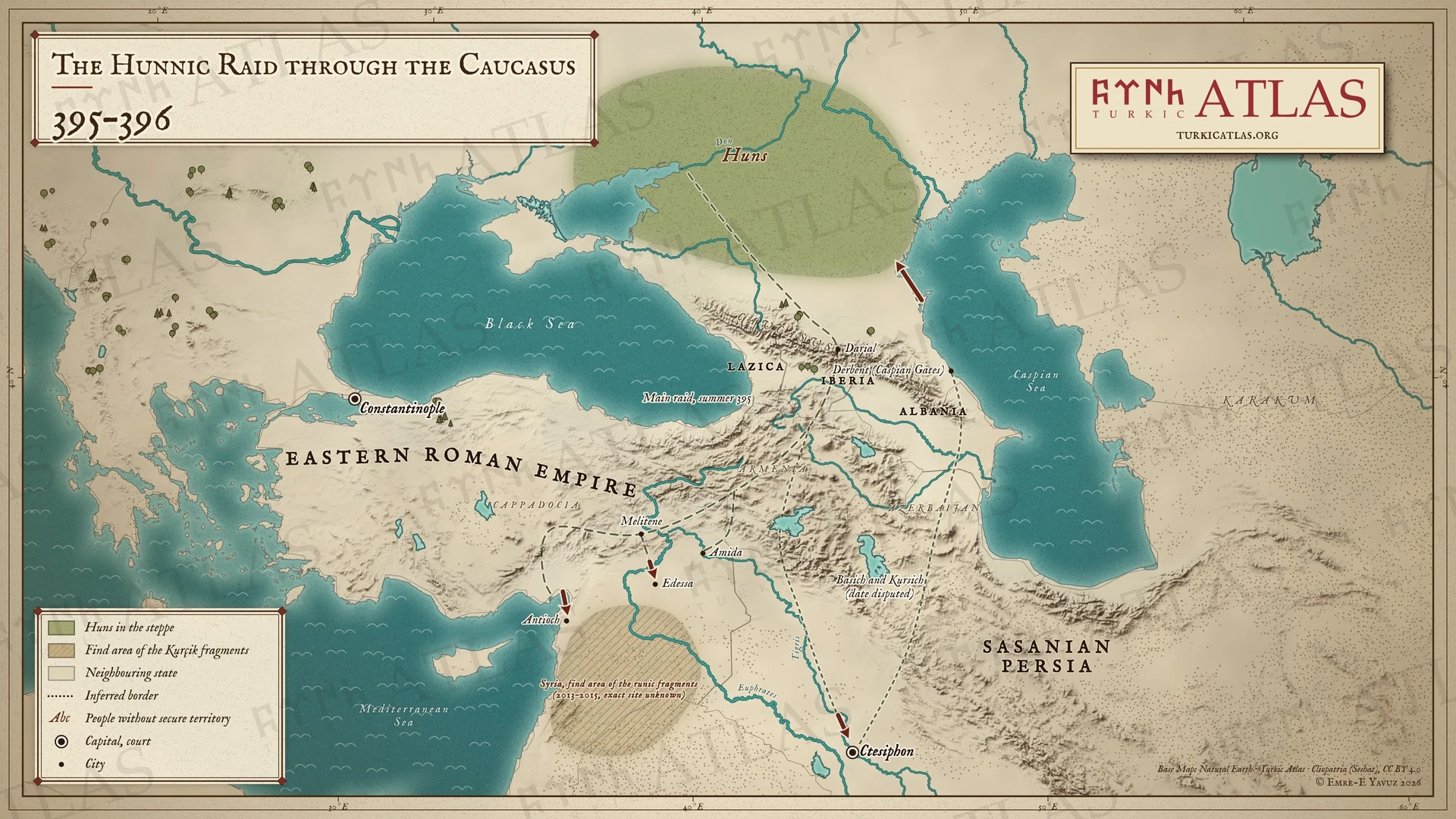
In the summer of 395 large hordes of Huns crossed the Don near its mouth. They turned south-east and broke through the Caucasus into the Persian empire and the Roman provinces south and south-west of Armenia.[1] It was their first great invasion of the Roman empire. Its raids were on a larger scale than any others until the days of Attila.[2] The Huns overran Armenia, laid waste Cappadocia and came as far as Syria and Antioch. Another army advanced against Persia almost to Ctesiphon, the Persian capital. It suffered a heavy defeat in the Persian counter-offensive.[3] The raid became a gigantic hunt for slaves.[4]
Causes
The cause of the invasion is said to have been a famine in the land of the Huns.[4][5] Priscus heard of it from Romulus, an envoy of the western Romans. He met Romulus in Attila’s camp in 449.[6] Romulus said that the Huns knew the road to the Medes, because they had once broken through that way when famine was raging in their country. The Romans did not fight them then, because of a war they were waging at the time.[7] Jerome writes that during the invasion the Roman army was away, held in Italy by civil war.[8][9] The war was the struggle between Stilicho and Rufinus, the praetorian prefect of the East.[9][2] The eastern army did not return to Constantinople and Asia Minor until the end of November 395.[10]
The raid into the Roman East
If the poet Claudian is to be believed, the Huns came over the Caspian barrier, the Darial pass, where nobody expected them. Northern barbarians usually came over the pass at Darband.[11] The church historian Philostorgius has them break through Greater Armenia into Melitene. From there they go into Euphratesia and as far as Coele Syria.[11][8] Claudian names Cappadocia, the Halys, Cilicia, Syria and the Orontes. Jerome names the cities on the Halys, the Cydnus, the Orontes and the Euphrates.[11] The Chronicle of Edessa gives the most exact date. In July 395 the Huns reached Osroene in northern Mesopotamia.[12] They came as far as Antioch and Edessa.[11]
Jerome wrote of the raid a year later: “Behold, the wolves, not of Arabia, but of the North, were let loose upon us last year from the far-off rocks of Caucasus, and in a little while overran great provinces.” The Huns besieged Antioch and dragged away flocks of captives. Reports were unanimous that they were making for Jerusalem, out of greed for gold.[13]
The Huns moved in several groups. One devastated the country south and west of the Anti-Taurus. When it crossed the Euphrates, the Romans attacked and destroyed it. Another group ravaged eastern Asia Minor and Syria.[4] The Syriac church historian John of Ephesus names Arzanene, Martyropolis, Amida and Arsamosata on and north of the upper Tigris among the places the Huns laid waste. In his account the bridge was cut after the Huns had crossed the Euphrates. Roman troops then gathered from several sides and annihilated them.[14]
The Syriac writers blamed the prefect Rufinus and the general Addai. Joshua the Stylite says that all Syria was delivered into the hands of the Huns by the treachery of Rufinus and the supineness of Addai. Addai would not let the federates go out against the Huns, because of treason in their midst.[15] Claudian also suggested that Rufinus had invited the Huns. Some scholars regard this as the poet’s propaganda for his patron Stilicho.[2] Rufinus was killed on 27 November 395.[16]
Basich and Kursich
Another group, led by Basich and Kursich, rode down the valleys of the Tigris and the Euphrates as far as Ctesiphon. When they heard that a Persian army was coming, they turned back, but they were overtaken. One band was cut down. The other left its prisoners behind, fled through Azerbaijan and returned over the Caspian Gates to the steppe.[4]
Romulus told Priscus how Basich and Kursich, leaders descended from the royal Scythians, had penetrated as far as the Medes. They later came to Rome to make an alliance.[7] They described a desert country and a marsh, which Romulus thought was the Maeotis. After fifteen days they crossed some mountains and came down into Media. While they were plundering, a Persian army came up and filled the air with missiles.[7] The Huns withdrew over the mountains with little booty, because the Medes had taken most of it back. To escape pursuit they took another road, past the place where flame burns out of a rock by the sea. By that road they returned home.[7] Modern accounts take the flame to point to the oil country of Baku.[11][17]
A second account gives the two leaders a different route. According to it, their cavalry rode from the region of Erzurum down the valleys of the Karasu and the Euphrates to Melitene and Cilicia.[18] They besieged Edessa and Antioch for a time, went down into Syria, pressed Tyre and turned towards Jerusalem.[18] In the autumn they turned north through Cappadocia and Galatia and came home by way of Azerbaijan and Baku, in 395 to 396.[18]
According to some scholars, the Liber Chalifarum, a Syriac compilation of the eighth century, describes the same invasion.[19] The Huns came down to the Euphrates and the Tigris in Persian territory and as far as the royal city of the Persians. When they learned that the Persians were advancing against them, they fled. The Persians chased them. They killed a band, took away all their plunder and freed eighteen thousand prisoners.[20]
Priscus gives no year for the raid. Romulus says only that it happened once, long ago.[7] There are three views on the date. The first identifies the raid with the invasion of 395 and holds that Basich and Kursich came to Rome in 404 or 407. The alliance, it holds, shows that their homes were in Europe, on the Danube.[10] The second also places them in the raid of 395.[5] The third dates their expedition to about 415 to 420, or a little later.[21] Earlier scholars identified the invaders as Sabirs or as Hephthalites.[12]
Stone fragments with runic writing were dug up illicitly in Syria during the civil war between 2013 and 2015. They commemorate one Apa Kurçik: “His loyal companions let Kurçik rest in peace.” One account identifies him with the Hun commander who invaded through the Caucasus in 395 and 396.[22] The same account argues that the text, if authentic, would prove the use of a script identical with the Orkhon script long before the Göktürks.[22]
Captives and withdrawal
The Huns drove away as many herds of cattle as they could. They took thousands of prisoners.[4] The Huns led the captives and the herds away north of the Caucasus. Claudian writes that the flower of Syria served as slaves beyond the Cimmerian marshes.[20][8] Theodoret, who was a small child in Antioch at the time, writes that many people in the overrun regions joined the Huns. Some were forced. Others went over of their own will and fought in their ranks.[23] The raid shows how great a distance the Huns could cover in a single campaign.[20]
There are four views on how the war ended. According to the first, the invasion met no opposition until the eunuch Eutropius gathered a few Gothic troops and what Roman soldiers he could find and took the field. He failed to recover the booty, and peace returned to the East only at the end of 398.[24] The second holds that the Hun groups left about 398 of their own accord, not because of any counter-offensive of Eutropius.[22] In the third, the Huns had already gone back to the steppe in 395.[4] The fourth dates the evacuation to late 396 and certainly before the end of 398. Since no source reports a victory in the field, it concludes that the Huns withdrew of their own accord with the booty they had come for.[25] In 396 the East feared that they would return as allies of the Persians. In 397 a few Hun hordes broke into Roman Armenia and were easily driven back.[26] Hun raids into Persian lands became more frequent after 395.[5]
The Danube front
There are three views on whether Huns also invaded Thrace. The first holds that they crossed the frozen Danube into Thrace in the winter of 395.[2] The second has them take Thrace in that year.[27] The third finds no Hun invasion of the Balkans in 395. According to it, Philostorgius telescoped three decades or more of earlier raids, and the invaders of Europe in Claudian’s poem were Goths.[28] Whether the raids over the Danube and over the Caucasus were concerted is disputed as well, again with three views. The first sees them as the work of two unrelated groups, which took advantage of the absence of the Roman armies at the same time.[29] The second holds that no Hun ruler of the 390s could impose his will on all the tribes. The raid into Asia was nevertheless a concerted action of Hun groups on a large scale.[1] The third holds that the two operations were not coordinated. No unified Hunnic leadership capable of planning on a large scale is visible at the time. The leaders Basich and Kursich are called archontes, high commanders. The common motive was economic, possibly the famine.[30]
Romulus drew his own conclusion from the raid. He told Priscus that Scythia was not far from Media. If Attila wished, he could subdue the Medes, the Parthians and the Persians without great effort and make them pay tribute.[7]
References
- ^ a b Maenchen-Helfen 1973, p. 51
- ^ a b c d Thompson 1948, p. 26
- ^ Yavuz 2025, p. 91–92
- ^ a b c d e f Maenchen-Helfen 1973, p. 52
- ^ a b c Golden 1992, p. 90
- ^ Thompson 1948, p. 30
- ^ a b c d e f Priscus; Müller 1851, fr. 8, p. 90
- ^ a b c Thompson 1948, p. 27
- ^ a b Maenchen-Helfen 1973, p. 54
- ^ a b Maenchen-Helfen 1973, p. 54–55
- ^ a b c d e Maenchen-Helfen 1973, p. 57
- ^ a b Maenchen-Helfen 1973, p. 55
- ^ Thompson 1948, p. 27–28
- ^ Maenchen-Helfen 1973, p. 57–58
- ^ Maenchen-Helfen 1973, p. 55–56
- ^ Maenchen-Helfen 1973, p. 56
- ^ Thompson 1948, p. 31
- ^ a b c Kafesoğlu 1997, p. 73
- ^ Maenchen-Helfen 1973, p. 53–54
- ^ a b c Maenchen-Helfen 1973, p. 58
- ^ Thompson 1948, p. 30–31
- ^ a b c Yavuz 2025, p. 92
- ^ Maenchen-Helfen 1973, p. 58–59
- ^ Thompson 1948, p. 28
- ^ Sinor 1990, p. 183–184
- ^ Maenchen-Helfen 1973, p. 52, 56
- ^ Yavuz 2025, p. 91
- ^ Maenchen-Helfen 1973, p. 53
- ^ Thompson 1948, p. 59
- ^ Sinor 1990, p. 182, 184
Sources
Literature
- Karl Müller (ed.), Fragmenta Historicorum Graecorum, Bd. IV (darin: Menandri Protectoris fragmenta, griechisch mit lateinischer Übersetzung) (1851)
- Otto J. Maenchen-Helfen, The World of the Huns: Studies in Their History and Culture (1973)
- E. A. Thompson, A History of Attila and the Huns (1948)
- Peter B. Golden, An Introduction to the History of the Turkic Peoples (1992)
- Emre-E. Yavuz, The Gokturk Empire: 2nd Edition (2025)
- Denis Sinor (ed.), The Cambridge History of Early Inner Asia (1990)
- İbrahim Kafesoğlu, Türk Millî Kültürü (1997)
What links here1
- Peoples
- Huns
Cite this article
Yavuz, Emre-E. “Hunnic invasion of 395.” Turkic Atlas, revised 8 November 2026. https://turkicatlas.org/conflicts/hunnic-invasion-of-395/
Last revised: 8 November 2026

